Bloodstone
Also known as: Heliotrope, Blood jasper
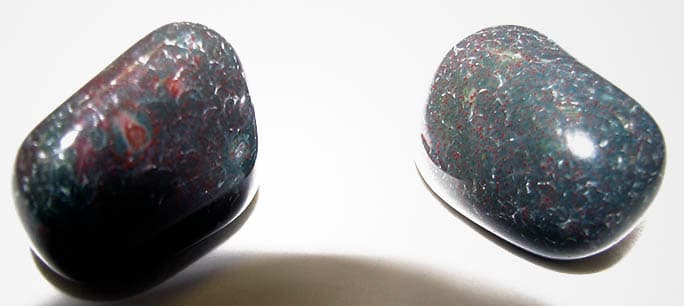
Bloodstone is a dark green variety of chalcedony — microcrystalline quartz, made of silica crystals far too small to see — scattered with vivid red to brownish-red flecks that look uncannily like droplets of blood. Those red spots are tiny inclusions of iron oxide, chiefly hematite, set against a deep green ground colored by green minerals such as chlorite and amphibole. The result is an opaque, solid stone, hard and durable at about 6.5 to 7 on the Mohs scale, with a waxy-to-dull luster, a white streak, and the same tough, fracture-resistant character as the rest of the chalcedony and jasper family. Because the green base is so heavily charged with mineral matter, bloodstone is firmly opaque rather than translucent, and it is sometimes classed alongside the jaspers for exactly that reason.
Its older and more poetic name is heliotrope, from Greek words meaning roughly "to turn the sun," a reference to an ancient belief that the stone reflected the sun in particular ways when held in water. Bloodstone has a long history as a carved and ornamental stone — used for seals, signet rings, cameos and intaglios since antiquity — and it carries deep symbolic weight, traditionally associated with the blood of the crucifixion in medieval Christian lore. Today it is best known as one of the traditional birthstones for March, prized for that unmistakable combination of forest-green body and blood-red spotting that no other common stone quite duplicates.
Bloodstone at a glance
- Classification
- Mineral — green variety of chalcedony / jasper (microcrystalline quartz) with iron-oxide spots
- Composition
- SiO₂ (silica, with green chlorite/amphibole and red iron-oxide inclusions)
- Hardness
- 6.5–7 (Mohs)
- Luster
- Waxy to dull
- Streak
- White
- Colors
- Dark green to blue-green ground with red to brownish-red spots and streaks
- Crystal system
- Trigonal (microcrystalline, massive aggregate)
- Transparency
- Opaque
How to identify it
The single most reliable clue is the look itself: a solidly opaque, dark green stone speckled or streaked with red to brownish-red spots. Hold a piece to a strong light and it should pass essentially none — bloodstone is opaque, which immediately separates it from translucent green chalcedonies like chrysoprase that glow when backlit. The green ground is usually a deep, slightly somber forest or blue-green rather than a bright apple green, and the red marks sit on or just below the surface like spattered drops, sometimes as fine dots, sometimes as larger blotches or short streaks. A green, opaque, waxy stone freckled with believable blood-red spots is the classic bloodstone signature.
Physical tests confirm it belongs to the quartz family. Because it is microcrystalline quartz, bloodstone is hard, about 6.5 to 7 on the Mohs scale, so it will readily scratch glass and resist scratching by a steel knife, ruling out softer painted or plastic imitations. It leaves a white streak regardless of the body color, feels cool and solid in the hand, and breaks with a smooth conchoidal (shell-like) fracture rather than splitting along flat planes. If an opaque green stone scratches glass, leaves a white streak, shows a waxy luster, and carries genuine red iron-oxide spots that are part of the stone rather than painted on, you are almost certainly holding real bloodstone.
Colors and varieties
Bloodstone's color is a two-part story. The green base comes from finely distributed green minerals — typically chlorite and amphibole-group minerals — woven through the silica, while the famous red spots are concentrations of iron oxide, mostly hematite. The proportion and arrangement of those two ingredients drive the look: some stones are a near-uniform deep green with only a sparse scatter of red, while others carry heavy, dramatic blood-red blotches or even yellowish and brownish flecks where the iron oxide is more oxidized. The best-regarded material shows a rich, even green ground with well-defined, contrasting red spots, the combination that gives the stone its name and its appeal.
A few named forms are worth knowing. "Plasma" is a related dark-green chalcedony that is green throughout with little or no red spotting — essentially heliotrope without the blood. "Fancy jasper" and other multicolored green jaspers can resemble bloodstone but lack the distinctive isolated red drops on a green field. A more common source of confusion is so-called "dragon blood jasper" (or dragon stone), a green-and-red ornamental stone that is a different material entirely — its green and red come from epidote and piemontite rather than chlorite and hematite, and its pattern is broad mottled patches rather than discrete blood-spots. Genuine bloodstone keeps its quiet green ground with crisp, drop-like red markings.
Meaning and properties
Few stones carry as much symbolic baggage as bloodstone. Because of the red-on-green spotting, it has been linked since the Middle Ages to blood and to the wounds of the crucifixion, earning a reputation as a stone of courage, vitality, endurance and grounding. As a traditional March birthstone it is often given as a token of strength and steadiness, and in modern crystal-working practice it is described as a stone for revitalizing energy, encouraging determination, and helping one feel calmly anchored in the body. These associations fit its bold, earthy appearance and its long history as a protective talisman carved into signets and amulets.
These meanings are cultural, historical and spiritual rather than scientifically demonstrated medical effects. Despite a folk reputation tied to blood and vitality, bloodstone does not cleanse, heal, or affect the blood or any organ, and it cannot cure, treat or prevent any physical or mental health condition. It is a handsome and meaningful stone to wear and to keep, but it is not a substitute for professional medical or psychological care.
Value: what bloodstone is worth
Bloodstone is an affordable ornamental and lapidary stone, so its value rests on beauty rather than rarity. The qualities that lift a piece are the depth and evenness of the green ground, the contrast and arrangement of the red spots, and the quality of the polish: a stone with a rich, solid green body and crisp, well-distributed blood-red drops is worth more than one that is muddy, grayish, or sparsely spotted. Pieces with attractive, well-balanced spotting that suits the cut — a cabochon or signet that centers the red marks well — command the most interest, while dull, cracked, or unevenly colored material sits at the bottom of the range. Fine antique carved bloodstone intaglios and seals can carry additional value as historical objects rather than for the gem material alone.
Cutting and treatment also factor in. Skilled lapidary work matters because the cutter decides how to orient the rough so the red spots fall pleasingly on the finished piece, so a thoughtfully cut cabochon can be worth more than careless material from the same block. Some green chalcedony is dyed to imitate or deepen bloodstone's color, and honest sellers disclose any treatment. As always on this site, no specific prices or sources are quoted here; judge a piece of bloodstone by the richness and evenness of its green, the contrast and balance of its red spotting, the quality of its polish, its soundness, and whether the color and spots are natural.
Real vs. fake bloodstone
Because bloodstone is inexpensive, it is rarely faked with costly substitutes; the main concerns are imitation by other green stones, dyeing, and outright painted or molded fakes. Glass and plastic imitations are the easiest to catch: they are softer and will not scratch glass, often show molding seams or trapped air bubbles, and feel warmer and lighter than stone, whereas real bloodstone is hard quartz that scratches glass and leaves a white streak. Be especially wary of "red spots" that sit only on the surface, look too uniform, or can be scratched or rubbed away — in genuine bloodstone the iron-oxide marks are an integral part of the stone, not a coating.
Mislabeling is the subtler trap, and most of it is sorted out by knowing the look. Plain green jaspers and dyed green chalcedony are sometimes sold as bloodstone despite lacking the characteristic isolated blood-red drops on a green ground. The most common mix-up is with "dragon blood jasper," a different green-and-red material colored by epidote and piemontite, which shows broad mottled red-and-green patches rather than discrete spots. When in doubt, look for the true signature: an opaque, deep-green chalcedony with a white streak, a hardness that scratches glass, and genuine drop-like red iron-oxide spots that are clearly part of the stone.
Care
Bloodstone is an easy stone to care for, thanks to its quartz-family hardness of about 6.5 to 7, which lets it shrug off everyday dust and grit, and its lack of cleavage, which makes it tough and resistant to chipping. Clean it with warm water, mild soap and a soft cloth or brush, then rinse and dry it; this gentle routine lifts skin oils and grime and restores the polished sheen without any risk to natural, untreated stone. Its durability makes bloodstone well suited to rings, signets, cabochons, beads and carvings that see regular handling.
A few sensible precautions apply, mostly aimed at dyed or assembled pieces. Avoid harsh household chemicals and prolonged soaking, which can attack any added dye and, over time, dull the surface, and keep dyed material out of prolonged intense sunlight, which can fade enhanced color. Solid natural bloodstone generally tolerates ultrasonic and steam cleaning, but these are safest avoided if a piece might be dyed, fractured, or assembled. Store bloodstone away from harder stones such as topaz, sapphire or diamond that could scratch it, and keep it from knocking hard against other objects so its polished surface and crisp red spots stay sharp.
Bloodstone look-alikes
Frequently asked questions
Why does bloodstone have red spots?
The red spots are tiny inclusions of iron oxide, chiefly hematite, concentrated within the stone. They sit against a dark green ground colored by green minerals such as chlorite and amphibole, and the contrast of red iron oxide on green silica is exactly what gives bloodstone its name and its drop-of-blood appearance.
Is bloodstone the same as heliotrope?
Yes. Heliotrope is the older mineralogical name for bloodstone, from Greek words meaning roughly "to turn the sun." The two names refer to the same green chalcedony with red iron-oxide spots; "bloodstone" simply describes the blood-like flecks, while "heliotrope" reflects an ancient belief about how the stone behaved in sunlight and water.
What is the difference between bloodstone and dragon blood jasper?
They look superficially similar but are different materials. Bloodstone is a dark green chalcedony colored by chlorite and amphibole with red spots of iron oxide. Dragon blood jasper gets its green and red from epidote and piemontite and shows broad mottled patches rather than discrete spots. Look for crisp, isolated blood-red drops on a deep even green for genuine bloodstone.
What birthstone is bloodstone?
Bloodstone is one of the traditional birthstones for March, where it is often listed alongside aquamarine. It has been associated with March for centuries and is valued as a symbol of courage, vitality and endurance, which is why it remains a popular birthstone choice for that month.
Is yours bloodstone? Find out from a photo
Photograph your crystal in good light and get an identification with an honest confidence level, the look-alikes to rule out and the at-home tests that confirm it.
Identify my crystal freeOn Android? Get the free rock identifier app
Related
More crystals in the field guide
Keep exploring
More on crystals: the full list of crystal types, how to identify a crystal and crystals by color.
Last updated 2026-06-25. Identification guidance is educational — confirm important results with the diagnostic tests described or a qualified expert.