Chrysocolla
Also known as: Chrysocolla chalcedony, Gem silica, Silica malachite
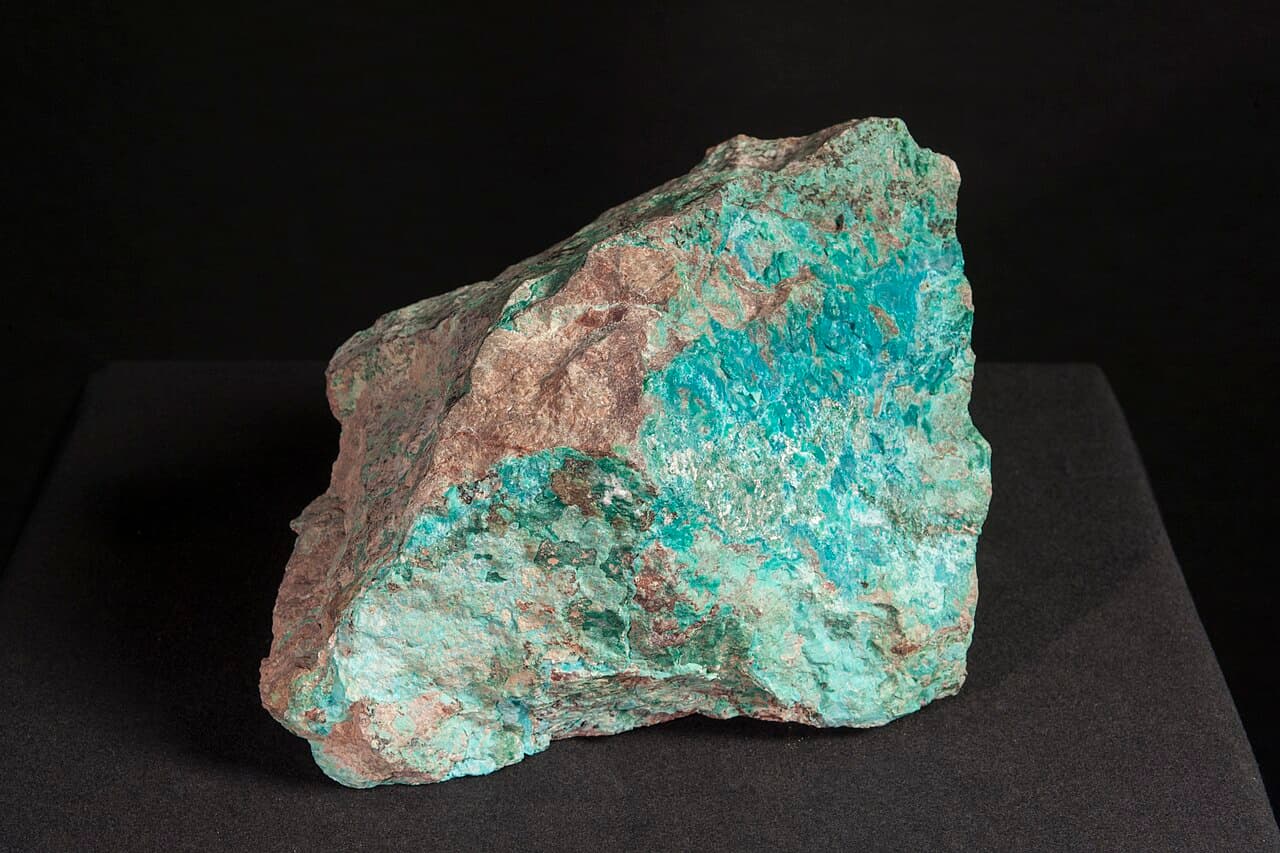
Chrysocolla is a hydrated copper silicate that paints itself across the oxidized zones of copper ore bodies in vivid blues, blue-greens and cyans. The copper is the source of that color, and the stone almost never forms in clean crystals; instead it occurs as crusts, botryoidal mounds, veins and earthy masses that look more like dried pigment than a faceted gem. In its pure state chrysocolla is a soft, porous mineral, often clinging to or coating other copper minerals, and it commonly turns up in the same deposits as malachite, azurite and turquoise. Because it forms by weathering rather than slow crystal growth, a single specimen can blend several copper minerals together in swirls of green and blue.
What complicates chrysocolla is that the name covers a wide range of hardness and quality. Truly pure chrysocolla is soft enough to scratch with a fingernail or copper coin, but much of the prized material is chrysocolla intimately intergrown with quartz or chalcedony — sold as "chrysocolla chalcedony" or "gem silica" — which is far harder, denser and more durable, taking a brilliant polish and reaching gem quality. Telling these apart matters enormously, because they look similar but behave like completely different stones: one is fragile and water-sensitive, the other is a tough, translucent gem. Much of the guidance below turns on recognizing which kind you are holding.
Chrysocolla at a glance
- Classification
- Mineral — hydrated copper silicate (often intergrown with quartz or chalcedony)
- Composition
- Cu₂₋ₓAlₓ(H₂₋ₓSi₂O₅)(OH)₄·nH₂O
- Hardness
- About 2–4 (pure); up to 6–7 when intergrown with quartz/chalcedony
- Luster
- Vitreous to dull or earthy; waxy and glassy in silica-rich material
- Streak
- White to pale bluish-green
- Colors
- Blue to blue-green to cyan, sometimes mixed with green or brown
- Crystal system
- Orthorhombic (almost always massive or botryoidal, not in visible crystals)
- Transparency
- Opaque to translucent (silica-rich material is the most translucent)
How to identify chrysocolla
Start with color and form. Chrysocolla is some shade of blue to blue-green to bright cyan, and it nearly always appears as massive, botryoidal, crusty or vein-filling material rather than as distinct crystals. It frequently shows up alongside other copper minerals, so a blue-green coating swirled together with bright green malachite or deep blue azurite, sitting on a rusty or coppery host rock, is a strong contextual clue. The surface may be smooth and grape-like, chalky and earthy, or glassy where silica is present, and the color often varies across a single piece in mottled patches rather than the even tone of a dyed imitation.
Hardness is the single most decisive test, because chrysocolla's hardness tells you which kind you have. Pure chrysocolla is very soft at roughly 2 to 4 on the Mohs scale — it can be marked by a fingernail or a copper coin and will not take a durable polish — whereas chrysocolla intergrown with quartz or chalcedony (gem silica) is hard at about 6 to 7, will scratch glass, and polishes to a glassy luster. So a soft, slightly porous, easily marked blue-green stone is likely pure chrysocolla, while a hard, translucent, glassy blue-green that resists scratching is silica-rich chrysocolla. A white to pale bluish streak and the absence of any reaction to acid (unlike the closely associated malachite) help confirm the identification.
Color and varieties
Chrysocolla's color comes from copper and ranges from a soft robin's-egg blue through turquoise blue-green to an intense cyan, occasionally tending greener where it grades into associated minerals. Because it forms in the oxidized cap of copper deposits, it is naturally mingled with other species, and many of its most attractive forms are mixtures: chrysocolla swirled with malachite gives green-and-blue patterns, blends with azurite add deep blue, and intergrowth with quartz or chalcedony produces the translucent, glassy material that is most valued. The color is genuine and copper-based, not a surface treatment, though the porous earthy grades can look chalkier and paler than the silica-rich ones.
The most important variety distinction is structural rather than chromatic. Pure, earthy chrysocolla is soft, porous and somewhat fragile; "chrysocolla chalcedony" or "gem silica" is chrysocolla-colored quartz or chalcedony that is hard, durable and often beautifully translucent, prized as a gemstone in its own right. There are also well-known mixed materials in which chrysocolla, malachite, azurite, turquoise and quartz occur together in a single colorful stone. For identification, the practical takeaway is that the same blue-green color spans everything from a crumbly mineral crust to a hard, glassy gem, so judging the material's hardness and translucency matters as much as judging its color.
Meaning and properties
In modern crystal-working traditions chrysocolla is often described as a stone of communication, calm and gentle expression, and it is sometimes called the "teaching stone" for its association with sharing knowledge and speaking with composure. Its soothing blue-green color leads many to connect it with the throat and with easing tension, and it is a popular choice for meditation pieces and tumbled stones meant to encourage thoughtful, measured speech. These associations are cultural and spiritual, and they are a large part of why a copper-deposit mineral has become such a widely sold ornamental stone.
These meanings are spiritual and personal, not scientifically demonstrated medical effects. Chrysocolla is a beautiful stone to keep, wear or use for reflection, but it does not cure, treat or prevent any physical or mental health condition and is not a substitute for professional medical or psychological care. Because pure chrysocolla contains copper and is soft and porous, it is also wise to handle it as a display or jewelry stone rather than placing it in drinking water or making elixirs from it.
Value: what chrysocolla is worth
Value in chrysocolla is dominated by hardness and translucency, which is to say by how much quartz or chalcedony is bound up with the copper coloring. Pure, soft, earthy chrysocolla is inexpensive and is sold mostly as rough specimens, decorative pieces and soft cabochons, because it cannot take a durable polish or withstand wear. By contrast, the hard, translucent silica-rich material — chrysocolla chalcedony and especially fine gem silica — is the most valuable form, prized for its glassy clarity and intense even color, and it commands gem prices that are far above the ordinary crusty material.
Within each grade, color, evenness, polish and freedom from cracks drive desirability. An intense, even cyan-to-blue color with good translucency and a clean glassy surface sits at the top; pale, chalky, cracked or muddy material sits at the bottom. Attractive mixed stones that combine chrysocolla with malachite, azurite or turquoise can also be valued for their pattern. The buyer's practical point is to establish whether a piece is soft pure chrysocolla or hard silica-rich gem material before judging its worth, because the two look alike but differ enormously in durability and price.
Real vs. fake chrysocolla
Genuine chrysocolla is more often misrepresented by grade than counterfeited outright: soft earthy material may be sold as if it were durable gem silica, and stabilized or resin-impregnated pieces are common because the porous pure mineral is hardened to make it usable in jewelry. Outright imitations exist too — dyed magnesite or howlite, dyed chalcedony, and plastic or glass can all be colored blue-green and offered as chrysocolla — so the goal is both to confirm the material is a real copper mineral and to establish how much silica it contains.
Hardness and translucency are again the best tools. Test an inconspicuous spot: pure chrysocolla is soft (about 2–4 Mohs) and can be marked by a steel point or even a fingernail, while genuine gem-silica chrysocolla is hard (6–7) and will scratch glass. A stone sold as durable "chrysocolla" that proves soft is likely earthy material being oversold, whereas one that is glass-hard and translucent is the silica-rich gem. An acetone swab on a hidden area can lift dye from a colored imitation, which natural chrysocolla will not do, and a hot-pin test can reveal plastic by its acrid smell. Be aware that chrysocolla is frequently stabilized with resin to make it wearable; this is legitimate but should be disclosed, and for valuable gem-silica purchases, expert testing is the safest confirmation.
Care
Care depends entirely on which chrysocolla you have, and the safe default is to treat it as the fragile pure mineral unless you are certain it is hard gem silica. Pure chrysocolla is soft and porous, so keep it away from water, perfume, lotions, cosmetics and household chemicals, all of which can soak in, dull the surface or affect the color; clean it only by wiping gently with a soft, barely damp cloth and drying it immediately, and never soak it. Avoid ultrasonic and steam cleaners entirely, since vibration and heat can damage soft or porous material, and protect pieces from knocks because the pure mineral chips and crumbles readily.
Hard chrysocolla chalcedony and gem silica are far more durable and can be cleaned with warm water and mild soap, but even these benefit from gentle handling and should be kept away from harsh chemicals. For all forms, store chrysocolla separately from harder gems such as quartz and topaz that could scratch it, ideally wrapped in a soft pouch, and keep it out of prolonged intense sunlight and away from sudden temperature changes. Because pure chrysocolla is both soft and water-sensitive, the most common mistake — soaking it or wearing it in everyday rough conditions — is exactly what to avoid.
Chrysocolla look-alikes
Frequently asked questions
Is chrysocolla soft or hard?
It depends on the material. Pure chrysocolla is soft, about 2–4 on the Mohs scale, and can be marked by a fingernail or steel point. But chrysocolla intergrown with quartz or chalcedony — sold as chrysocolla chalcedony or gem silica — is hard, around 6–7, and will scratch glass. A hardness test is the best way to tell which you have.
What is the difference between chrysocolla and gem silica?
Both share the same copper-based blue-green color, but gem silica (chrysocolla chalcedony) is chrysocolla coloring within hard, translucent quartz or chalcedony, making it durable and gem-quality. Pure chrysocolla is soft, porous and fragile by comparison. Gem silica is far more valuable and can be worn in jewelry, while pure chrysocolla is delicate.
Can chrysocolla get wet?
Pure chrysocolla should not be soaked. It is soft and porous, so water, perfume, lotions and household chemicals can soak in, dull it or affect its color; wipe it only with a soft, barely damp cloth and dry it at once. Hard chrysocolla chalcedony or gem silica tolerates a quick wash with mild soap, but if you are unsure which you have, treat it as the fragile pure mineral.
How can I tell chrysocolla from turquoise?
Check hardness and translucency. Pure chrysocolla is much softer (about 2–4 Mohs) than turquoise (5–6) and can be marked easily on a hidden spot, and silica-rich chrysocolla is often more translucent. Turquoise is usually more opaque and frequently shows a brown or black matrix, whereas chrysocolla is commonly mottled and associated with malachite or azurite in copper deposits.
What does chrysocolla do spiritually?
Chrysocolla is best known in crystal traditions as a stone of communication and calm expression — often linked to the throat chakra, to speaking difficult truths gently, and to soothing anxiety. Those meanings are cultural belief rather than demonstrated effect. What is factual is why it looks so calming: chrysocolla is a hydrated copper silicate, and copper is what paints it that blue-green sea color.
Who should wear chrysocolla?
Anyone drawn to the color — with one practical caveat that matters more than any tradition. Chrysocolla is soft (Mohs 2–4 when pure) and porous, so it belongs in pendants, earrings and occasional-wear pieces rather than in a daily ring that meets keyboards, doors and washing-up. If you want chrysocolla in a ring, look for gem silica or chrysocolla in chalcedony, where the color is held in a quartz matrix at Mohs 7.
Is chrysocolla a rare stone?
Ordinary chrysocolla is not rare — it forms readily in the oxidized zones of copper deposits and is widely available and affordable from Peru, Arizona, the Congo and Israel. What is genuinely scarce is the top material: gem silica, the translucent blue-green chrysocolla-in-chalcedony, is one of the most valuable chalcedonies there is, and clean solid pieces of good color command real premiums.
Is chrysocolla a turquoise?
No — they are different minerals that happen to share a blue-green range. Turquoise is a copper aluminium phosphate at Mohs 5–6; chrysocolla is a copper silicate, usually much softer at 2–4, and it often shows a greener, more watery blue with black or brown matrix from the host rock. In practice, hardness separates them: turquoise resists a steel pin where pure chrysocolla scratches easily. Confusingly, chrysocolla is sometimes sold as 'chrysocolla turquoise' — that is a trade name, not a species.
Is yours chrysocolla? Find out from a photo
Photograph your crystal in good light and get an identification with an honest confidence level, the look-alikes to rule out and the at-home tests that confirm it.
Identify my crystal freeOn Android? Get the free rock identifier app
Related
More crystals in the field guide
Keep exploring
More on crystals: the full list of crystal types, how to identify a crystal and crystals by color.
Last updated 2026-08-29. Identification guidance is educational — confirm important results with the diagnostic tests described or a qualified expert.