Charoite
Also known as: Lilac stone, Siberian purple stone
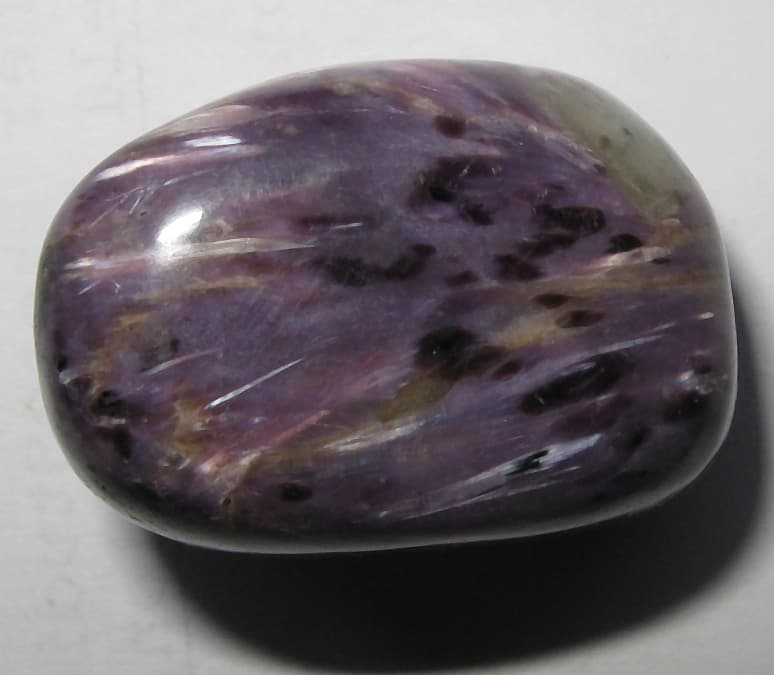
Charoite is one of the most distinctive purple stones in the mineral world — a rare violet-to-lilac potassium-calcium silicate famous for the swirling, fibrous, almost feathery pattern that flows across its polished surface. Instead of forming clean, blocky crystals, charoite grows as masses of tightly interlocked silky fibers, so a finished cabochon looks less like a single gem and more like a swirl of purple smoke, marbled with paler lavender, white and frequently flecked with jet-black aegirine and small golden-orange patches of tinaksite. That chatoyant, satiny play of light across the fibers gives good charoite a glowing, three-dimensional depth that is hard to mistake for anything else.
What makes charoite genuinely special is that it comes from only one place on Earth: the Murun massif near the Chara River in the Sakha Republic (Yakutia) of Siberia, Russia, which is where it gets its name. It was not formally described to science until the 1970s, so it is a relative newcomer compared with classic gems, and its single, remote source makes it a true collector's stone. At Mohs 5 to 6 it is moderately hard — softer than quartz but tough enough to take a high polish — and it is almost always cut and sold as cabochons, beads, spheres and carvings rather than faceted gems, precisely because its beauty lives in that swirling fibrous pattern.
Charoite at a glance
- Classification
- Mineral — rare potassium-calcium silicate (inosilicate)
- Composition
- (K,Sr,Ba,Mn)₁₅–₁₆(Ca,Na)₃₂[Si₇₀(O,OH)₁₈₀](OH,F)₄·nH₂O (a complex hydrated K-Ca silicate)
- Hardness
- 5–6 (Mohs) — softer than quartz, scratched by a steel knife
- Luster
- Silky to pearly; vitreous on fresh surfaces, chatoyant when polished
- Streak
- White
- Colors
- Violet, lilac and lavender, marbled with white, gray, black (aegirine) and orange (tinaksite)
- Crystal system
- Monoclinic (forms massive, fibrous, interlocking aggregates rather than single crystals)
- Transparency
- Translucent to opaque
How to identify it
The fastest way to recognize charoite is by its color and its texture together. The color is an unusual, almost glowing violet-to-lilac that runs from soft lavender to a rich grape purple, and it is almost never uniform — it swirls and streaks. Layered into that purple you will typically see the three classic companion minerals: silky white fibers, glossy black needles or patches of aegirine, and small golden-to-orange flecks of tinaksite. That specific combination of swirling purple plus black plus orange, with a satiny chatoyant sheen, is the single strongest fingerprint of genuine charoite.
Back up the look with simple physical clues. Charoite is fibrous, so when you tilt a polished piece in the light you see a cat's-eye-like shimmer flowing across the surface as the light catches countless tiny parallel fibers — a marbled, almost woven appearance rather than the glassy interior of a transparent crystal. It is moderately hard at Mohs 5 to 6, so a steel knife will scratch it but it still holds a good polish, and it has a white streak. A purple stone that is uniformly colored, perfectly clear, or that forms sharp geometric crystals is almost certainly not charoite — real charoite is all about that flowing, fibrous, multi-toned swirl.
Colors and varieties
Charoite's defining color is purple, but it spans a surprisingly wide range within a single stone — pale lilac and lavender flowing into deep violet and grape, often with cooler grayish or bluish-purple zones. The intensity comes largely from manganese in its structure, and the most prized material shows a deep, saturated violet with strong, well-defined swirling bands rather than a washed-out or muddy gray-purple. Because it is fibrous, the color almost always appears as feathery streaks and marbled patches, giving each piece a unique, painterly look.
Rather than having named gem varieties, charoite is graded by the quality and mix of its swirl. Top-grade pieces combine rich purple with bold silky chatoyancy and tasteful accents of black aegirine and golden-orange tinaksite; lower grades are paler, grayer, or so heavily loaded with black that the purple is lost. Some specimens are mostly lilac with delicate white feathering, while others read as dramatic purple-and-black. In the trade you will mainly encounter charoite as cabochons, tumbled stones, beads, spheres and small carvings, all chosen to show off that flowing fibrous pattern to best effect.
Meaning and properties
In modern crystal traditions, charoite is often called a stone of transformation and spiritual insight. Its deep violet color links it in popular practice to the third-eye and crown chakras, and people keep it for meditation, dream work and a sense of inner calm, describing it as a stone that encourages perspective, courage in the face of change, and release of fear or stress. Because it is rare and visually striking, it also has a reputation as a treasured 'master' or collector's stone carried for inspiration and emotional grounding.
These associations are spiritual and cultural, not scientifically established medical effects. Charoite is not a medicine and does not diagnose, treat or cure any physical or psychological condition; holding or wearing it delivers no measurable health benefit. Enjoy it for its rarity, its remarkable swirling beauty and the calming, reflective associations people attach to it, and rely on qualified medical and mental-health professionals for any actual health concern.
Value
Charoite's value is driven first by its rarity — it comes from a single, remote Siberian deposit — and then by the quality of its color and pattern. The most desirable pieces show a deep, saturated violet with bold, well-organized swirling chatoyancy and attractive accents of black aegirine and orange tinaksite; pale, grayish, muddy or excessively black material is worth considerably less. Strong silky shimmer (chatoyancy), a clean high polish and an interesting, balanced swirl all push a piece up the quality scale.
Form and workmanship matter too. Well-cut cabochons and finely finished carvings, spheres and beads that display the swirl to advantage command more than rough or dull offcuts, and larger pieces of consistently high-grade material are scarcer and more sought after. Because supply depends on one limited source, fine charoite is genuinely collectible. There is no single fixed price, so the honest way to judge worth is to compare like with like: between two similar pieces, the deeper, more vivid purple with the stronger, cleaner swirl and better polish will be the more valuable.
Real vs. fake
Because real charoite is rare and desirable, imitations and enhancements appear in the market. The most common issues are dyed substitutes — pale or gray stones dyed an unnaturally even purple — and reconstituted or pressed material made from charoite powder bound in resin. Warning signs include a flat, uniform purple with no flowing fibrous swirl, color that pools in cracks, an obviously plasticky feel or warmth, and visible mold seams or trapped round bubbles, which point to glass or plastic rather than a natural stone.
Use the stone's own fingerprints to confirm it. Genuine charoite shows a swirling, fibrous, marbled pattern with a silky chatoyant sheen and almost always carries some black aegirine and/or orange tinaksite — a perfectly clean, single-color 'charoite' should raise suspicion. It is moderately hard (Mohs 5 to 6), so it resists a fingernail and will not crumble like a soft dyed howlite. If a purple stone is suspiciously cheap and abundant, flawlessly uniform, or feels like warm plastic, treat it as an imitation; when a purchase matters, buy from a reputable seller who can vouch for the source.
Care
Charoite is reasonably durable but not bulletproof, so treat it as a semi-precious stone. At Mohs 5 to 6 it is softer than quartz and can be scratched by harder stones, sand or a steel blade, so store it separately or wrapped in a soft cloth, keep it away from abrasive jewelry, and protect rings and pendants from knocks. Its fibrous structure also means a sharp impact can chip or fracture a piece along the fibers.
Clean charoite gently with lukewarm water, a drop of mild soap and a soft cloth or brush, then rinse and dry it promptly. Avoid harsh chemicals, acids and prolonged soaking, and skip ultrasonic and steam cleaners, which can stress the fibrous, slightly porous material. Keep it out of prolonged intense sunlight and high heat to help preserve its violet color. Handled with this modest care, a charoite cabochon or carving will keep its glowing purple swirl and silky polish for many years.
Charoite look-alikes
Frequently asked questions
What is charoite and where does it come from?
Charoite is a rare violet-to-lilac potassium-calcium silicate known for its swirling, silky, fibrous pattern. It is found in only one place on Earth — the Murun massif near the Chara River in Siberia, Russia — which is how it got its name. It is Mohs 5–6 and is almost always cut as cabochons, beads, spheres and carvings rather than faceted gems.
How can I tell real charoite from a fake?
Look for the natural swirling, fibrous, marbled purple with a silky chatoyant sheen, almost always accompanied by black aegirine and/or small orange-gold flecks of tinaksite. Be suspicious of a flat, perfectly uniform purple, color that pools in cracks, a plasticky or warm feel, or trapped bubbles and mold seams, which point to dyed stone, glass or resin. Genuine charoite is moderately hard (5–6), so it resists a fingernail.
Is charoite rare and valuable?
Yes, it is genuinely rare because it comes from a single, remote Siberian deposit. Value rises with a deep, saturated violet color, a bold and well-organized silky swirl, tasteful black-and-orange accents, and a clean high polish. There is no single fixed price, but between two similar pieces the richer purple with the stronger, cleaner swirl is the more valuable.
Can charoite get wet?
Brief contact with water is fine. Clean it gently with lukewarm water, mild soap and a soft cloth, then rinse and dry promptly. Avoid harsh chemicals, acids, prolonged soaking, ultrasonic and steam cleaners, and intense heat or sunlight, all of which can stress its fibrous structure or fade its violet color over time.
Is yours charoite? Find out from a photo
Photograph your crystal in good light and get an identification with an honest confidence level, the look-alikes to rule out and the at-home tests that confirm it.
Identify my crystal freeOn Android? Get the free rock identifier app
Related
More crystals in the field guide
Keep exploring
More on crystals: the full list of crystal types, how to identify a crystal and crystals by color.
Last updated 2026-06-25. Identification guidance is educational — confirm important results with the diagnostic tests described or a qualified expert.