Jasper
Also known as: Red jasper, Picture jasper, Ocean jasper
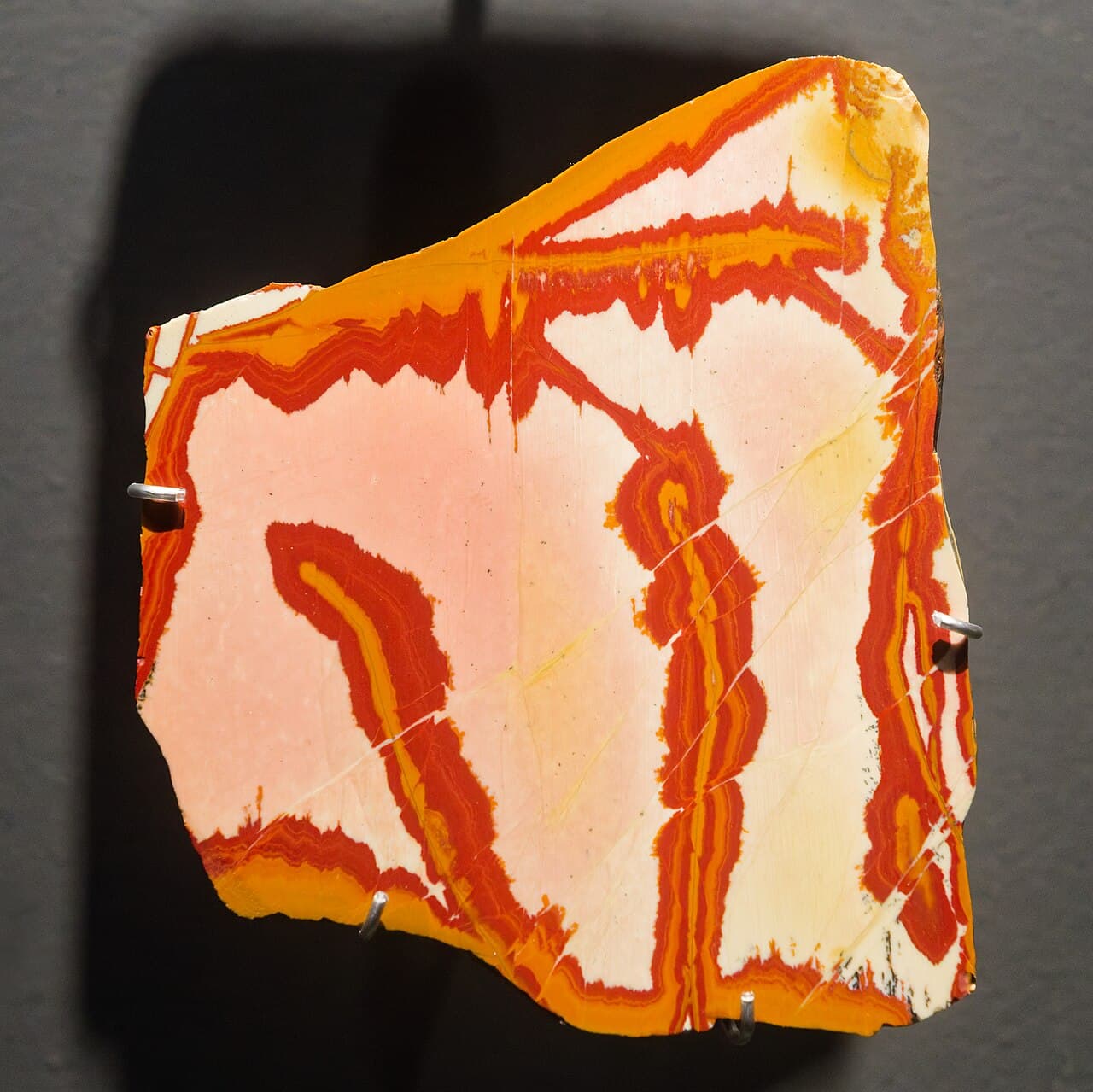
Jasper is an opaque variety of chalcedony — that is, a form of microcrystalline quartz, made of silicon dioxide crystals far too small to see. What turns ordinary silica into jasper is impurity: jasper is densely packed with foreign mineral matter, chiefly iron oxides along with clay and other minerals, often making up fifteen percent or more of the stone. These impurities are what give jasper both its rich earthy colors and its defining opacity, blocking light so thoroughly that even a thin slice will not let the light through. It is hard and durable at about 6.5 to 7 on the Mohs scale, with a waxy-to-dull luster and a white streak, and it takes a fine polish that brings out its colors and patterns.
The single most useful fact for recognizing jasper is that it is opaque. This is what separates it from its close cousins in the chalcedony family: carnelian and agate are translucent, glowing when held to a light, while jasper stays solid and stony no matter how bright the source. Jasper is famous for its endless variety of colors and patterns — deep brick reds, browns, mustard yellows and greens, frequently swirled, spotted, banded or scenic — which has given rise to a long list of descriptive names such as red jasper, picture jasper, ocean jasper and mookaite. Tough, abundant and richly patterned, it has been used for seals, beads, carvings and ornamental stone for thousands of years.
Jasper at a glance
- Classification
- Mineral — opaque variety of chalcedony (microcrystalline quartz)
- Composition
- SiO₂ (silica, with abundant mineral impurities)
- Hardness
- 6.5–7 (Mohs)
- Luster
- Waxy to dull
- Streak
- White
- Colors
- Earthy reds, browns, yellows and greens; very often spotted, banded or scenic
- Crystal system
- Trigonal (microcrystalline, massive aggregate)
- Transparency
- Opaque
How to identify jasper
Start with opacity, the master clue. Hold the stone up to a strong light: jasper is opaque and lets no light pass, even at a thin edge, which immediately separates it from translucent quartz relatives like carnelian and agate that glow when backlit. Next look at color and pattern — jasper typically shows warm, earthy tones of red, brown, yellow and green, and it very often carries patterns: spots, swirls, bands, orbs or even scenic, landscape-like designs. The luster of a broken or unpolished surface is waxy to dull rather than glassy, and a polished surface takes a smooth, satiny shine. A solidly opaque, earthy-colored, often patterned stone with a waxy feel is the classic jasper signature.
Physical tests confirm it is quartz-family material. Because jasper is microcrystalline quartz, it is hard, about 6.5 to 7 on the Mohs scale, so it will readily scratch glass and resist scratching by a steel knife — a quick way to rule out softer painted or plastic imitations. It has a white streak regardless of its body color, feels cool and solid in the hand, and breaks with a smooth conchoidal (shell-like) fracture rather than splitting along flat planes. If an opaque, earthy stone scratches glass, leaves a white streak and shows a waxy luster with that characteristic patterning, you are almost certainly holding genuine jasper.
Colors and varieties
Jasper's colors come almost entirely from the mineral impurities trapped within the silica, and iron is the great colorist: iron oxides produce the deep reds and browns of classic red jasper, while other iron states and additional minerals lend yellows, oranges and greens. Because the impurities are distributed unevenly as the stone forms, jasper is rarely a single flat color; instead it tends toward mottling, banding and swirling, which is exactly what makes it so prized for ornamental use. The base palette is consistently earthy and muted rather than bright and jewel-like — think brick, rust, ochre, olive and cream — a tonal range that itself helps identify the stone.
The varieties of jasper are named largely for their patterns and appearance rather than for any difference in basic composition. Red jasper is the solid brick-red form colored by iron; picture jasper shows brown and tan bands that resemble desert landscapes or scenery; ocean jasper is a patterned material full of colorful orbs and rings; and mookaite is a creamy-to-red patterned jasper popular for cabochons. Many other trade names exist for distinctive patterns. It is worth noting that some inexpensive, vividly colored "jasper" beads on the market are actually dyed — natural jasper keeps its earthy, muted palette, so improbably bright blues, purples or neon greens usually signal dye rather than a natural variety.
Meaning and properties
Jasper has long been regarded as a grounding and nurturing stone, sometimes called a "supreme nurturer," a reputation that fits its earthy colors and solid, comforting weight. Across various traditions it has been associated with stability, endurance, protection and a sense of being calmly rooted, and red jasper in particular has been linked to strength, courage and steady physical energy. In modern crystal-working practice jasper is often described as a stone for grounding scattered feelings, supporting perseverance through difficult tasks, and fostering a patient, down-to-earth frame of mind, and it is a popular everyday carry stone for exactly these grounding associations.
These meanings are cultural, historical and spiritual rather than scientifically demonstrated medical effects. Jasper is a handsome and meaningful stone to wear and to keep, but it does not cure, treat or prevent any physical or mental health condition and is not a substitute for professional medical or psychological care.
Value: what jasper is worth
Jasper is an abundant and affordable ornamental stone, so its value rests far more on beauty than on rarity. The qualities that lift a piece are the appeal of its pattern, the richness and contrast of its colors, and the quality of the polish: a striking scenic picture jasper, a vividly orbed ocean jasper or a richly contrasting mookaite is worth more than a plain, muddy or evenly colored piece. Well-figured material with clear, attractive designs and no cracks or dull dead spots commands the most interest, while bland or fractured stone sits at the bottom of the range. Because the appeal is largely visual and subjective, an unusually beautiful or distinctive pattern can carry a real premium even though the underlying material is common.
Cutting and treatment also factor in. Skilled lapidary work matters because the cutter chooses how to slice and orient the rough to bring out the best pattern, so a well-cut cabochon that centers a fine design can be worth considerably more than carelessly cut material from the same block. Honest sellers disclose dyeing, which is common in cheap, unnaturally bright "jasper"; natural, undyed material in its earthy palette is generally preferred by collectors. As always on this site, no specific prices or sources are quoted here; judge a piece of jasper by the beauty and clarity of its pattern, the contrast of its colors, the quality of its polish, its soundness, and whether the color is natural or dyed.
Real vs. fake jasper
Because jasper is abundant and cheap, it is rarely faked with expensive substitutes; the main issues are dyeing and mislabeling rather than outright synthetics. Dyed jasper is the most common concern: pale or porous natural jasper is sometimes dyed in unnaturally vivid colors — bright blues, purples and neon greens that never occur in natural jasper, which keeps an earthy, muted palette of red, brown, yellow and green. Suspect dye when the color is improbably bright or uniform, when it pools or concentrates along cracks and pores, or when the price is very low for a strikingly colored "rare" stone. A genuine, natural jasper carries the quiet earthy tones described above and a believable, irregular pattern.
Mislabeling within the chalcedony family is the other pitfall, and the opacity test settles most of it. The stones most often confused with jasper are its translucent relatives carnelian and agate; the simplest separation is to hold the stone to a strong light, because jasper is opaque and passes no light, while carnelian glows orange and agate shows light through its bands. Plastic and glass imitations, where they occur, are softer and fail a hardness test — they will not scratch glass, may show molding seams or trapped bubbles, and feel warmer and lighter than stone — whereas real jasper is hard quartz that scratches glass and leaves a white streak. When uncertain, the combination of true opacity, a white streak, a hardness that scratches glass and a natural earthy color is the reliable signature of genuine, undyed jasper.
Care
Jasper is one of the more carefree stones to own, thanks to its quartz-family hardness of about 6.5 to 7, which lets it shrug off the everyday dust and grit that would scratch softer materials, and its lack of cleavage, which makes it tough and resistant to chipping. Clean it with warm water, mild soap and a soft cloth or brush, then rinse and dry it; this gentle routine removes skin oils and grime and restores the polished sheen without any risk to natural, undyed stone. Its durability makes jasper well suited to beads, cabochons, carvings and tumbled pieces that get regular handling.
A few sensible precautions apply, mostly aimed at dyed or lower-quality material. Avoid harsh household chemicals and prolonged soaking, which can attack the dye in color-enhanced pieces and, over time, dull any stone's surface; for the same reason it is best to keep dyed jasper out of prolonged intense sunlight, which can fade added color. Steam and ultrasonic cleaners are generally tolerated by solid natural jasper but are safest avoided when a piece might be dyed, fractured or assembled. Store jasper away from harder stones such as topaz, sapphire or diamond that could scratch it, and keep it from knocking hard against other objects so its polished surface stays crisp.
Jasper look-alikes
Frequently asked questions
What is the difference between jasper and agate?
Both are forms of chalcedony (microcrystalline quartz), but the key difference is transparency. Jasper is opaque and lets no light through, owing to its heavy load of mineral impurities, while agate is translucent and banded, showing light through its layers when held up to a strong source. Hold the stone to a light: if it glows, it is agate; if it stays solid and dark, it is jasper.
Why is jasper opaque when other quartz is clear?
Jasper is densely packed with foreign mineral impurities — chiefly iron oxides along with clay and other minerals — which can make up fifteen percent or more of the stone. Those impurities both color the stone its earthy reds, browns, yellows and greens and block light from passing through, so jasper is opaque where purer quartz and chalcedony are clear or translucent.
How can I tell if jasper is dyed?
Look at the color. Natural jasper keeps an earthy, muted palette of red, brown, yellow and green, so improbably bright blues, purples or neon greens almost always signal dye. Dye also tends to pool and concentrate along cracks and pores and to look unnaturally uniform, and dyed pieces are often sold very cheaply despite their vivid color.
Is jasper a crystal or a rock?
Jasper is a mineral material — an opaque variety of chalcedony, which is microcrystalline quartz. Its quartz crystals are simply far too small to see individually, so the stone looks solid and stony rather than crystalline. It is hard and durable at about 6.5 to 7 on the Mohs scale and leaves a white streak.
Is yours jasper? Find out from a photo
Photograph your crystal in good light and get an identification with an honest confidence level, the look-alikes to rule out and the at-home tests that confirm it.
Identify my crystal freeOn Android? Get the free rock identifier app
Related
Compare jasper with look-alikes
More crystals in the field guide
Related reading
Keep exploring
More on crystals: the full list of crystal types, how to identify a crystal and crystals by color.
Last updated 2026-06-24. Identification guidance is educational — confirm important results with the diagnostic tests described or a qualified expert.