Agate
Also known as: Banded chalcedony, Fortification agate
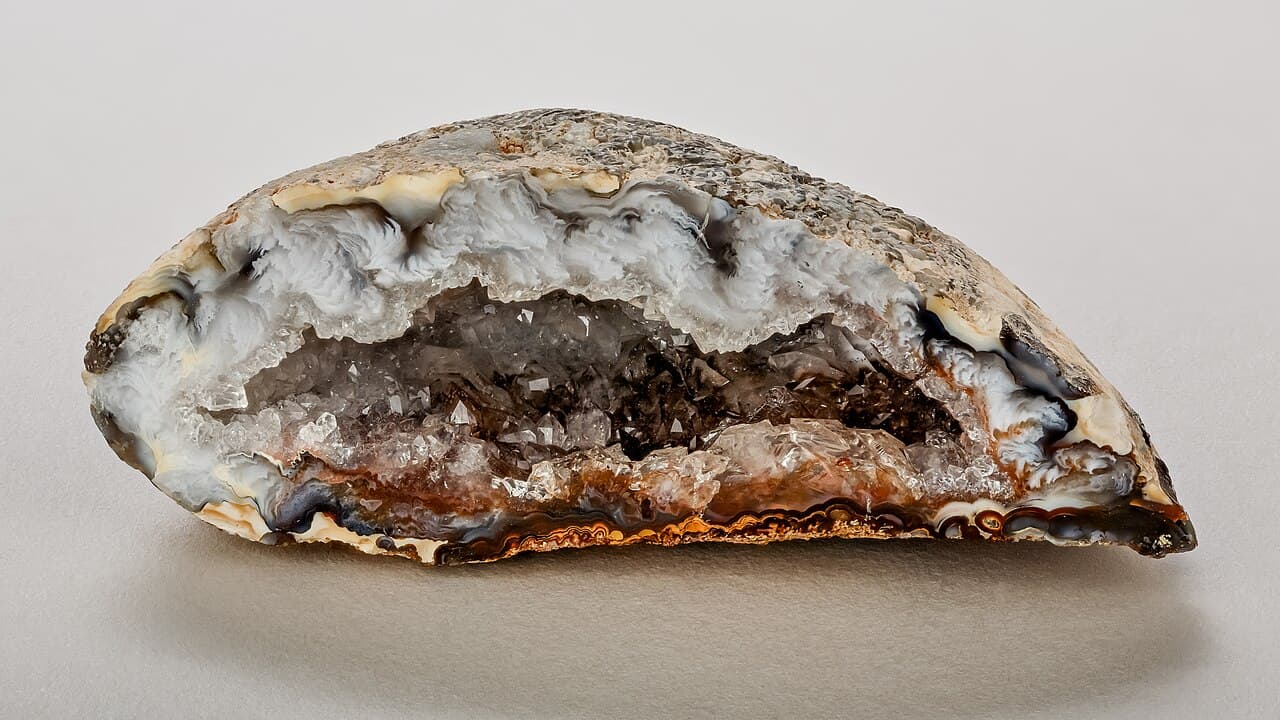
Agate is a banded variety of chalcedony — the microcrystalline (cryptocrystalline) form of quartz, made of silica, SiO₂. What sets it apart from plain chalcedony is its pattern: agate is defined by curved, concentric, or wavy bands of slightly different color and translucency, often called fortification banding because the angular layers resemble the walls of a fort seen from above.
Most agate forms inside gas cavities and cracks in volcanic rock such as basalt. Silica-rich fluids seep into the empty pocket and deposit thin layers of chalcedony against the cavity walls over a long period, building up the banding from the outside in. Because it is essentially quartz, agate is hard and durable (Mohs 6.5–7), takes a high polish, and is one of the most widely collected and carved gem materials in the world.
Agate at a glance
- Classification
- Mineral — chalcedony (a banded, microcrystalline quartz variety)
- Composition
- SiO₂ (silica, with trace elements producing the colors)
- Hardness
- 6.5–7 (Mohs)
- Luster
- Vitreous to waxy
- Streak
- White
- Colors
- Highly variable — gray, white, brown, red, orange, blue, and many others, usually in bands
- Crystal system
- Trigonal (microcrystalline — no visible crystals)
- Transparency
- Translucent to opaque
How to identify agate
The single most reliable clue is banding. Genuine agate shows curved or concentric bands that more or less follow the shape of the cavity it grew in — fine parallel lines, onion-like rings, or angular fortification patterns. Hold a thin edge or a cut slice up to a strong light: the lighter bands are translucent and glow softly while the denser bands stay more opaque, giving agate its characteristic layered, slightly waxy glow.
Agate is hard enough to scratch glass and will resist scratching by a steel knife (6.5–7 on the Mohs scale), and it leaves a white streak on an unglazed tile. A cut-and-polished face feels glassy-smooth and shows a waxy-to-vitreous luster. There are no visible crystal faces because the quartz crystals are microscopic; instead you see a solid, banded mass. If a translucent chalcedony has no banding at all, it is plain chalcedony or, if it is solid orange-red, carnelian — agate is specifically the banded one.
Types and varieties of agate
Agate comes in a huge range of named varieties, most based on pattern or color. Fortification agate is the classic form, with sharp, angular concentric bands that mimic the outline of a fortress. Lace agate (such as crazy lace and blue lace agate) shows swirling, looping bands that resemble lace or ribbons.
A few popular types are not strictly banded, which trips people up. Moss agate and dendritic agate are translucent or near-clear chalcedony containing branching, plant-like inclusions of green or black minerals (often iron or manganese oxides); because the pattern comes from inclusions rather than layered bands, mineralogists consider these chalcedony with inclusions rather than true banded agate, even though the trade calls them agate. Fire agate shows a shimmering, iridescent play of color caused by thin layers of iron oxide within the chalcedony. Other widely sold varieties include thunder eggs, plume agate, and water-level (Uruguay-style) agate, where flat horizontal bands record where the silica settled like sediment inside the cavity.
Meaning and properties
Agate has been worn as an amulet and carved into beads and seals since antiquity, and in modern crystal traditions it is generally regarded as a grounding, stabilizing stone associated with balance and calm. Specific varieties carry their own associations — blue lace agate with soothing communication, moss agate with nature and new growth — and the banding itself is often read as a symbol of steadiness.
Note: these metaphysical and crystal-healing associations are cultural and spiritual rather than scientifically established medical effects. Agate is wonderful to collect and wear for its history and beauty, but it is not a substitute for medical care or professional advice.
Value: what agate is worth
Most agate is inexpensive — common banded tumbled stones, slices, and bookends are among the most affordable gem materials available. Value rises with the quality and rarity of the pattern rather than the material itself: crisp, well-defined banding, strong natural color, good translucency, and an absence of cracks or dull dead spots all add worth.
Certain naturally colored and patterned varieties command real premiums — fine fire agate, well-figured moss and plume agate, and intricate crazy lace, for example — while ordinary gray banded agate that has been brightly dyed remains cheap. As always, attractive natural color is valued over artificial color.
Real vs. fake and dyed agate
Agate is one of the most commonly dyed stones on the market, and this is important to understand because the dyeing is usually legitimate, not fraud. Natural agate is often pale gray, white, or brown, and it is porous enough to absorb dye, so much of the vividly colored sliced agate sold as coasters and decor — electric blue, hot pink, neon green, deep purple — has been dyed. These colors are real treatments, but they are not the stone's natural appearance.
Tell-tale signs of dyed agate: unnaturally intense, candy-bright color; color that pools darker along cracks and porous bands while leaving denser bands pale; and color combinations (vivid blue or magenta) that essentially never occur naturally. Dyeing does not make the stone fake — it is still genuine agate — but a seller should disclose it, and untreated natural-color material is generally preferred by collectors.
True imitations are less common but do exist: dyed banded calcite or onyx-marble can mimic agate but is much softer (it scratches easily and fizzes in weak acid), and glass 'agate' shows molded swirls plus tiny round bubbles and lacks a white streak. A quick hardness check — genuine agate scratches glass and is not scratched by a steel blade — rules most of these out.
Care
Agate is durable and easy to care for: warm water, mild soap, and a soft brush are all it needs. Dyed pieces can slowly fade with prolonged exposure to strong sunlight, so display brightly colored slices out of direct sun. Avoid harsh chemicals and sudden temperature shocks, which can stress any quartz.
Agate look-alikes
Frequently asked questions
What is agate?
Agate is a banded variety of chalcedony, which is the microcrystalline form of quartz (SiO₂). It forms when silica-rich fluids deposit thin, curved layers of chalcedony inside gas cavities in volcanic rock, building up the concentric banding that defines it.
How can I tell if a stone is agate?
Look for curved or concentric banding and translucency: backlight a thin edge and the lighter bands glow while denser bands stay opaque. Agate is also hard — it scratches glass, resists a steel knife, and leaves a white streak. Un-banded translucent chalcedony is not agate.
What's the difference between agate and jasper?
Translucency and pattern. Agate is translucent and banded — light passes through its lighter layers. Jasper is opaque chalcedony with random or blotchy coloring, and no light passes through it. They are chemically the same quartz family but look and behave differently when backlit.
Is brightly colored agate dyed?
Very often, yes. Natural agate is frequently pale gray, white, or brown, so vivid blue, pink, green, or purple sliced agate has usually been dyed. The dyeing is a legitimate, disclosed treatment rather than fakery, but signs include unnaturally intense color and dye pooling along cracks. The stone is still genuine agate.
What are moss agate, blue lace agate and fire agate?
They are varieties named for their pattern rather than by a strict banding rule. Moss agate — by far the most sought-after — is translucent chalcedony filled with green dendritic mineral inclusions that resemble moss or foliage; strictly speaking it is not a true banded agate at all, since it lacks the concentric banding, but the trade name has long since stuck and it is enormously popular in rings. Blue lace agate is the pale blue, delicately banded material best known from Namibia. Fire agate shows iridescent flashes produced by thin iron-oxide layers just beneath its surface. Crazy lace, botswana, tree and dendritic agate are other common named varieties.
Is yours agate? Find out from a photo
Photograph your crystal in good light and get an identification with an honest confidence level, the look-alikes to rule out and the at-home tests that confirm it.
Identify my crystal freeOn Android? Get the free rock identifier app
Related
Compare agate with look-alikes
More crystals in the field guide
Related reading
Keep exploring
More on crystals: the full list of crystal types, how to identify a crystal and crystals by color.
Last updated 2026-07-19. Identification guidance is educational — confirm important results with the diagnostic tests described or a qualified expert.