Apophyllite
Also known as: Fluorapophyllite, Hydroxyapophyllite
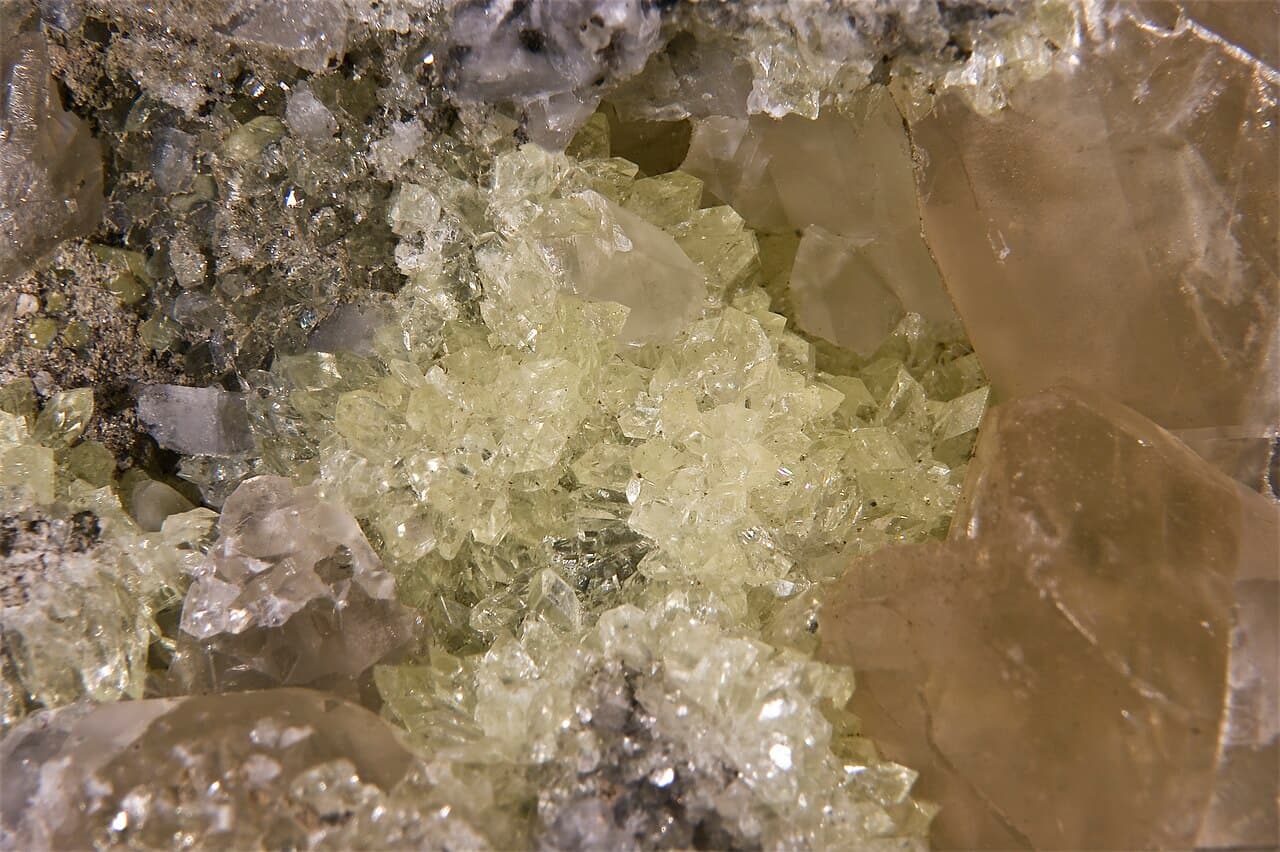
Apophyllite is one of the most photogenic crystals in any collection — a glassy, often water-clear potassium-calcium phyllosilicate that grows as crisp cubes and steep four-sided pyramids perched on a bed of matrix. "Apophyllite" is really a small group of closely related minerals (chiefly fluorapophyllite and hydroxyapophyllite), but collectors and shops treat them as one. The crystals are usually colorless to white, sometimes a soft mint green, and occasionally a gentle peach or pink, with a bright vitreous luster on the prism faces and a distinctly pearly sheen on the flat top — a clue to the mineral's defining feature, its perfect basal cleavage.
The classic apophyllite specimen comes from the ancient basalt lava flows of the Deccan Traps in Maharashtra, India, where gas cavities in the rock became lined with zeolites and apophyllite as mineral-rich water slowly worked through the basalt. There, glassy apophyllite cubes are famously found sitting on velvety beige stilbite or alongside other zeolites, making dramatic display pieces. It is a moderately soft mineral at about 4.5 to 5 on the Mohs scale and is best known purely as a collector's and display crystal rather than a gemstone, prized for its clarity, its sharp geometry, and the way light plays through a clean, transparent point.
Apophyllite at a glance
- Classification
- Mineral group — hydrated potassium-calcium phyllosilicate (sheet silicate)
- Composition
- KCa₄Si₈O₂₀(F,OH)·8H₂O (group; varies by species)
- Hardness
- 4.5–5 (Mohs)
- Luster
- Vitreous (glassy) on prism faces, pearly on the basal cleavage face
- Streak
- White
- Colors
- Most often colorless to white; also pale green, and sometimes peach, pink or yellowish
- Crystal system
- Tetragonal
- Transparency
- Transparent to translucent
How to identify apophyllite
The habit is the first giveaway. Apophyllite grows as blocky, cube-like crystals and steep, pyramid-topped points, frequently clustered together and standing up from a matrix rather than tumbled smooth. A common and almost diagnostic combination is glassy, colorless or pale-green apophyllite cubes sitting on a bed of beige, peachy zeolite — most famously stilbite — a pairing that comes from the basalt cavities of India. The crystals are bright and glassy on their side faces but show a softer, pearly shimmer across the flat top, which reflects the perfect basal cleavage running parallel to that face.
Two simple checks confirm it. First, hardness: apophyllite is only about 4.5 to 5 on the Mohs scale, so a steel knife will scratch it and it will not scratch glass cleanly — this immediately rules out the much harder quartz it is often mistaken for. Second, cleavage: because apophyllite has one direction of perfect basal cleavage, well-formed crystals can flake or split cleanly across the top into thin sheets, leaving a pearly surface, whereas quartz has no cleavage and breaks in curved, conchoidal fractures. A white streak, the tetragonal cube-and-pyramid form, and that pearly top together make apophyllite straightforward to recognize.
Colors and varieties
Most apophyllite is colorless to white, and the finest pieces are wonderfully transparent — clear enough to look straight through a well-formed point. The next most popular color is a soft mint to apple green, caused by trace impurities (vanadium is often cited), which collectors prize especially when the green crystals are clustered with contrasting zeolites. Peach, pink, and pale yellow apophyllite also occur, the warmer tints frequently tied to inclusions or to an underlying or intergrown coating of stilbite, giving the crystals a gentle blush.
Beyond color, the group itself accounts for the main "varieties": fluorapophyllite (the fluorine-dominant and most common member) and hydroxyapophyllite (the hydroxyl-dominant member), which look essentially identical to the eye and are distinguished only by chemical analysis. Whatever the color or species, the identifying features stay constant — the glassy cube-and-pyramid crystals, the moderate hardness of 4.5 to 5, the perfect pearly basal cleavage, and the white streak — so color alone is a description of the specimen rather than a reliable way to tell apophyllite from anything else.
Meaning and properties
In modern crystal-working traditions apophyllite is treated as a high-clarity, "high-vibration" stone, and its glass-clear pyramids lead many people to associate it with mental clarity, calm, and meditation. It is popularly linked to the crown and third-eye chakras and is often kept on a desk or in a meditation space as an aid to focus and a peaceful, reflective mood, while green apophyllite is sometimes connected with the heart. These are cultural and spiritual associations drawn from folklore and personal practice, not measurable effects of the mineral.
It is important to be clear that none of these uses are scientifically established medical or psychological treatments. Apophyllite is a beautiful and rewarding mineral to collect, study, and display for its clarity and crystal form, but it is not a remedy for any physical or mental health condition and should never replace advice or care from a qualified professional.
What apophyllite is worth
For apophyllite the value is in the specimen, not in cut gems. The most sought-after pieces are clean, undamaged clusters of glassy, transparent crystals with sharp pyramid terminations, ideally on an attractive matrix or paired with contrasting zeolites such as a bed of peachy stilbite. Strong, even green color, large transparent points, good size, and pristine crystal tips all push a piece higher, while cloudy crystals, chips on the fragile terminations, or dull, etched faces bring it down. A striking apophyllite-on-stilbite plate from India can be a centerpiece display item.
Faceted apophyllite does exist as a collector curiosity, but it is impractical as jewelry: at only 4.5 to 5 on the Mohs scale, with perfect cleavage, it is far too soft and fragile for rings or daily wear and is cut mainly to show off exceptional clarity. As with all minerals, price depends on the interplay of clarity, color, crystal form, size, matrix, and especially condition rather than any single number — an intact, sparkling cluster commands a clear premium over a damaged or murky one.
Real vs. fake
Apophyllite is rarely faked with synthetics, but a few honesty issues come up. The most common is enhancement of color — pale or white clusters that have been dyed or artificially coated to imitate desirable green, so a harsh, unnaturally uniform green, color pooled in the gaps between crystals, or tint that rubs off is a warning sign. Specimens are also sometimes repaired or rebuilt, with broken crystals glued back onto a matrix; checking the bases of the points for glue lines or mismatched attachment helps spot this. And other glassy minerals from the same Indian basalt cavities are occasionally mislabeled as apophyllite.
The mineral's own properties make verification easy. Genuine apophyllite is soft at 4.5 to 5, so a steel point scratches it and it cannot scratch glass — anything that resists a knife or scratches glass is not apophyllite (most likely quartz). It shows perfect basal cleavage, so its flat top has a pearly sheen and can flake into thin sheets, unlike quartz's curved fracture. The crisp tetragonal cube-and-pyramid habit and white streak round out the picture, and natural color is soft and a little uneven rather than electric and perfectly even.
Care
Apophyllite is delicate and needs gentle handling. It is soft at 4.5 to 5 on the Mohs scale and has one direction of perfect cleavage, so its crystal tips chip easily and a sharp knock can split a crystal cleanly across the top. Never store specimens loose against harder stones such as quartz, and always handle a piece by its matrix rather than by the fragile points. Keep apophyllite away from sudden temperature changes and from prolonged dry heat, which over time can stress the water-bearing structure of zeolite-associated specimens.
Clean apophyllite only lightly — gentle dusting with a soft, dry brush is safest, or at most a quick wipe with a barely damp soft cloth, dried promptly afterward. Avoid soaking it, and never use ultrasonic or steam cleaners, whose vibration and heat can split the crystals along the cleavage. Store each specimen separately, cushioned in a soft cloth or its own padded compartment, so the points are protected from knocks and from being scratched by other minerals.
Apophyllite look-alikes
Frequently asked questions
Is apophyllite one mineral or several?
It is a small group of very similar minerals rather than a single species. The main members are fluorapophyllite (fluorine-rich, the most common) and hydroxyapophyllite (hydroxyl-rich), which look essentially identical and can only be told apart by chemical analysis. In shops and collections they are almost always labeled simply as "apophyllite."
How can I tell apophyllite from clear quartz?
Use hardness and cleavage. Apophyllite is soft at 4.5 to 5, so a steel knife scratches it and it will not scratch glass, while quartz is hard at 7 and does the opposite. Apophyllite also has perfect basal cleavage — its flat top is pearly and can flake into thin sheets — whereas quartz has no cleavage and breaks in curved, shell-like fractures. The crystal shapes differ too: apophyllite makes cubes and steep pyramids, quartz makes six-sided prisms.
Why is apophyllite so often found on stilbite?
Both crystallized in the same setting: gas bubbles and cavities in ancient basalt lava flows, especially the Deccan Traps in Maharashtra, India. As mineral-rich water moved through the basalt, zeolites like stilbite and then apophyllite grew on the cavity walls, so glassy apophyllite points are commonly found perched on velvety, peach-colored stilbite, making for striking display specimens.
Can apophyllite be worn as jewelry?
Not really for everyday wear. At only 4.5 to 5 on the Mohs scale and with perfect cleavage, apophyllite is too soft and too prone to chipping and cleaving to survive the knocks of a ring or bracelet. It is occasionally faceted as a collector curiosity to show off exceptional clarity, but it is valued and kept first and foremost as a display and specimen crystal.
Is yours apophyllite? Find out from a photo
Photograph your crystal in good light and get an identification with an honest confidence level, the look-alikes to rule out and the at-home tests that confirm it.
Identify my crystal freeOn Android? Get the free rock identifier app
Related
More crystals in the field guide
Keep exploring
More on crystals: the full list of crystal types, how to identify a crystal and crystals by color.
Last updated 2026-06-25. Identification guidance is educational — confirm important results with the diagnostic tests described or a qualified expert.