Fluorite
Also known as: Fluorspar, Rainbow fluorite (multicolored/banded material)
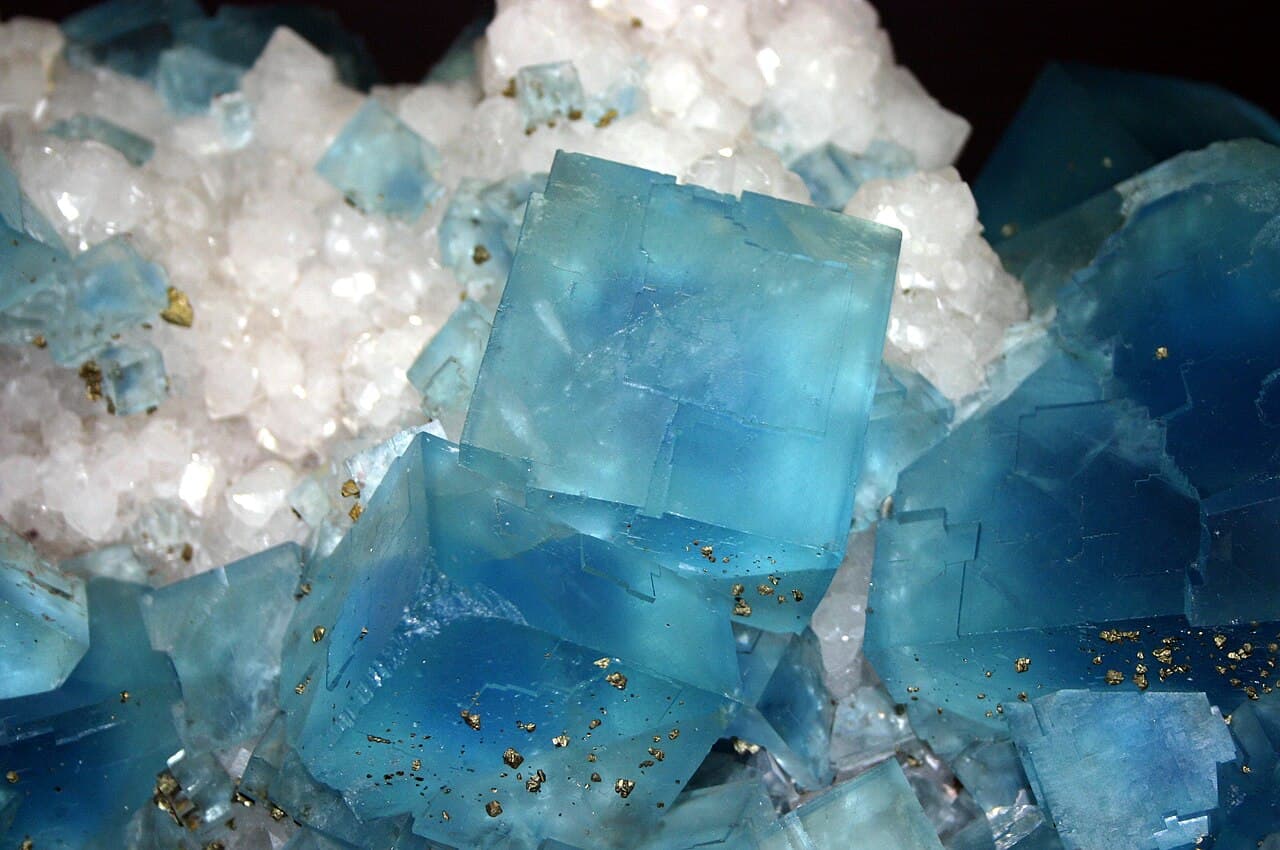
Fluorite is calcium fluoride, a mineral that comes in a wider range of colors than almost any other and that is famous twice over in science: it defines hardness 4 on the Mohs scale, and the very word "fluorescence" was coined from it because so many specimens glow under ultraviolet light. Collectors love it for its glassy, jewel-like crystals, its candy spectrum of purples, greens, blues, and yellows, and the way a single specimen can stack several colors in neat bands.
Its hallmark crystal habit is the cube, often grown as interpenetrating or stepped cubes, though it also forms octahedrons and other isometric shapes. Underneath that, fluorite has perfect octahedral cleavage, meaning it splits cleanly along four directions to reveal eight-sided forms; cleaved "octahedron" pieces are a classic sight in rock shops.
The catch is that fluorite is soft and brittle. At Mohs 4 it scratches easily and is not a hardwearing jewelry stone, and its perfect cleavage means a sharp knock can pop a clean flake off a corner. That softness is actually a useful identification feature, because it is one of the quickest ways to tell fluorite apart from the much harder quartz and glass it can superficially resemble.
Fluorite at a glance
- Classification
- Mineral — halide
- Composition
- CaF₂
- Hardness
- 4 (Mohs) — defines 4 on the scale
- Luster
- Vitreous
- Streak
- White
- Colors
- Purple, green, blue, yellow, colorless, pink; often color-zoned or banded
- Crystal system
- Isometric (cubic)
- Transparency
- Transparent to translucent
How to identify fluorite
Start with hardness, because it is decisive. Fluorite sits at exactly 4 on the Mohs scale, so it can be scratched by a steel knife or a hardened nail and, crucially, it cannot scratch glass. This single test separates fluorite from quartz and from glass imitations, both of which are much harder (quartz is 7 and will scratch glass easily). If a colorful, glassy "crystal" is soft enough that a knife marks it, you are very likely holding fluorite rather than quartz.
Crystal shape is the next clue. Fluorite belongs to the isometric (cubic) system, and well-formed specimens are typically cubes, sometimes intergrown or stepped, and occasionally octahedrons. Cubic crystals with a glassy luster and rich color are a strong sign of fluorite.
Cleavage is a defining feature. Fluorite has perfect octahedral cleavage along four directions, which is why broken pieces and prepared specimens so often appear as clean eight-faced octahedrons, and why corners chip off along flat triangular planes. Quartz, by contrast, has no cleavage and breaks with curved, shell-like conchoidal fractures. Flat octahedral cleavage versus curved fracture is a reliable way to tell the two apart.
Color and zoning help confirm it. Fluorite spans purple, green, blue, yellow, colorless, and pink, and a single crystal often shows several of these in sharp bands or color-zoned cubes, which is unusual among common minerals. Finally, many fluorites fluoresce, often glowing blue or violet under ultraviolet light. Fluorescence is variable and not every specimen shows it, so treat a glow as supporting evidence rather than proof, but combined with softness, cubic habit, and octahedral cleavage it makes the identification clear.
Colors and varieties
Fluorite is one of the most colorful minerals known. Purple and violet are the classic and most familiar shades, but green, blue, yellow, colorless, and pink all occur, and rarer specimens show other hues. The color comes from trace impurities and from defects in the crystal structure rather than from a single coloring element, which is part of why the range is so broad and why color alone is never enough to identify a stone.
Color zoning is one of fluorite's signature traits. Many crystals grow in distinct bands, so a single cube can show, for example, a green core wrapped in purple, with sharp boundaries between the zones. Massive, multicolored banded material is widely sold as "rainbow fluorite," typically alternating purple and green layers, and it is a favorite for carved spheres, towers, and beads.
Some fluorite is also notable for fluorescence and, less commonly, for the way certain specimens can appear a different color under different lighting. As varieties, though, these are descriptive labels for color and optical behavior; chemically it is all calcium fluoride.
Meaning and properties
In crystal traditions, fluorite is often described as a stone of focus, mental clarity, and order, with the different colors sometimes assigned their own associations (for example, purple with intuition and green with balance). Multicolored "rainbow" fluorite is popularly linked to organizing scattered thoughts. These ideas make it a common choice for desks, study spaces, and meditation.
Such meanings are spiritual and cultural, not medical. Fluorite does not diagnose, treat, prevent, or cure any physical or mental condition, and nothing here is health advice. Enjoy it for its symbolism or simply for its remarkable color, but do not rely on it in place of professional care. Note also that fluorite contains fluorine within a stable crystal compound; handling polished or whole specimens is fine, but you should not grind, lick, or ingest it, and dust from cutting should not be inhaled.
Value
Most fluorite is affordable, which is one of the reasons it is such a popular collector and decorative mineral. Value rises with the quality and saturation of color, the sharpness and completeness of crystal faces, transparency, the drama of color zoning, and overall specimen size and condition. Clean, gemmy, well-formed cubes and aesthetically arranged crystal clusters are worth more than cloudy or damaged pieces.
Because fluorite is soft and cleaves easily, condition is especially important: chipped corners and cleavage flakes reduce a specimen's appeal, while crystals with intact edges and bright luster stand out. Fine multicolored or unusually vivid specimens, and large transparent crystals, sit at the higher end.
Care
Fluorite needs careful handling because it is soft and cleavable. At Mohs 4 it scratches very easily, including from ordinary household dust and from harder stones, so do not store it loose against quartz, agate, or metal, and do not assume it will survive everyday wear the way a quartz stone would. Its perfect octahedral cleavage means a single sharp knock or drop can pop a clean flake off a corner.
Clean it gently with a soft, slightly damp cloth or lukewarm water and a drop of mild soap, then dry it. Never use ultrasonic or steam cleaners, which can shatter it along cleavage planes, and avoid harsh chemicals and acids. Fluorite is also sensitive to heat and to sudden temperature changes, which can cause it to crack, so keep it away from hot water and rapid hot-to-cold swings. Prolonged intense light can also fade the color of some specimens, so display vivid pieces out of harsh direct sun.
Fluorite look-alikes
Frequently asked questions
What is fluorite?
Fluorite is calcium fluoride (CaF₂), a halide mineral that comes in an exceptionally wide range of colors, commonly purple, green, blue, and yellow, often in bands. It defines hardness 4 on the Mohs scale, typically forms cubic crystals, has perfect octahedral cleavage, and frequently glows under ultraviolet light.
How can I tell fluorite from quartz?
Use hardness and cleavage. Fluorite is soft (Mohs 4): a steel knife scratches it and it cannot scratch glass, whereas quartz (Mohs 7) scratches glass easily. Fluorite also has perfect octahedral cleavage and often forms cubes, while quartz has no cleavage and breaks with curved, shell-like fractures.
Why does fluorite glow under UV light?
Many fluorites fluoresce, often glowing blue or violet under ultraviolet light because trace elements and structural defects absorb UV and re-emit visible light. The phenomenon of fluorescence was actually named after fluorite. Note that not every specimen fluoresces, so a glow supports identification but is not proof on its own.
Is fluorite fragile, and how do I care for it?
Yes. Fluorite is soft (Mohs 4) and has perfect cleavage, so it scratches and chips easily and a sharp knock can split it. Clean it gently with mild soap and water, never use ultrasonic or steam cleaners, avoid harsh chemicals, heat, and sudden temperature changes, and store it apart from harder stones.
What does fluorite symbolize?
Fluorite is commonly called the 'genius stone,' associated with focus, mental clarity and order — a meaning that suits a mineral famous for growing in near-perfect geometric cubes and octahedra. Modern crystal practice often assigns different purposes to different colors: purple to intuition, green to renewal, clear to clarity. These associations are cultural and spiritual rather than medical, and fluorite treats no condition.
What are rainbow, green and purple fluorite?
They are color varieties of a single mineral, calcium fluoride, whose trace impurities and natural irradiation give it an unusually wide palette. Green and purple are the most common single colors; 'rainbow fluorite' (also sold as banded or multicolor fluorite) is material with several color zones layered in one piece, typically purple-green-clear banding that follows the crystal's growth directions. Blue, yellow and colorless fluorite also occur, and one crystal can contain several zones at once — a large part of why fluorite is a collector favorite.
Is yours fluorite? Find out from a photo
Photograph your crystal in good light and get an identification with an honest confidence level, the look-alikes to rule out and the at-home tests that confirm it.
Identify my crystal freeOn Android? Get the free rock identifier app
Related
Compare fluorite with look-alikes
More crystals in the field guide
Related reading
Keep exploring
More on crystals: the full list of crystal types, how to identify a crystal and crystals by color.
Last updated 2026-07-19. Identification guidance is educational — confirm important results with the diagnostic tests described or a qualified expert.