Calcite
Also known as: Calcium Carbonate, Iceland Spar (clear variety), Calcspar
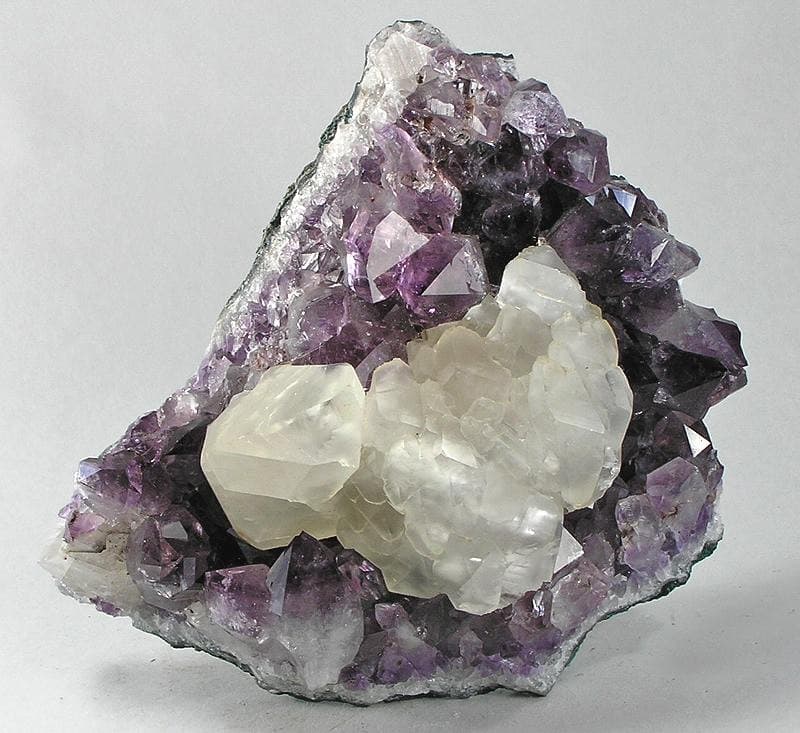
Calcite is calcium carbonate (CaCO3) and one of the most widespread minerals on Earth. It is the main building block of limestone and marble, the material of most seashells and coral, and a common cement that binds many sedimentary rocks together. Because it crystallizes in so many environments, calcite appears in an enormous variety of shapes and colors, from glass-clear rhombs to chalky white masses, scalenohedral dogtooth points, and banded cave formations like stalactites and flowstone. Despite all that variety, calcite has a tidy set of properties that make it one of the easiest minerals to identify with confidence.
Two simple tests do most of the work. First, calcite fizzes vigorously when a drop of dilute acid such as household vinegar touches it, because the acid releases carbon dioxide gas from the carbonate. Second, a clear crystal of calcite shows strong double refraction: lay it over a printed line and you will see the line appear doubled. Add a low hardness of 3 (a steel knife or even a copper coin will scratch it) and perfect rhombohedral cleavage that makes it break into leaning, block-shaped pieces, and calcite becomes one of the most diagnostic minerals a beginner can learn.
Calcite at a glance
- Classification
- Carbonate mineral (calcite group)
- Composition
- CaCO3
- Hardness
- 3 (Mohs)
- Luster
- Vitreous to pearly or dull
- Streak
- White
- Colors
- Extremely variable: colorless, white, yellow, orange, pink, brown, green, blue, gray, and more
- Crystal system
- Trigonal
- Transparency
- Transparent to translucent to opaque
How to identify calcite
The single most reliable test for calcite is the acid reaction. Place a drop of dilute hydrochloric acid or ordinary white vinegar on a fresh surface; calcite reacts at once with vigorous, visible fizzing as carbon dioxide escapes. This effervescence confirms a carbonate and, combined with the other properties below, points firmly to calcite. Pair the acid test with hardness: calcite is only 3 on the Mohs scale, so a steel knife, a nail, or even a copper coin will scratch it easily, immediately separating it from much harder minerals like quartz.
Cleavage and optics seal the identification. Calcite has perfect rhombohedral cleavage in three directions, none at right angles, so when it breaks it tends to split into slanted, block-like rhombs that look like squashed cubes leaning to one side. Clear, well-formed calcite (the variety known as Iceland spar) also displays striking double refraction, doubling any line or dot viewed through it. Add a white streak and a vitreous luster, and you have a mineral that announces itself: it fizzes, it is soft, it cleaves into rhombs, and clear pieces show two images. No other common mineral combines all four traits.
Color and varieties
Calcite is famous for its color range. Pure calcite is colorless or white, but trace elements and inclusions produce yellow, honey, orange, pink, red, brown, green, blue, lavender, and gray varieties, sometimes several shades in a single specimen. Optical calcite, or Iceland spar, is the water-clear form prized for its double refraction. Honey and golden calcites are popular display pieces, orange calcite is typically a warm, translucent massive material, and blue and green calcites owe their tints to trace impurities. Because so many colors exist, color alone is never enough to identify calcite; always confirm with the acid and hardness tests.
Habit is just as varied as color. Calcite forms sharp rhombohedrons, elongated scalenohedral dogtooth crystals, flat nailhead crystals, and stacked or twinned aggregates, as well as massive, granular, fibrous, and stalactitic forms in caves. Many specimens fluoresce vividly under ultraviolet light, often glowing red, pink, or orange, which makes calcite a favorite among fluorescent-mineral collectors. This combination of countless crystal shapes, a full rainbow of colors, and frequent fluorescence is part of why calcite is one of the most collected minerals in the world.
Meaning and properties
In crystal-healing and metaphysical traditions, calcite is commonly described as a cleansing and energy-amplifying stone, and different colors are associated with different intentions in those practices, such as orange calcite with creativity and clear calcite with clarity. Some practitioners use it to symbolically clear or refresh a space. These associations come from spiritual, cultural, and personal belief systems rather than from scientific evidence, and calcite should not be relied upon to treat, diagnose, or cure any condition. It is not a substitute for professional medical or mental health care.
If you enjoy the symbolic side of minerals, calcite's gentle appearance and rainbow of colors make it a popular choice for meditation spaces and display, and you can treat those uses as a personal or spiritual practice. Just keep the practical cautions in mind: calcite is soft and acid-sensitive, so it is better admired and handled gently than worn as rugged jewelry. For any health concern, consult a qualified healthcare professional rather than depending on a crystal.
Value and what affects price
As one of the most common minerals on Earth, ordinary calcite is inexpensive, and plain white or massive pieces are widely available at low cost. Value rises with the quality of crystal form, transparency, color, and aesthetics. Sharp, undamaged crystals with clean faces, vivid or unusual colors, and good transparency are far more desirable than cloudy or broken fragments. Clear optical calcite (Iceland spar) showing strong double refraction is sought after for its optical novelty, and large, flawless cleavage rhombs are collectible.
Specimens with dramatic crystal habits, attractive associations with other minerals, or strong fluorescence can command higher prices, especially well-documented display pieces. Because the mineral itself is abundant, condition and presentation matter more than rarity for most calcite. Soft cleavage edges chip and scratch easily, so well-preserved, undamaged crystals are notably more valuable than handled or weathered ones. As always, judge a piece on its clarity, color, crystal quality, and condition rather than on marketing names.
Real vs. fake: avoiding misidentification
Outright fakes of calcite are uncommon because the mineral is cheap, so the real risk is misidentification, mistaking another mineral for calcite or the reverse. The acid test is your safeguard: genuine calcite fizzes briskly in dilute acid or vinegar, while quartz, fluorite, and gypsum do not react. Be aware that the closely related carbonate dolomite reacts only weakly, usually fizzing slowly or mainly when it is powdered or the acid is warmed, which helps separate dolomite from true calcite. Aragonite shares calcite's chemistry and also fizzes, but it forms in a different crystal system and typically shows different habits.
When buying clear optical calcite, the double-refraction test is a quick authenticity check: real Iceland spar visibly doubles a line viewed through it, which glass and most imitations will not do. Dyed calcite exists in the decorative market, so unnaturally vivid, uniform colors on inexpensive tumbled pieces can indicate dye rather than natural coloring; a hidden or freshly broken surface sometimes reveals paler natural material underneath. Combining the acid reaction, the hardness of 3, rhombohedral cleavage, and the double-refraction check makes confident calcite identification straightforward.
Care and cleaning
Calcite needs gentler care than most popular crystals because it is both soft and chemically reactive. At Mohs 3 it scratches very easily, so store it apart from harder minerals and avoid stacking specimens against one another. Its perfect cleavage means a knock can split off a clean flake along an edge, so handle crystals carefully and support larger pieces from underneath. Clean calcite only with a soft, dry or barely damp cloth, or a soft brush to remove dust; avoid prolonged soaking.
The most important rule is to keep calcite away from acids of any kind, since the same reaction that helps identify it will etch and dissolve the surface. That means no vinegar, no acidic cleaners, and care around anything acidic, including some skin contact and acidic household products. Because calcite is mildly soluble, limit water exposure and dry it promptly. Strong, sudden temperature changes are also best avoided. Treated with this gentle routine, calcite keeps its bright luster and crisp crystal edges.
Calcite look-alikes
Frequently asked questions
How do I know if a rock is calcite?
Run two quick tests. First, put a drop of vinegar or dilute acid on it; calcite fizzes vigorously as carbon dioxide bubbles off. Second, try to scratch it: calcite is soft (Mohs 3), so a steel knife or copper coin marks it easily. If it also breaks into slanted, block-shaped rhombs and a clear piece doubles a line viewed through it, you have calcite.
Why does calcite fizz in vinegar?
Calcite is calcium carbonate, and when acid touches a carbonate it reacts to release carbon dioxide gas. The escaping gas is what you see and hear as vigorous fizzing or effervescence. Even weak household vinegar produces a visible reaction on fresh calcite. This carbonate reaction is one of the most reliable field tests for identifying calcite and other carbonate minerals.
What is the difference between calcite and quartz?
They are easy to separate with simple tests. Calcite is soft (Mohs 3), fizzes in acid, cleaves into leaning rhombs, and clear pieces double images. Quartz is much harder (Mohs 7, so a knife will not scratch it), does not react with acid, has no cleavage, and breaks with curved conchoidal surfaces. If your specimen fizzes and is easily scratched, it is calcite, not quartz.
Can I clean calcite with water or put it in jewelry?
Use only brief, gentle cleaning, a soft dry or barely damp cloth, and never acids, which dissolve and etch calcite. Because it is mildly soluble, limit soaking and dry it promptly. Calcite is also soft and cleaves easily, so it makes fragile jewelry that scratches and chips; it is better suited to display and careful handling than to everyday rings or bracelets.
Is yours calcite? Find out from a photo
Photograph your mineral in good light and get an identification with an honest confidence level, the look-alikes to rule out and the at-home tests that confirm it.
Identify my mineral freeOn Android? Get the free rock identifier app
Related
Compare calcite with look-alikes
More minerals in the field guide
Related reading
Keep exploring
More on minerals: how to identify a mineral, the streak test and the full list of crystal types.
Last updated 2026-06-24. Identification guidance is educational — confirm important results with the diagnostic tests described or a qualified expert.