Clear Quartz
Also known as: Rock Crystal, Crystal Quartz, Clear Crystal Quartz
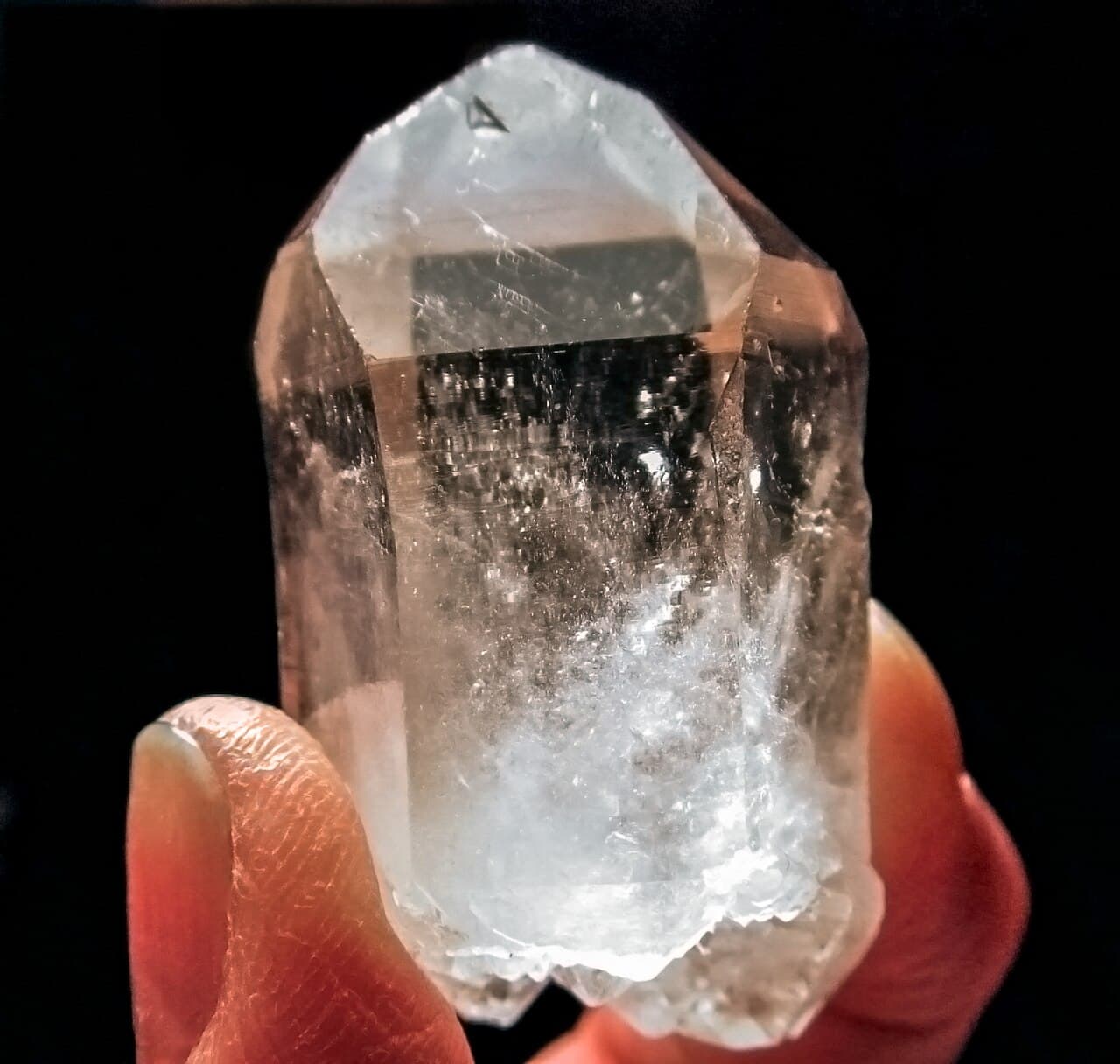
Clear quartz is the colorless, transparent form of quartz, the most abundant mineral family in the Earth's continental crust. Chemically it is pure silicon dioxide (SiO2), and when it grows free of the trace impurities and irregularities that produce amethyst, citrine, or smoky quartz, the result is water-clear and glassy. Well-formed specimens often appear as six-sided (hexagonal) prisms capped by pyramid-shaped terminations, a habit so recognizable that the old term for it, rock crystal, has been used for thousands of years to describe ice-clear quartz carved into seals, lenses, and ornaments.
For anyone learning to identify minerals, clear quartz is an ideal reference point because its properties are consistent and easy to test. It is hard (Mohs 7), it has no cleavage and instead breaks with the curved, shell-like fracture surfaces that geologists call conchoidal, and it leaves a white streak. It is also piezoelectric, meaning it generates a tiny electrical charge when squeezed, which is why precisely cut quartz crystals keep time in watches and stabilize frequencies in radios and computers. That same durability and clarity make clear quartz one of the most common crystals on shelves and in collections worldwide.
Clear Quartz at a glance
- Classification
- Silicate (tectosilicate); quartz group
- Composition
- SiO2
- Hardness
- 7 (Mohs)
- Luster
- Vitreous (glassy)
- Streak
- White
- Colors
- Colorless to white; clear quartz specifically is transparent and colorless
- Crystal system
- Trigonal (hexagonal habit)
- Transparency
- Transparent to translucent
How to identify clear quartz
Start with hardness, because it rules out most look-alikes quickly. Clear quartz sits at 7 on the Mohs scale, so it will scratch glass and an ordinary steel knife blade, while almost nothing in a typical mineral box will scratch it. If your specimen is easily marked by a knife or a copper coin, it is not quartz. Next, look at how it breaks: quartz has no cleavage, so broken surfaces are curved and glassy (conchoidal fracture) rather than the flat, mirror-like planes you see in calcite or fluorite. The streak is white, and the luster on fresh or crystal faces is vitreous, like the gleam of a glass marble.
Crystal shape is the most satisfying confirmation when it is present. Clear quartz commonly forms long six-sided prisms that taper to a pyramid-shaped point, and the prism faces are often marked with fine horizontal striations running perpendicular to the crystal's length. Many specimens are doubly clear with internal fractures, veils, or needle-like inclusions, which are perfectly normal and do not change the identification. If the piece is a tumbled pebble with no faces, lean on hardness and the absence of cleavage. Clear quartz is also notably cool to the touch and does not fizz when a drop of vinegar is applied, which separates it from carbonate minerals.
Color and varieties
By definition, clear quartz is colorless and transparent, but it belongs to a large and colorful family. The same mineral, SiO2, becomes amethyst when natural irradiation and trace iron tint it purple, citrine when it turns golden to amber, smoky quartz when it darkens to gray or brown, and rose quartz when fine inclusions lend a pink blush. A single crystal can even be part colorless and part colored. Because color in quartz comes from impurities and structural defects rather than from the silica itself, truly clear quartz is essentially the pure end member.
Clear quartz also varies in its internal character. Some pieces are flawless and glass-clear, prized for carving and optics, while others contain captivating natural features: misty veils, rainbow flashes from internal fractures, phantom outlines of earlier growth stages, or slender mineral needles (such as rutile or tourmaline) that pierce the crystal. Massive vein quartz, by contrast, is milky white and translucent rather than transparent, owing to countless microscopic fluid inclusions. Collectors distinguish these by clarity and habit, but all are the same mineral species.
Meaning and properties
In crystal-healing and metaphysical traditions, clear quartz is often called the master healer or the universal amplifier, and it is among the most widely used stones in those practices. Practitioners describe it as a stone of clarity and focus that is believed to magnify intention and the energy of other crystals placed near it, which is why it frequently anchors crystal grids and meditation layouts. These ideas are part of spiritual and cultural belief systems and personal practice, not scientific or medical fact, and clear quartz should never be used as a substitute for professional medical care.
Culturally, the appeal of clear quartz is easy to understand: a flawless, ice-clear crystal looks like frozen light, and many ancient peoples genuinely believed rock crystal was permanently frozen ice or solidified water. That long symbolic history of purity and illumination carries into how the stone is described and used today. If you find these associations meaningful, treat them as a personal or spiritual practice rather than a treatment, and consult a qualified healthcare provider for any physical or mental health concern.
Value and what affects price
Clear quartz is one of the most common and affordable crystals on the market, which is good news for new collectors. It is abundant worldwide and forms in a wide range of geologic settings, so plain tumbled stones and small clusters are inexpensive and easy to find. Value rises with clarity, size, and the quality of the crystal form. A large, undamaged single crystal with sharp faces, perfect water clarity, and a complete natural termination commands far more than a cloudy fragment of the same weight.
Aesthetic and collector factors also matter. Specimens with attractive natural inclusions, well-defined phantoms, glassy luster, and clean, complete terminations are more desirable, as are matched clusters with many intact points. Because the mineral itself is plentiful, condition and presentation drive price more than rarity does. Beware of paying premium prices for ordinary clear quartz dressed up with grand marketing names; the underlying material is widespread, and honest sellers will describe clarity, origin habit, and any repairs plainly.
Real vs. fake: spotting glass imitations
The most common substitute for clear quartz is ordinary glass, and a few quick checks usually settle the question. Temperature is the simplest: natural quartz feels distinctly cool and takes longer to warm against your skin, while glass warms up quickly and feels less cold to begin with. Look inside for round or teardrop-shaped air bubbles, which form in molten glass but never occur in natural quartz; gas trapped in real quartz appears as irregular fluid pockets, not perfect spheres. Glass is also softer, so a genuine quartz point will scratch a glass surface, whereas glass will not scratch quartz.
Crystal form is the other giveaway. Natural clear quartz tends to show flat crystal faces, horizontal striations on the prism, and a true pyramid termination, while molded glass shows rounded edges, mold seams, or a too-perfect symmetry. Many tumbled glass beads are simply too flawless and uniform to be natural. If you can apply a drop of vinegar, note that neither quartz nor glass will fizz, so that test only helps against carbonates; for the quartz-versus-glass question, rely on the cool touch, bubble check, and a careful scratch test on an inconspicuous spot.
Care and cleaning
Clear quartz is one of the lowest-maintenance crystals to own because it is hard and chemically stable. At Mohs 7 it resists everyday scratching, and it is not water-soluble, so a gentle wash with lukewarm water and a soft cloth is all routine cleaning requires. Avoid storing it loose with softer minerals, which it can scratch, and keep harder materials away from its polished surfaces. Although quartz is tough, sharp impacts can still chip the brittle edges of terminations, so handle pointed crystals with reasonable care.
Two cautions are worth remembering. First, prolonged exposure to strong, direct sunlight can fade the color of some quartz varieties; pure clear quartz has no color to lose, but treated or naturally colored quartz can pale over time, so display colored pieces away from intense sun. Second, sudden temperature changes can crack quartz through thermal shock, so do not pour boiling water over a cold crystal or leave specimens where they will heat and cool rapidly. With those simple precautions, clear quartz will stay glassy and bright for a lifetime.
Clear Quartz look-alikes
Frequently asked questions
How can I tell clear quartz from glass?
Check temperature, bubbles, and hardness. Clear quartz feels noticeably cool and warms slowly, while glass feels warmer right away. Real quartz never contains the round air bubbles you often see in glass, and at Mohs 7 a quartz point will scratch a glass surface but glass will not scratch quartz. Natural crystal faces, horizontal striations, and a pyramid termination also point to genuine quartz.
Is clear quartz the same as a diamond?
No. Clear quartz is silicon dioxide with a hardness of 7, while diamond is carbon and the hardest natural material at 10. Diamond has far greater brilliance and fire, much higher density, and is enormously more valuable. Colorless quartz has historically been used as an inexpensive diamond imitation, but a simple hardness or density test, or a jeweler's inspection, separates them easily.
Why is some clear quartz cloudy or milky inside?
Cloudiness comes from countless microscopic fluid inclusions, internal fractures, or fine mineral needles trapped as the crystal grew. Milky quartz is simply quartz packed with these tiny inclusions, which scatter light. This is completely natural and does not mean the piece is fake or low quality; many collectors actually prize the veils, phantoms, and rainbows that such features create.
Can clear quartz go in water or sunlight?
Clear quartz is not water-soluble, so brief contact with water and a gentle rinse are fine. Pure clear quartz has no color to fade, but naturally colored or treated quartz can pale in strong, prolonged sunlight, so display colored pieces away from direct sun. Avoid sudden temperature shifts, such as pouring boiling water on a cold crystal, because thermal shock can crack quartz.
Is yours clear quartz? Find out from a photo
Photograph your crystal in good light and get an identification with an honest confidence level, the look-alikes to rule out and the at-home tests that confirm it.
Identify my crystal freeOn Android? Get the free rock identifier app
Related
Compare clear quartz with look-alikes
More crystals in the field guide
Related reading
Keep exploring
More on crystals: the full list of crystal types, how to identify a crystal and crystals by color.
Last updated 2026-06-24. Identification guidance is educational — confirm important results with the diagnostic tests described or a qualified expert.