Malachite
Also known as: Copper carbonate, Green copper ore
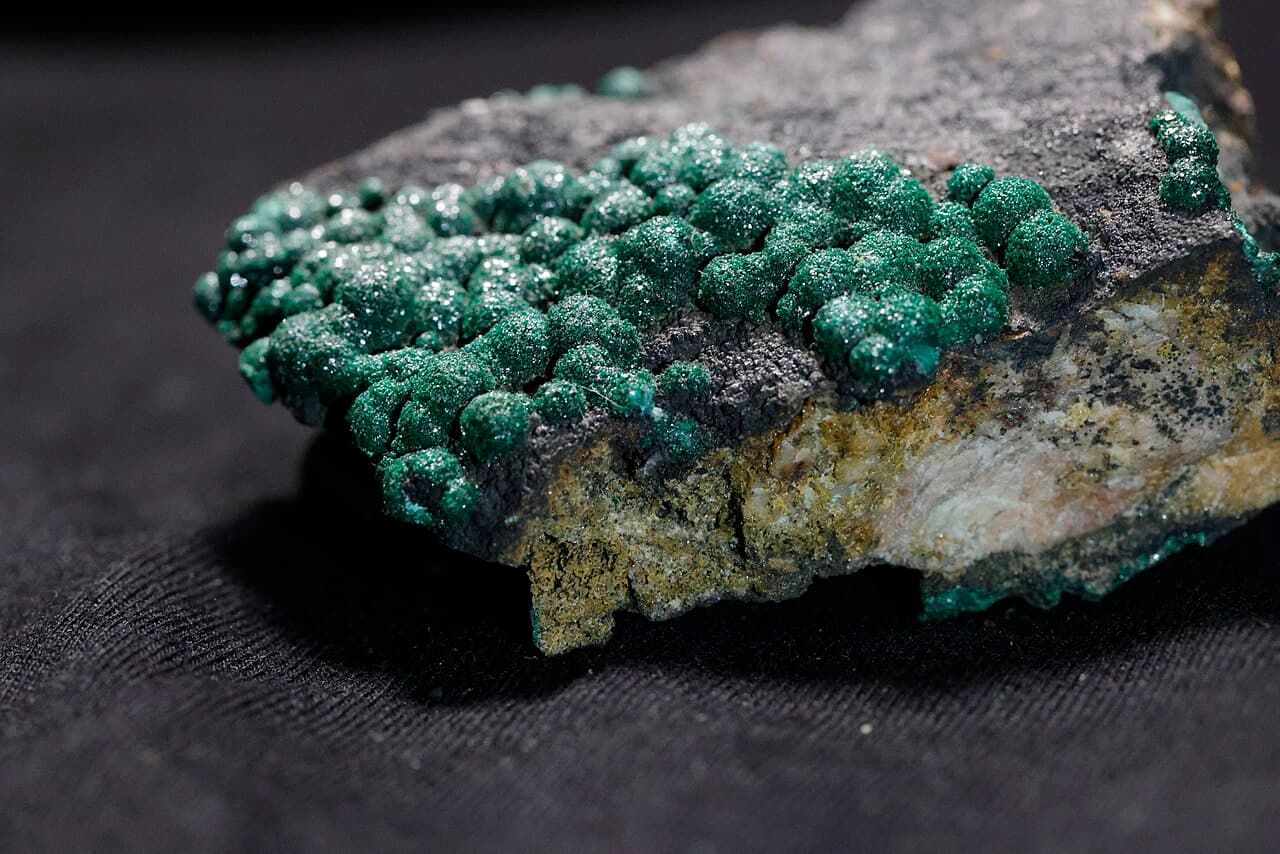
Malachite is a bright green copper carbonate mineral, with the formula Cu₂CO₃(OH)₂ (a basic, or hydrated, copper carbonate). It forms in the upper, oxidized zones of copper ore deposits, where copper-bearing solutions react with carbonate rock such as limestone. Because copper is the coloring agent rather than a trace impurity, malachite's green is intense and consistent — there is no pale or colorless variety the way there is with quartz.
What makes malachite instantly recognizable is its banding: concentric rings, swirls, and bullseye patterns in alternating light and dark green. These bands form as the mineral is deposited in layers inside cavities and over rounded (botryoidal) surfaces, so a cut and polished slab looks like contour lines on a map. It is a relatively soft, dense, opaque stone that takes a brilliant polish, which is why it has been carved into ornaments, boxes, and inlay for thousands of years.
Malachite at a glance
- Classification
- Mineral — basic copper carbonate (carbonate class)
- Composition
- Cu₂CO₃(OH)₂ (hydrated copper carbonate)
- Hardness
- 3.5–4 (Mohs)
- Luster
- Silky to dull when massive; adamantine to vitreous on crystals
- Streak
- Light/pale green
- Colors
- Bright green to dark green, almost always banded in concentric layers
- Crystal system
- Monoclinic (usually massive, botryoidal or fibrous — distinct crystals are rare)
- Transparency
- Opaque (rarely translucent in thin slivers)
How to identify malachite
The single most diagnostic feature of malachite is its concentric banding in shades of green — light-and-dark rings, swirls, or eye patterns running through an opaque stone. No other common green mineral reproduces this layered, contour-line look. Combined with a noticeably heavy feel for its size (it is dense, with a specific gravity around 3.6–4.0), the banding alone identifies most specimens.
Two physical tests confirm it. First, malachite is soft: at Mohs 3.5–4 a steel knife or nail scratches it easily, which rules out the much harder green quartz, jade, and green glass. Second, as a carbonate it effervesces (fizzes) in dilute hydrochloric acid, and even a drop of vinegar may produce slow, fine bubbling on a fresh surface — a behavior no silicate look-alike shares. A streak test gives a pale green powder. Run the acid test only on an inconspicuous spot, since it etches the surface.
In the field, malachite often occurs alongside deep-blue azurite (a closely related copper carbonate), and the two are frequently intergrown in the same specimen. A green stone speckled or banded with patches of vivid blue is a strong indicator of the malachite–azurite pair forming in a weathered copper deposit.
Colors and varieties
Malachite is essentially always green — the question is only the shade and pattern. Bands range from a pale, almost minty green through grass green to a deep blackish forest green, and it is the interleaving of these tones that produces the prized target or bullseye figuring. Velvety, fibrous masses can show a soft sheen called silky or 'plush' malachite when light catches the needle-like crystals.
Several natural associations are commonly sold under combined names. Malachite intergrown with blue azurite is marketed as azurite-malachite or azurmalachite. Malachite blended with blue-green chrysocolla and other copper minerals appears in mixed copper-silicate stones. These are genuine mineral combinations, not treatments — but the names tell you the stone is a mixture rather than pure malachite.
Meaning and properties
In crystal-healing and metaphysical traditions, malachite is often called a 'stone of transformation' and is associated with protection, emotional release, and the heart chakra because of its green color. Some practitioners use it as a symbolic guard against negativity or to mark periods of personal change.
These associations are spiritual and cultural beliefs, not scientifically established medical effects. Malachite should never be relied on to treat, cure, or prevent any physical or mental health condition; for medical concerns, consult a qualified healthcare professional. This caution matters more than usual with malachite because it is a copper mineral and genuinely toxic if mishandled — see the safety guidance in the care section below.
What malachite is used for
Historically, malachite has been a decorative and lapidary stone above all. Its rich banding and high polish made it a favorite for carved boxes, vases, jewelry, beads, cabochons, and stone inlay; on a larger scale it was used for veneer on columns and tabletops in grand interiors. Powdered malachite was also one of the oldest green pigments used in painting and cosmetics, valued for its vivid color.
As an ore, malachite is a source of copper, though today it is more often collected and carved than smelted. It remains popular with mineral collectors for its display specimens — botryoidal 'grape-cluster' crusts and stalactitic forms with concentric eyes are especially sought after.
Value: what malachite is worth
Malachite is generally an affordable to moderately priced stone. Tumbled pieces, beads, and small polished slabs are inexpensive and widely available, while larger carvings and fine specimens command more. Value rises with the quality and contrast of the banding: bold, well-defined concentric eyes and bullseye patterns are more desirable than muddy or uniformly dark material.
Natural display specimens — intact botryoidal crusts, stalactites, or pieces with crisp azurite intergrowths — are prized by collectors and priced above ordinary lapidary rough. As always, condition matters: because malachite is soft, chips, scratches, and dull spots reduce value.
Real vs. fake malachite
Imitation malachite is common because the banded green look is easy to mimic. Most fakes are dyed or molded polymer, resin, or reconstituted stone (crushed mineral powder set in binder). Real malachite is cool to the touch, noticeably dense and heavy, and slightly soft (a steel pin or knife scratches it, leaving a pale green mark). Plastic imitations feel warm and light, and a hot-pin test on a hidden spot may produce an acrid plastic smell.
The pattern is the best tell. Natural malachite banding is irregular and organic — rings vary in width, drift, and never repeat perfectly. Printed or molded fakes often show patterns that are too uniform, repeat across multiple beads, or have a painted-on look under magnification. A confirming check is the acid test: genuine malachite fizzes in dilute acid (a carbonate reaction), while plastic and most reconstituted imitations do not. Use acid only on a tiny hidden area.
Care and safety
Malachite is delicate. At Mohs 3.5–4 it scratches easily, so store it apart from harder stones and keep jewelry away from knocks and abrasion. It is also sensitive to chemicals and heat: avoid acids, ammonia, and harsh cleaners, and don't expose it to ultrasonic or steam cleaners, which can damage the surface or shatter banded pieces. Clean only with a soft, dry or barely damp cloth, and avoid prolonged soaking.
Safety is a real concern with malachite because it is a copper-bearing mineral. The polished surface is stable to handle, but the dust is toxic — never cut, grind, sand, or carve it dry. Lapidary work must be done wet, with proper ventilation and dust protection, to avoid inhaling copper-laden particles. For the same reason, do NOT make malachite elixirs, gem waters, or anything ingested, and wash your hands after handling rough or broken pieces. Keep it away from children who might mouth it.
Malachite look-alikes
Frequently asked questions
What is malachite?
Malachite is a bright green copper carbonate mineral (Cu₂CO₃(OH)₂) that forms in the weathered, oxidized zones of copper ore deposits. It is best known for its concentric green banding and has been carved and polished as a decorative stone for thousands of years.
How can I tell if malachite is real?
Genuine malachite is dense and cool to the touch, slightly soft (a steel pin scratches it, leaving a pale green streak), and shows irregular, non-repeating concentric banding. It also fizzes in dilute acid because it is a carbonate. Plastic or resin imitations feel light and warm, often show repeating or printed-looking patterns, and do not effervesce. Test acid only on a hidden spot.
Is malachite toxic or safe to handle?
A polished, intact piece is safe to hold and wear. The danger is the dust: because malachite contains copper, cutting, grinding, or sanding it dry releases toxic particles, so lapidary work must be done wet with dust protection. Do not make malachite elixirs or ingest it in any form, and wash your hands after handling rough material.
What is malachite used for?
Malachite is used chiefly as a decorative and lapidary stone — for carvings, jewelry, beads, inlay, and display specimens — thanks to its vivid banding and high polish. Historically it was also a green pigment and a copper ore. In crystal-healing traditions it is used as a symbolic 'stone of transformation,' though those uses are spiritual rather than medical.
What does malachite symbolize?
Malachite has long been a stone of protection and transformation — ancient Egypt ground it for pigment and eye paint, and Russian tradition treated it as a guardian stone — with modern crystal practice associating it with the heart, change and setting boundaries. These meanings are cultural and spiritual rather than medical. Note that malachite's practical cautions come from its chemistry, not its lore: it is a copper carbonate, so see the question above on handling it safely.
What is azurite-malachite?
Azurite and malachite are closely related copper carbonates that form together in the same oxidized copper deposits, and azurite slowly alters into malachite over geological time — which is why so many specimens show deep blue azurite patches embedded in, or grading into, green malachite. Material sold as 'azurite-malachite' (or azurmalachite) is that natural blue-and-green intergrowth, prized for the contrast. Both minerals are soft and copper-bearing, so handle the mixed material with the same care as malachite alone.
Is yours malachite? Find out from a photo
Photograph your crystal in good light and get an identification with an honest confidence level, the look-alikes to rule out and the at-home tests that confirm it.
Identify my crystal freeOn Android? Get the free rock identifier app
Related
More crystals in the field guide
Keep exploring
More on crystals: the full list of crystal types, how to identify a crystal and crystals by color.
Last updated 2026-07-19. Identification guidance is educational — confirm important results with the diagnostic tests described or a qualified expert.