Rhodochrosite
Also known as: Manganese spar, Raspberry spar, Inca rose, Rosinca
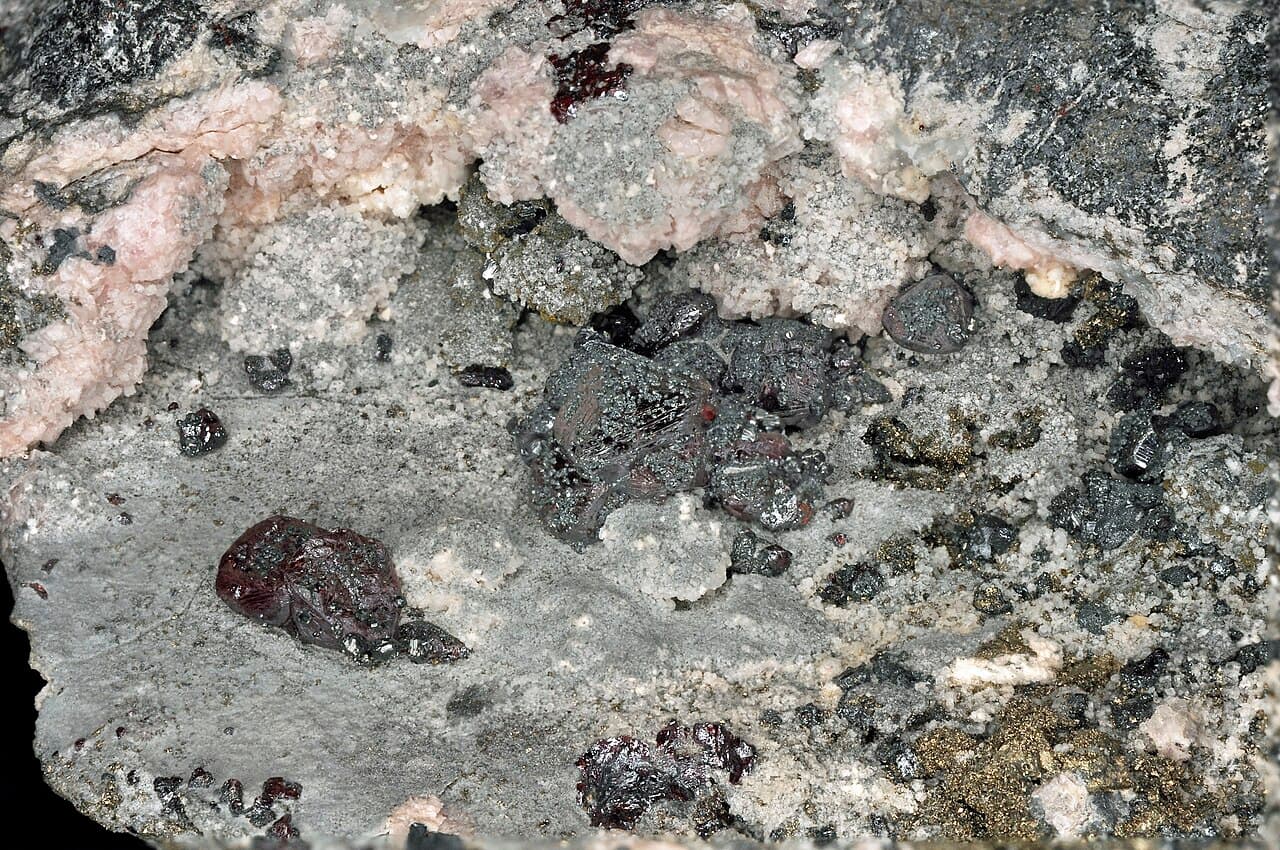
Rhodochrosite is manganese carbonate, with the chemical formula MnCO₃, and it is one of the most recognizable rose-pink minerals in the collecting world. By far the most common form people meet is the banded, layered material: cut slices from stalactites that show concentric rings and ribbons of pink and white, a pattern that earns it the nickname Inca rose. These slices are polished into cabochons, beads, slabs and ornaments, and the soft pink-on-white banding is the signature most people learn to spot first. Much rarer, and far more valuable, are the transparent gem-red crystals — rich, glowing scarlet-to-cherry rhombohedrons that rank among the most prized of all mineral specimens.
Chemically, rhodochrosite belongs to the calcite group of carbonate minerals, and it carries the family's tell-tale traits: it is soft, it has rhombohedral cleavage, and it reacts with acid. The manganese in its makeup is what produces the color, ranging from gentle baby-pink in the banded material to deep raspberry-red in the finest crystals. Because it is so soft — only about 3.5 to 4 on the Mohs scale — rhodochrosite is delicate to wear and easy to scratch, which is part of why so much of it is sold as display pieces and carvings rather than everyday jewelry. That softness, the banding, and the acid reaction together make it fairly straightforward to identify once you know what to look for.
Rhodochrosite at a glance
- Classification
- Mineral — carbonate (calcite group)
- Composition
- MnCO₃
- Hardness
- About 3.5–4 (Mohs)
- Luster
- Vitreous to pearly
- Streak
- White
- Colors
- Rose-pink to raspberry-red, commonly banded with white
- Crystal system
- Trigonal (hexagonal)
- Transparency
- Transparent (rare crystals) to translucent or opaque (banded material)
How to identify it
The most common rhodochrosite is easy to recognize on looks alone: a stone built from curving bands and rings of pink and white, often with a soft, almost candy-striped appearance. This banded material comes from stalactitic growth, so polished slices frequently show concentric circles, like the cross-section of a tree branch, in alternating shades of rose and cream. If you are holding a pink-and-white banded ornamental stone with that layered, ringed look, rhodochrosite should be near the top of your list. The rarer form is completely different — transparent, glassy rhombohedral crystals in a vivid red — but those are uncommon enough that most people will only ever see them in museums or high-end specimens.
Two simple physical tests confirm it. First, hardness: rhodochrosite is soft, only about 3.5 to 4 on the Mohs scale, so a steel knife or even a copper coin will scratch it. Second, the acid test: because it is a carbonate, a drop of warm dilute acid (such as vinegar or weak hydrochloric acid) will make it fizz and release tiny bubbles of carbon dioxide. It also shows rhombohedral cleavage — a tendency to break along smooth, angled flat surfaces — and leaves a white streak. The combination of a pink body, low hardness, an acid reaction and a white streak rules out the harder pink stones it is often confused with.
Colors and varieties
Rhodochrosite's color is driven by its manganese content and spans a wide range of pinks and reds. The banded ornamental material is usually a mix of pale to medium rose pink layered with white, cream or pale gray bands, and some pieces carry hints of orange, peach or brown where other minerals are present. The depth and evenness of the pink, along with the attractiveness of the banding pattern, are what collectors and jewelers look for in this material. Even, well-defined bands and a clean, saturated pink are more desirable than muddy or washed-out tones.
The aristocrats of the species are the transparent crystals, which can reach a glowing raspberry-, cherry- or scarlet-red that is among the most beautiful colors in the mineral kingdom. Sharp, gem-clear rhombohedrons in this rich red — famously from certain world-class deposits — are rare and highly prized. Gem-quality faceted rhodochrosite exists too, but its softness and easy cleavage make it a connoisseur's gemstone rather than a practical one. Across all of these forms, the identifying constants stay the same: the manganese-driven pink-to-red color, a white streak, low hardness, and a carbonate's reaction to acid.
Meaning and properties
In modern crystal-working traditions, rhodochrosite is strongly associated with the heart and with self-love. Its warm rose-pink color naturally links it to the heart chakra in these practices, and people describe it as a stone for compassion, emotional healing, comfort and the gentle working-through of old hurts. It is often kept or carried as a soothing, nurturing stone and is sometimes called the stone of the compassionate heart. These are cultural and spiritual associations that many people find personally meaningful.
It is important to be clear that these meanings are spiritual and traditional rather than scientifically established medical effects. Rhodochrosite is a lovely stone to collect, display and appreciate, but it is not a treatment for any physical or emotional health condition and should never be used in place of advice or care from a qualified medical or mental-health professional. Enjoy it for its color, its banding and its craftsmanship rather than as medicine.
What it's worth
For the banded ornamental material that makes up most of the market, value is driven by color and pattern. A strong, even rose pink with attractive, well-defined banding is more desirable than a pale, muddy or poorly patterned piece, and good polish, translucency and skillful cutting all add to the appeal of cabochons, beads and slices. This material is relatively accessible, which is part of its popularity — it offers a striking pink-and-white look without the price of the rare crystals.
Transparent red crystals are an entirely different proposition. Because sharp, gem-clear rhodochrosite crystals in a rich raspberry-to-scarlet red are genuinely rare, fine crystallized specimens are prized by serious collectors and can be valued far above ordinary banded material. As with any stone, worth comes from the combination of color, clarity, crystal form, size and condition rather than a single figure, and damage matters — because rhodochrosite is soft and cleaves easily, clean, undamaged pieces command a strong premium over scratched, chipped or cleaved ones.
Real vs. fake
Most issues with rhodochrosite are not outright fakes but cases of mistaken identity, because several other pink stones look superficially similar. The most important confusion is with rhodonite, which has a nearly identical rose-pink color but is a completely different mineral — a much harder manganese silicate, typically laced with black manganese-oxide veining rather than the smooth white banding of rhodochrosite. Rose quartz, pink opal and pink (rose) calcite are also confused with it. The reliable separators are hardness and the acid test: rhodochrosite is soft and fizzes in acid, rhodonite is hard and does not react, and quartz is far harder than either.
Genuine fakes and enhancements do appear in the gem and bead trade, so it is worth being alert. Dyed or color-enhanced stones can be passed off as rhodochrosite, and pink glass or resin imitations turn up in cheap beads and tumbled mixes; glass often betrays itself with swirl marks, molded shapes or trapped bubbles, and it lacks rhodochrosite's cleavage and acid reaction. If banding looks painted-on or unnaturally perfect, be cautious. When a high price is involved — especially for transparent red crystals or faceted gems — it is wise to buy from a reputable dealer and, for valuable pieces, to seek professional gemological testing.
Care
Rhodochrosite needs gentle handling because it is genuinely delicate. At only about 3.5 to 4 on the Mohs scale it scratches very easily, and its rhombohedral cleavage means a sharp knock can split it along a flat plane. Store it apart from harder stones and metal so it does not get scuffed, ideally wrapped in soft cloth or in its own padded compartment, and treat any jewelry set with it as occasional-wear rather than everyday pieces. Rings and bracelets are especially vulnerable to bumps and abrasion.
Clean rhodochrosite only with a soft, slightly damp cloth and dry it promptly; avoid prolonged soaking. Critically, because it is a carbonate, keep it away from all acids and acidic cleaners — even mild household products and acidic liquids can etch or dull its surface. Skip ultrasonic and steam cleaners, which can shock it along its cleavage, and avoid harsh chemicals and strong, prolonged sunlight, which may fade some material over time. With careful storage and gentle cleaning, rhodochrosite keeps its soft pink glow for a lifetime.
Rhodochrosite look-alikes
Frequently asked questions
Is rhodochrosite the same as rhodonite?
No — they are different minerals that are easily confused because both are rose-pink. Rhodochrosite is a soft manganese carbonate (Mohs 3.5–4) that fizzes in acid and is often banded pink-and-white. Rhodonite is a much harder manganese silicate (Mohs ~6) that does not react with acid and is usually marked with black veining rather than white banding.
How can I tell if my rhodochrosite is real?
Check three things: hardness, the acid test and the look. Real rhodochrosite is soft enough to be scratched by a steel knife, it fizzes when a drop of weak acid (like vinegar) touches a hidden spot because it is a carbonate, and natural banded material shows soft concentric pink-and-white rings. Glass or resin imitations are harder, won't fizz, and often show bubbles or swirl marks. For valuable transparent red crystals, get professional gemological testing.
Can you wear rhodochrosite as everyday jewelry?
It is best treated as occasional-wear jewelry rather than daily wear. At only 3.5–4 on the Mohs scale it scratches easily, and its cleavage means a hard knock can split it. Pendants and earrings, which take less abuse, are safer than rings or bracelets. Store it separately from harder stones and keep it away from acids and ultrasonic cleaners.
Why is some rhodochrosite cheap and some very expensive?
The common, affordable form is the banded pink-and-white ornamental material cut into cabochons, beads and slices. The expensive form is transparent, gem-clear crystals in a rich raspberry-to-scarlet red, which are genuinely rare and prized by collectors. Color, clarity, crystal form, size and condition all drive the difference, and because the mineral is soft and cleaves easily, undamaged pieces are worth considerably more.
Is yours rhodochrosite? Find out from a photo
Photograph your crystal in good light and get an identification with an honest confidence level, the look-alikes to rule out and the at-home tests that confirm it.
Identify my crystal freeOn Android? Get the free rock identifier app
Related
More crystals in the field guide
Keep exploring
More on crystals: the full list of crystal types, how to identify a crystal and crystals by color.
Last updated 2026-06-25. Identification guidance is educational — confirm important results with the diagnostic tests described or a qualified expert.