Rhodonite
Also known as: Manganese spar
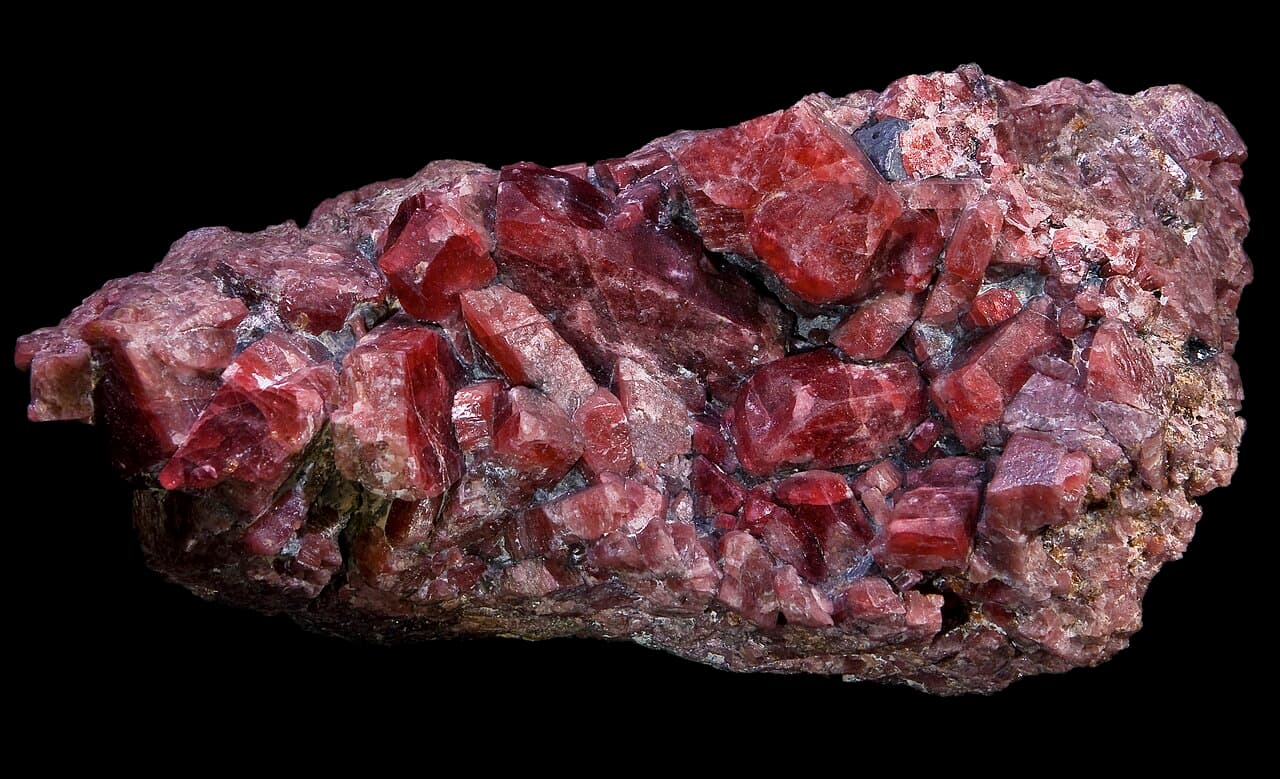
Rhodonite is a manganese silicate mineral, with the general formula (Mn,Fe,Mg,Ca)SiO₃, instantly recognizable for its warm pink-to-rose-red color. Its very name comes from the Greek word for rose. While it can form well-shaped triclinic crystals, those are uncommon and prized by collectors; the rhodonite most people encounter is massive — solid, compact material without obvious crystal faces — that is cut and polished into cabochons, beads and carvings. Its luster is glassy to slightly dull, and it ranges from translucent in the best pieces to fully opaque.
The single most distinctive feature of rhodonite is the way its rose-pink body is laced with networks of black. As the mineral weathers, manganese oxidizes and deposits as black manganese oxide along fractures and grain boundaries, producing the characteristic black veins, dendrites and patches that web across the pink. This pink-with-black-veining pattern is what makes polished rhodonite so easy to recognize and so popular for ornamental use, and it is the first thing to look for when telling rhodonite apart from other pink stones.
Rhodonite at a glance
- Classification
- Mineral — manganese inosilicate (pyroxenoid)
- Composition
- (Mn,Fe,Mg,Ca)SiO₃
- Hardness
- About 5.5–6.5 (Mohs)
- Luster
- Vitreous to slightly pearly or dull
- Streak
- White
- Colors
- Rose-pink to red, typically with black manganese-oxide veining
- Crystal system
- Triclinic
- Transparency
- Translucent to opaque
How to identify rhodonite
The look is the first clue: a rose-pink to red stone, usually massive rather than crystalline, threaded with branching black veins and patches. Those black markings are oxidized manganese that has crept along cracks and grain edges, and the contrast of warm pink against dark, spidery black is rhodonite's signature. The pink can be soft and pale or a deep, almost raspberry red, and the polished surface is glassy with a translucent-to-opaque body. If you are looking at a pink ornamental stone laced with black, rhodonite should be at the top of your list.
Two simple tests separate rhodonite from its closest look-alike, rhodochrosite. First, hardness: rhodonite is fairly hard at about 5.5 to 6.5 on the Mohs scale, hard enough that a steel knife will not scratch it easily, whereas rhodochrosite is much softer at roughly 3.5 to 4 and is scratched readily. Second, rhodonite is a silicate and does not fizz or react in contact with weak acid, while rhodochrosite is a carbonate and effervesces in dilute acid. Combined with the black manganese veining and a white streak, the higher hardness and lack of acid reaction reliably confirm rhodonite.
Color and varieties
Rhodonite's color spans a range of pinks and reds, from gentle, dusty rose to a saturated red that approaches crimson, with the manganese content driving the depth of color. Most material is veined and patched with black manganese oxide, and the amount and pattern of that black varies widely: some pieces show only fine threads, while others are heavily netted or carry broad dark zones. Many specimens also include gray, brown or cream areas where other minerals are mixed in. For ornamental use, an even, strong pink crossed by attractive but not overwhelming black veining is the most appealing combination.
Distinct varieties exist as well. Sharply formed transparent-to-translucent crystals of rhodonite are rare and highly sought after by collectors, in contrast to the abundant massive material. There is also fowlerite, a zinc-bearing rhodonite known from certain deposits. Across all of these, the identifying fundamentals stay constant: the rose-pink to red silicate body, the characteristic black manganese-oxide veining, a white streak, and a hardness high enough to resist a steel point.
Meaning and properties
In modern crystal-working traditions rhodonite is closely tied to the theme of the heart: compassion, emotional healing and the working-through of difficult feelings. Its rose-pink color naturally connects it with the heart chakra in these practices, and it is often described as a stone for forgiveness, reconciliation and self-care, with the black manganese veining sometimes read as a reminder that healing includes the hard parts as well as the tender ones. People keep and carry rhodonite as a comforting, grounding heart stone.
These meanings are cultural and spiritual rather than scientifically established medical effects. Rhodonite is a beautiful stone to collect, wear and appreciate, but it is not a treatment for any physical or emotional health condition and should never replace counseling, medical advice or care from a qualified professional. Enjoy it for its color and craftsmanship, not as medicine.
What rhodonite is worth
For the massive ornamental material that makes up most of the market, value is driven by color and pattern. A strong, even rose-to-red pink is more desirable than a pale or muddy tone, and the black manganese veining is part of the appeal — an attractive, well-distributed web of black against bright pink generally adds to the look, whereas dull gray-brown patches or large blank areas detract. Good translucency, a high polish and skillful cutting all increase the worth of cabochons, beads and carvings.
Well-formed, transparent rhodonite crystals are an entirely different proposition: because sharp crystals are rare, fine crystallized specimens are prized by collectors and valued well above ordinary massive material. As with any stone, worth comes from the combination of color, clarity, pattern, size and workmanship rather than a single number, and condition matters — clean, undamaged, richly colored pieces command a premium over cracked, faded or poorly finished material.
Care
Rhodonite is reasonably durable thanks to its hardness of about 5.5 to 6.5, but it has cleavage and can chip or crack if struck, and the black-veined zones can be slightly weaker. Clean it gently with lukewarm water, a little mild soap and a soft brush or cloth, then rinse and dry it. Avoid harsh chemicals, solvents and cosmetics, and keep rhodonite out of prolonged harsh sunlight, which over time can fade its pink color.
It is safest to avoid ultrasonic and steam cleaners, since vibration or sudden heat can exploit fractures and cleavage and cause damage. Protect rhodonite from knocks and from sudden temperature changes, and store it separately — ideally wrapped in a soft cloth or in its own compartment — so harder stones do not scratch its polished surface. With gentle handling, a polished rhodonite piece will keep its rosy color and luster for many years.
Rhodonite look-alikes
Frequently asked questions
What is the difference between rhodonite and rhodochrosite?
They look alike but behave differently. Rhodonite is a silicate, hard at about 5.5 to 6.5, does not fizz in acid, and is laced with black manganese-oxide veins. Rhodochrosite is a carbonate, much softer at about 3.5 to 4, fizzes in dilute acid, and usually shows banded pink-and-white patterns rather than black veining. Hardness and the acid test separate them reliably.
What causes the black veins in rhodonite?
The black markings are manganese oxide. As rhodonite weathers, some of its manganese oxidizes and is deposited as black manganese oxide along cracks and grain boundaries, creating the branching veins, dendrites and patches that web across the pink. This pink-with-black pattern is one of rhodonite's most reliable identifying features.
Is rhodonite hard enough for jewelry?
Rhodonite is moderately hard at about 5.5 to 6.5 on the Mohs scale, which is durable enough for pendants, earrings and beads. Because it has cleavage and can chip if struck, it is best in protected settings rather than rings that take heavy daily wear, and it should be shielded from hard knocks.
What does rhodonite symbolize?
In crystal-working traditions rhodonite is associated with the heart — compassion, emotional healing and forgiveness — and is linked with the heart chakra because of its rose-pink color. These are cultural and spiritual meanings rather than proven medical effects, so rhodonite should be enjoyed for its beauty and not used as a substitute for professional care.
Is yours rhodonite? Find out from a photo
Photograph your crystal in good light and get an identification with an honest confidence level, the look-alikes to rule out and the at-home tests that confirm it.
Identify my crystal freeOn Android? Get the free rock identifier app
Related
More crystals in the field guide
Keep exploring
More on crystals: the full list of crystal types, how to identify a crystal and crystals by color.
Last updated 2026-06-24. Identification guidance is educational — confirm important results with the diagnostic tests described or a qualified expert.