Vivianite
Also known as: Blue Iron Earth, Blue Ironstone, Mullicite
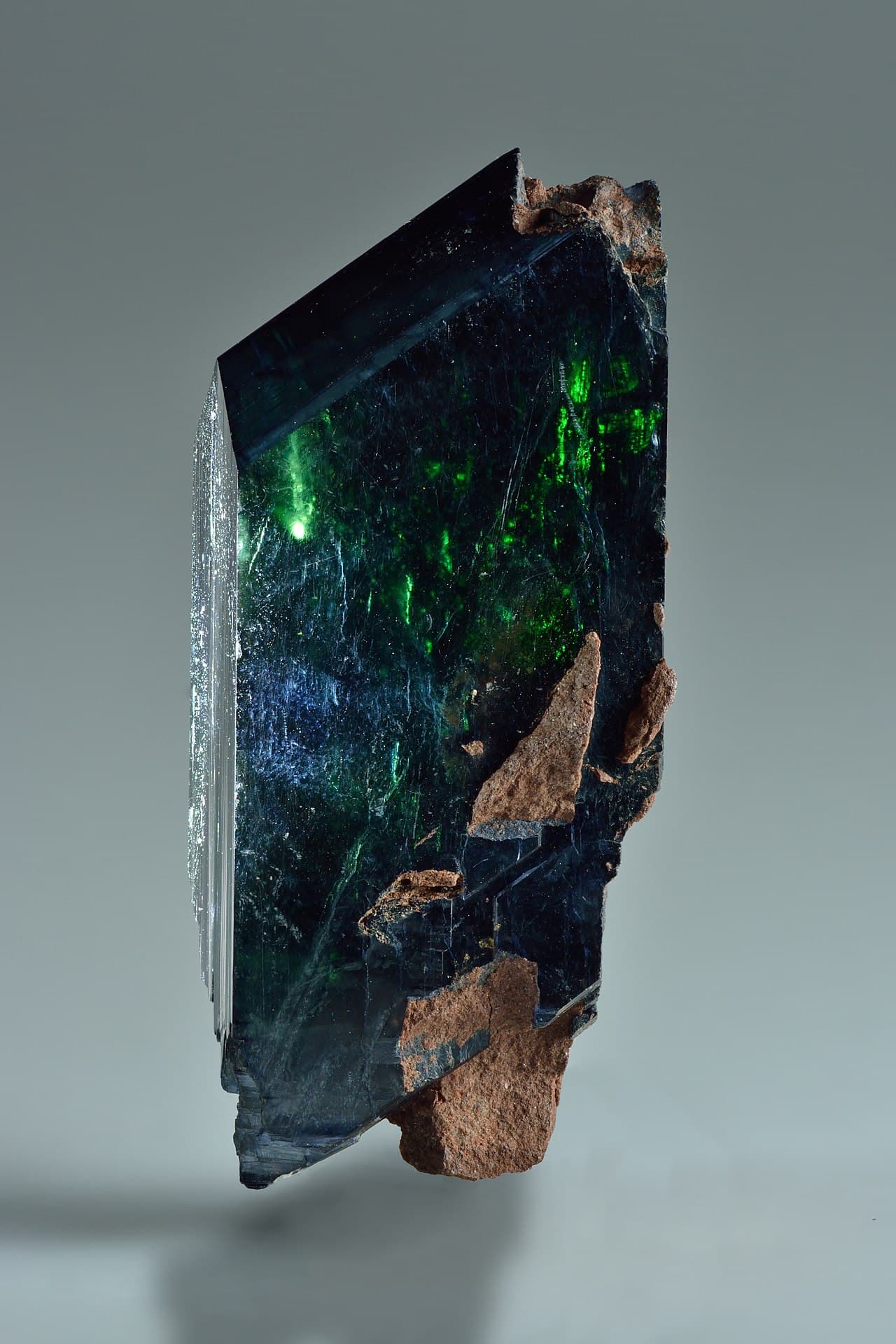
Vivianite is a hydrated iron phosphate mineral famous for a single dramatic trick: it changes color before your eyes over time. Freshly exposed or freshly mined crystals are often nearly colorless, pale green, or a faint bluish gray, but on contact with light and air the iron inside slowly oxidizes, deepening the mineral to a rich blue, then blue-green, and eventually a dark indigo or near-black. This light-driven color shift is the trait collectors remember most, and it is also the single most important thing to know about caring for a specimen. Vivianite forms in iron-rich, phosphate-rich, oxygen-poor settings such as bog iron deposits, peaty sediments, recent muds, and around buried organic material, which is why it famously turns up as blue crusts on fossil bones, shells, and even archaeological finds.
What makes vivianite genuinely useful to identify is the combination of a very soft, sometimes flexible bladed habit with that telltale deepening blue. It is extremely soft at only about 1.5 to 2 on the Mohs scale, so a fingernail can scratch it, and well-formed crystals appear as elongated blades or prisms that can be split into thin, slightly bendable flakes. Many specimens are not crystalline at all but occur as soft, earthy, deep-blue masses, sometimes called blue iron earth, smeared through clay or coating a fossil. Put those clues together, a soft phosphate that is pale when fresh and darkens to deep blue in the light, growing in swampy iron-rich ground or on old bone, and vivianite becomes a recognizable and rewarding mineral to learn.
Vivianite at a glance
- Classification
- Phosphate mineral (hydrated iron phosphate)
- Composition
- Fe3(PO4)2 · 8H2O
- Hardness
- 1.5 to 2 (Mohs)
- Luster
- Vitreous to pearly on cleavage; dull or earthy when massive
- Streak
- Colorless to pale bluish white, darkening to blue on exposure
- Colors
- Nearly colorless or pale green when fresh, darkening to deep blue, blue-green, then indigo to near-black
- Crystal system
- Monoclinic
- Transparency
- Transparent to translucent in crystals; opaque when earthy
How to identify it
Start with softness, because vivianite is one of the softest minerals you are likely to encounter. At Mohs 1.5 to 2 it is scratched easily by a fingernail, and its bladed crystals have one perfect cleavage that lets thin flakes peel away and even flex slightly without snapping, an unusual and helpful clue. Look at the habit next: classic vivianite occurs as elongated, striated blades or prisms, often radiating or fanning out, while a great deal of material is instead soft and earthy, forming deep-blue powdery masses, crusts, or stains in clay and sediment. The setting matters too. Vivianite forms in wet, oxygen-poor, iron- and phosphate-rich ground, so finding a blue mineral on a fossil bone or shell, in bog iron, or in recent muddy sediment is a strong contextual hint.
The decisive trait is the color behavior. A fresh vivianite surface is often pale, nearly colorless, greenish, or only faintly blue, but on exposure to light it darkens over hours, days, and years to a deep blue, blue-green, and ultimately indigo or near-black. If you have a specimen that is much darker on its exposed faces than where it has been freshly broken, that progressive darkening points firmly to vivianite. No single test is conclusive alone, but extreme softness, flexible bladed cleavage, the swampy or fossil-associated setting, and a blue that deepens with light together make a confident identification, and they cleanly separate vivianite from harder blue minerals that hold a stable color.
Colors and varieties
Vivianite's color is really a sequence rather than a fixed shade. When first exposed, crystals can be almost colorless, pale apple-green, or a soft bluish gray, and many specimens look surprisingly pale in the moment they are uncovered. Exposure to light then drives the iron from a reduced to a more oxidized state, and the mineral marches through a deepening blue, into blue-green and teal tones, and finally toward a very dark indigo or blackish blue. This is why two pieces from the same find can look quite different depending on how long each has been out of the ground and in the light, and why old museum specimens are often far darker than freshly collected ones.
The main varietal distinction is between well-formed crystals and the earthy form. Crystalline vivianite shows glassy to pearly bladed prisms, sometimes in striking radiating sprays, prized by collectors for both color and form. The earthy variety, historically called blue iron earth, is a soft, deep-blue powdery or claylike material that coats and replaces organic matter, including the blue staining frequently seen on fossil bones, teeth, shells, and on buried wood or even old metal. Because color in vivianite is unstable and tied to exposure rather than to a stable chromophore in a hard lattice, color alone is never a safe identifier, so always pair the blue with the extreme softness, the flexible cleavage flakes, and the iron-and-phosphate setting before settling on a name.
Meaning and properties
In crystal-lore and metaphysical traditions, vivianite's deep, slowly emerging blue is often associated in those practices with calm reflection, emotional insight, and a sense of transformation, partly because the stone so visibly changes over time. Some collectors keep it simply as a conversation piece that embodies change. These associations are cultural, spiritual, and personal rather than scientific, and vivianite should not be relied upon to diagnose, treat, or cure any physical or emotional condition. It is not a substitute for professional medical or mental-health care, and anyone with a health concern should consult a qualified professional.
There is also a practical note that matters more than any folklore: vivianite is extremely soft and light-sensitive, which makes it a poor choice for jewelry or for anything that puts it in water or sunlight. It contains iron and phosphate and should be treated as a display and study specimen, not as something to wear all day, make into elixirs, or taste. Because the earthy form is a fine blue powder, avoid inhaling its dust and wash your hands after handling crumbly pieces. Enjoy vivianite for its remarkable, evolving color and its scientific story rather than for any claimed physical benefit.
Value and what affects price
Vivianite's value is driven mostly by crystal quality, size, color depth, and how well the fragile blades have survived intact. Sharp, lustrous, well-formed crystals and dramatic radiating sprays in a strong, even blue are far more desirable than dull earthy material or pale, partly altered pieces. Large, undamaged crystals are genuinely difficult to recover and preserve because the mineral is so soft and cleaves so easily, which adds to the appeal of fine specimens. Earthy blue masses, blue-stained clay, and fossils merely coated with vivianite are common and inexpensive, though a striking blue crust on an attractive fossil can carry value as a curiosity in its own right.
Condition and stability have an outsized effect here. Because vivianite is light-sensitive and continues to darken over time, a specimen's appearance is not permanent, and crystals stored in light can deepen toward near-black or grow patchy, which collectors weigh carefully. Cracks, crumbling edges, and cleavage damage all lower value, while crisp blades, good luster, and a rich but not overdarkened blue raise it. As always, judge a piece on its actual crystal form, color, luster, and condition rather than on a name or label, and remember that part of what you are buying is a mineral that will keep changing if it is not stored in the dark.
Real vs. fake: avoiding misidentification
Vivianite is more often honestly misidentified than deliberately faked, because its dramatic blue invites confusion with other blue minerals rather than with imitations. Outright fakes such as dyed or resin-bound blue material are possible but uncommon; the bigger risk is mislabeling. The single most useful authenticity check is the combination of extreme softness and the color-change behavior: real vivianite is so soft a fingernail scratches it, splits into thin flexible cleavage flakes, and shows exposed faces noticeably darker than fresh breaks because it deepens with light. A blue stone that resists a fingernail, refuses to split into bendable flakes, or holds a perfectly stable color is almost certainly not vivianite.
Use the setting and a couple of simple tests to confirm. Genuine vivianite turns up in iron- and phosphate-rich, oxygen-poor places, frequently as blue staining on fossil bone, teeth, shells, or buried wood, so context supports the identification. Unlike carbonate copper minerals such as azurite, vivianite does not fizz in ordinary acid, which helps separate it from blue carbonates. If a specimen pairs a soft, flaky blue mineral with fossil or swampy material and shows that progressive darkening, it is very likely the real thing; if it is hard, color-stable, and fizzes in acid, look elsewhere.
Care and cleaning
Vivianite is one of the more demanding minerals to store, and good care starts with keeping it in the dark. Because light drives its color from pale to deep blue and eventually toward near-black, the best way to preserve a specimen's appearance is to keep it out of sunlight and bright display lighting, ideally in a closed drawer or a box, and to bring it into light only briefly. Handle it as little as possible, since at Mohs 1.5 to 2 it scratches with a fingernail and its blades chip and cleave with the slightest pressure. Support delicate crystals on padding and keep them well away from harder minerals that could abrade them.
Clean vivianite only with the gentlest methods, a soft dry brush or, at most, a barely damp touch, and avoid soaking it, since it is a hydrated mineral and prolonged water exposure can damage it. Never use acids, ultrasonic cleaners, heat, or harsh chemicals, all of which can ruin a specimen. Keep storage conditions cool and stable, avoid drying it out or exposing it to swings in humidity, and watch for any flaking or color change as a sign it needs gentler handling. With patient, low-light, hands-off care, vivianite holds its striking blue and crisp bladed form far longer than a piece left exposed on a sunny shelf.
Vivianite look-alikes
Frequently asked questions
Why does vivianite change color over time?
Vivianite contains iron, and when it is freshly exposed much of that iron is in a reduced state, leaving crystals nearly colorless, pale green, or only faintly blue. On contact with light and air the iron gradually oxidizes, and the mineral deepens through blue and blue-green to a dark indigo or near-black. This light-driven oxidation is normal and progressive, which is why exposed faces look much darker than fresh breaks and why older specimens are generally darker than newly collected ones.
How can I tell vivianite from other blue minerals?
Lean on its softness and its color behavior. Vivianite is so soft a fingernail scratches it (Mohs 1.5 to 2) and its bladed crystals split into thin, slightly flexible flakes, which most blue minerals will not do. It also darkens with light exposure rather than holding a fixed color, and unlike blue copper carbonates such as azurite it does not fizz in acid. A soft, flaky blue mineral that deepens in the light, often on a fossil or in swampy iron-rich ground, is very likely vivianite.
Why is vivianite often found on fossils and bones?
Vivianite forms in wet, oxygen-poor settings that are rich in iron and phosphate, and decaying organic material like bone, teeth, and shell supplies exactly the phosphate it needs. As groundwater carries iron and phosphate through buried organics in bogs, peat, and recent sediments, vivianite crystallizes as blue crusts and stains directly on the fossil. That is why blue vivianite coatings are a familiar sight on fossil bone and on archaeological finds.
Can vivianite be used in jewelry?
It is a poor choice for jewelry. At Mohs 1.5 to 2 vivianite is extremely soft and scratches and chips with the slightest wear, and it is light-sensitive, so it darkens and can degrade with sun and display lighting. It is also a hydrated mineral that water can damage. For these reasons vivianite is best kept as a protected display or study specimen, stored away from light, rather than worn or set in rings or pendants.
Is yours vivianite? Find out from a photo
Photograph your mineral in good light and get an identification with an honest confidence level, the look-alikes to rule out and the at-home tests that confirm it.
Identify my mineral freeOn Android? Get the free rock identifier app
Related
More minerals in the field guide
Keep exploring
More on minerals: how to identify a mineral, the streak test and the full list of crystal types.
Last updated 2026-06-25. Identification guidance is educational — confirm important results with the diagnostic tests described or a qualified expert.