Wulfenite
Also known as: Yellow lead ore, Lead molybdate
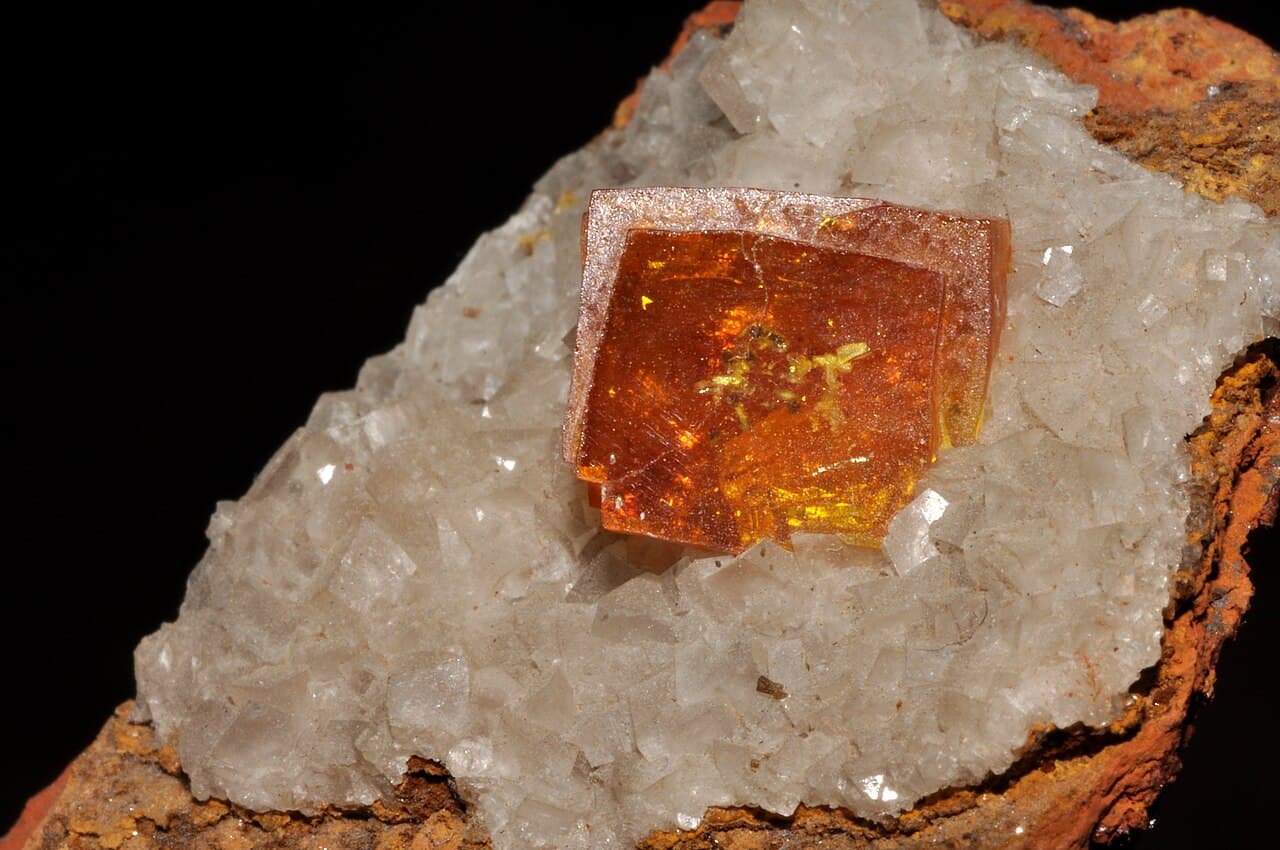
Wulfenite is a lead molybdate (PbMoO₄) and one of the most instantly recognizable minerals in any collection: thin, flat, square tabular crystals that look like vivid little tiles, glowing in intense orange, yellow, and — most prized of all — deep red. The crystals catch the light with a brilliant adamantine-to-resinous luster, almost like stained glass, and the best of them are so flat and platy that a cluster can resemble a scatter of square wafers perched on rock. Arizona's legendary Red Cloud Mine produced the saturated, blood-red wulfenite that is the benchmark every collector measures the species against.
Beyond its beauty, wulfenite is a minor ore of molybdenum and forms in the oxidized, weathered zones of lead deposits, where lead minerals react with molybdenum-bearing solutions — which is why it so often turns up alongside other colorful secondary lead minerals like vanadinite, mimetite, and cerussite. It is named after Franz Xaver von Wulfen, an 18th-century Austrian mineralogist and Jesuit. One feature governs how it should be handled: wulfenite contains lead. It is perfectly safe to own and display, but specimens should be handled minimally, never licked or ingested, and you should always wash your hands afterward — a routine precaution that applies to all lead-bearing minerals.
Wulfenite at a glance
- Classification
- Mineral — lead molybdate (the wulfenite group of molybdates)
- Composition
- PbMoO₄
- Hardness
- 2.5–3 (Mohs)
- Luster
- Adamantine (brilliant) to resinous
- Streak
- White to pale yellow
- Colors
- Vivid orange, yellow, and red; also brown, gray, olive, and rarely colorless
- Crystal system
- Tetragonal
- Transparency
- Transparent to translucent
- Magnetic
- Not magnetic
How to identify it
Wulfenite is one of the easier minerals to recognize once you know its calling card: thin, flat, square tabular crystals — essentially little four-sided plates or tiles — in glowing orange, yellow, or red, often perched flat-on or edge-on across a rock surface. That square, platy crystal shape (a product of its tetragonal symmetry) combined with the vivid color and a brilliant adamantine-to-resinous luster is usually enough to name it on sight. Where it occurs is another clue: wulfenite is a secondary lead mineral from oxidized ore zones, so it commonly sits among other colorful lead minerals such as vanadinite, mimetite, and cerussite.
Two physical properties confirm it. Wulfenite is soft — just 2.5 to 3 on the Mohs scale — so it is easily scratched by a steel knife and even by a copper coin, and it feels distinctly heavy for its size because of its lead content (high specific gravity, around 6.5 to 7). A bright square tabular crystal that is soft, heavy, and intensely orange-to-red is almost certainly wulfenite. The key visual separator from its nearest look-alike, vanadinite, is crystal shape: wulfenite forms square (four-sided) tablets, while vanadinite forms hexagonal (six-sided) prisms and barrels.
Colors and varieties
Color is wulfenite's whole appeal. The most familiar shades are bright orange and golden yellow, but the species ranges from pale honey and lemon through orange to brown, olive, and gray, and — the crown jewel — a deep, saturated red. The red and orange-red material, colored by trace chromium, is the most coveted, and the Red Cloud Mine in Arizona is famous worldwide for producing thick, intensely red, well-formed crystals that set the standard for the species. Whatever the color, the diagnostic combination holds: square tabular crystals, a brilliant adamantine luster, a soft hardness, and real heft.
Wulfenite's signature variety distinction is really about crystal habit. Most celebrated are the razor-thin, flat square plates that look like translucent wafers, but it also forms thicker blocky tablets, steep pyramidal crystals, and drusy crusts of tiny bright crystals coating rock. Collectors prize sharp, lustrous, undamaged crystals with strong color and good transparency; the thin-plate Arizona reds and the brilliant orange clusters from Mexican localities are among the most sought-after. Dull, pale, or broken material is far more common and far less valued.
Meaning and properties
In contemporary crystal-working circles wulfenite is sometimes described as an energizing, creativity-sparking stone linked to motivation and vitality, with its fiery orange-red color taken as a symbol of warmth and drive. These associations come from folklore and personal practice, not from any measurable physical effect of the mineral, and wulfenite's documented importance is scientific — as a striking specimen species and a minor molybdenum ore — rather than metaphysical.
A safety note is especially important here because wulfenite contains lead. It is fine to own, display, and admire, but it should be handled minimally, never licked, ground, or ingested, and you should always wash your hands after touching raw specimens. For the same reason it should never be used to make "crystal-infused" water or worn against the skin in any way that risks contact and abrasion. And like any mineral, wulfenite is something to appreciate and study — not a remedy for any physical or mental health condition and no substitute for advice from a qualified professional.
Value
Wulfenite's worth lies almost entirely in its appeal as a specimen rather than as an ore; although it is a source of molybdenum, it is too scarce to matter much industrially. Collector value is driven by color, crystal quality, and locality: deep-red and intense orange-red crystals are the most prized, especially sharp, lustrous, transparent plates, and material from celebrated localities — above all the rich reds of Arizona's Red Cloud Mine — commands a strong premium. Size, the perfection and gloss of the crystals, and an undamaged matrix all add to desirability, while pale, dull, or chipped pieces are common and modestly priced.
Wulfenite is essentially never used as a wearable gemstone. At just 2.5 to 3 on the Mohs scale it is far too soft and fragile to survive everyday wear, and its thin, brittle crystals chip and cleave easily, so any faceted wulfenite is a delicate collector curiosity rather than jewelry. As with all minerals, value depends on the interplay of color, crystal sharpness, transparency, size, condition, and locality rather than any single fixed figure, and a vivid, undamaged, well-formed crystal commands far more than dull or broken material.
Real vs. fake
Wulfenite is rarely faked with synthetics, so the real questions are honest identification — chiefly telling it from similar colorful lead minerals — and watching for repaired or color-enhanced specimens. The most common mix-up is with vanadinite, and the cleanest separator is crystal shape: wulfenite forms square (four-sided) tabular plates, while vanadinite forms hexagonal (six-sided) prisms and barrels. Both are soft, heavy, and brightly colored, but that difference in symmetry is decisive. Crocoite, another red-orange lead mineral, instead forms slender prismatic needles rather than flat squares.
Confirm a specimen with simple checks. Genuine wulfenite is soft (scratched by a knife at 2.5 to 3), heavy for its size because of its lead content, gives a white-to-pale-yellow streak, and shows a brilliant adamantine luster on those characteristic square tablets. Because top color and perfect crystals carry a premium, inspect prized pieces for hidden damage: look for glued-back crystals, filled chips, or color that looks painted or pools unnaturally. As always, weigh price against quality — a suspiciously cheap "Red Cloud red" deserves a careful second look.
Care
Wulfenite is among the more fragile minerals to keep, so handle it sparingly and gently. At 2.5 to 3 on the Mohs scale its thin, platy crystals scratch, chip, and snap with very little force, so never store it loose against harder minerals, always support a specimen by its matrix rather than the crystals, and keep it where it cannot be knocked. Some wulfenite also fades in prolonged strong light, so keep prized colored pieces out of harsh, direct sunlight.
Clean wulfenite as little as possible and never aggressively. Light dusting with a soft, dry brush is safest; avoid soaking, harsh chemicals, and acids, and never use ultrasonic or steam cleaners, whose vibration and heat will fracture the delicate crystals. Because wulfenite contains lead, treat it as a handle-minimally specimen: wash your hands after touching raw material, keep it away from food and out of the reach of children and pets, and do not breathe any dust if a piece is damaged. Store it separately, cushioned in soft material or its own padded compartment.
Wulfenite look-alikes
Frequently asked questions
How do I tell wulfenite from vanadinite?
Both are soft, heavy, brightly red-orange lead minerals that often grow side by side, so they are easy to confuse — but their crystal shapes are different. Wulfenite forms thin, flat, square (four-sided) tabular crystals, like little tiles, while vanadinite forms hexagonal (six-sided) prisms and barrels. The quickest test is simply to look at the shape of a crystal's cross-section: four sides means wulfenite, six sides means vanadinite.
Is wulfenite dangerous because it contains lead?
Wulfenite is safe to own and display, but because it is a lead molybdate you should handle it sensibly. Don't lick, grind, or ingest it, avoid breathing any dust if a piece breaks, keep it away from food and out of reach of children and pets, and wash your hands after handling raw specimens. Solid, intact crystals on a shelf pose no hazard — the precautions are about avoiding ingestion and inhalation of lead-bearing material.
Why is red wulfenite so valuable?
Color and locality drive it. Deep, saturated red wulfenite — colored by trace chromium — is far scarcer than the common yellow and orange, and the thick, lustrous red crystals from Arizona's legendary Red Cloud Mine are the benchmark every collector measures the species against. Sharp, transparent, undamaged crystals with strong red color from a celebrated locality command a clear premium over pale or broken material.
Can wulfenite be made into jewelry?
Not practically. At just 2.5 to 3 on the Mohs scale, wulfenite is extremely soft, and its thin, platy crystals are brittle and chip easily, so it cannot withstand the scratching and knocks of everyday wear. Any faceted wulfenite is a fragile collector's curiosity kept in a cabinet, not a wearable gem. Its lead content is a further reason to keep it off the skin and simply enjoy it as a display specimen.
Is yours wulfenite? Find out from a photo
Photograph your mineral in good light and get an identification with an honest confidence level, the look-alikes to rule out and the at-home tests that confirm it.
Identify my mineral freeOn Android? Get the free rock identifier app
Related
More minerals in the field guide
Keep exploring
More on minerals: how to identify a mineral, the streak test and the full list of crystal types.
Last updated 2026-06-25. Identification guidance is educational — confirm important results with the diagnostic tests described or a qualified expert.