Barite
Also known as: Baryte, Heavy spar, Barytine
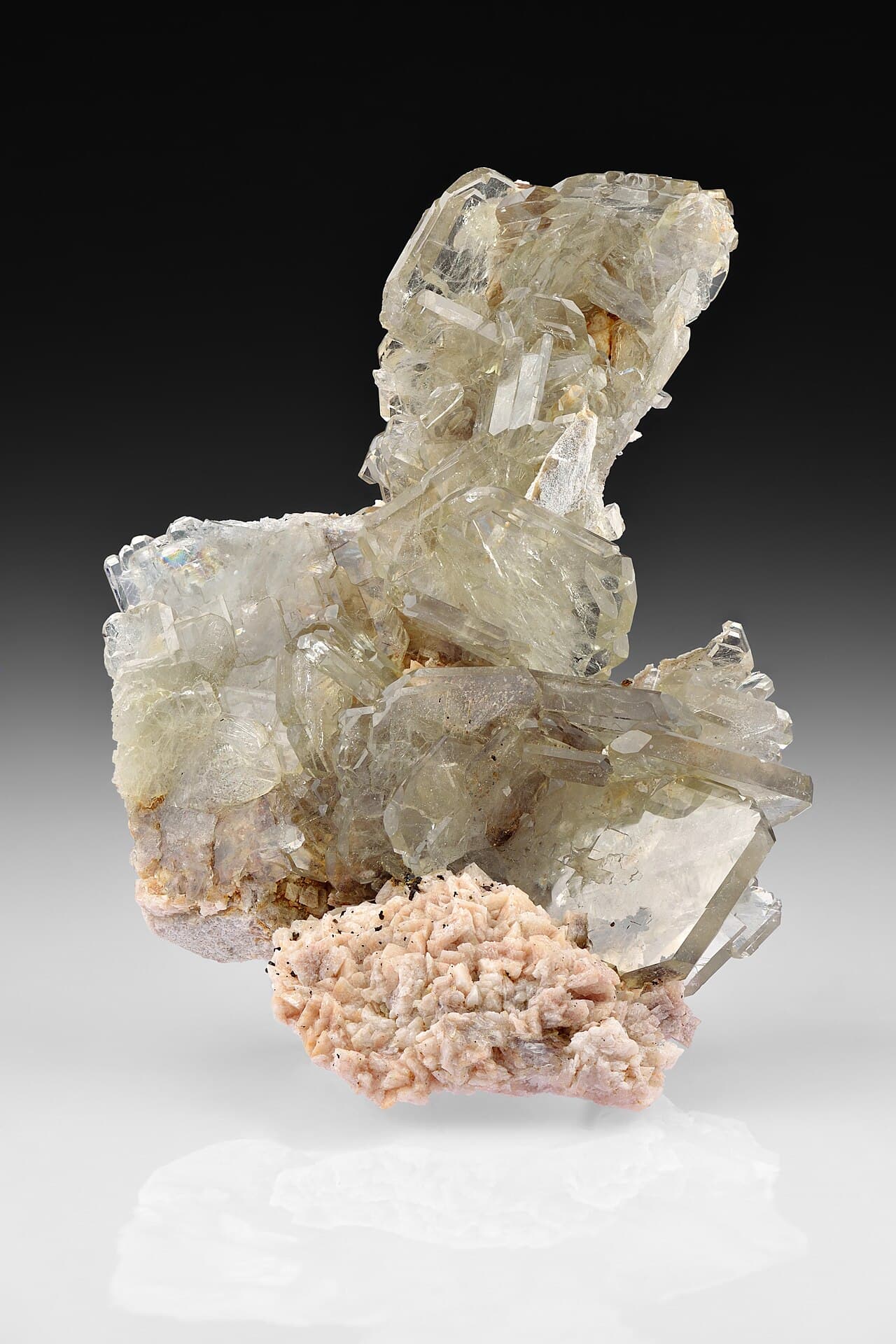
Barite, also spelled baryte, is barium sulfate (BaSO₄) and is the principal ore of the element barium. To the eye it is an unremarkable mineral — usually white, gray, pale blue, yellow, or tan, with a glassy to pearly luster — but in the hand it gives itself away instantly: it is astonishingly heavy. That density is so characteristic that barite has carried the old miner's name "heavy spar" for centuries, and weight is the single most useful clue for telling it apart from the many pale, soft minerals it otherwise resembles. It is only moderately hard, 3 to 3.5 on the Mohs scale, soft enough to scratch with a knife or even a copper coin, yet it feels far heavier than that softness would lead you to expect.
Barite crystallizes most often as tabular or bladed crystals, frequently stacked into book-like or cockscomb groups, and it forms the well-known "desert rose" — flat, petal-shaped crystals clustered into a rosette, sometimes with sand grains caught between the blades. It is a common gangue mineral in hydrothermal veins alongside ores of lead, zinc, and silver, and it also occurs in sedimentary rocks and around hot springs. Far from being only a collector's curiosity, barite is an industrial workhorse: its high density makes it the standard weighting agent in the drilling muds used to drill oil and gas wells, and it serves as a filler in paints, paper, and rubber and as a barium source in glass and medicine.
Barite at a glance
- Classification
- Mineral — barium sulfate (the barite group of sulfates)
- Composition
- BaSO₄
- Hardness
- 3–3.5 (Mohs)
- Luster
- Vitreous (glassy) to pearly or resinous
- Streak
- White
- Colors
- Commonly white, colorless, gray; also pale blue, yellow, brown, and reddish from impurities
- Crystal system
- Orthorhombic
- Transparency
- Transparent to translucent, often opaque in massive form
- Magnetic
- Not magnetic
How to identify it
The first and most reliable test for barite is to pick it up. Because barium is a heavy element, barite has a notably high specific gravity — roughly 4.5, well above ordinary pale minerals like quartz, calcite, gypsum, or feldspar — so a fist-sized piece feels surprisingly dense, almost metallic in heft, even though it is a dull, non-metallic, light-colored mineral. That unexpected weight, the property behind the name "heavy spar," is the most diagnostic clue in the field and the quickest way to separate barite from look-alikes that are otherwise similar in color and luster.
Two further checks tighten the identification. Hardness: barite is soft at 3 to 3.5 on the Mohs scale, so a steel knife scratches it easily and it does not scratch glass — anything that is both very heavy and easily scratched is a strong candidate for barite. Crystal habit and reaction round it out: look for flat, tabular or bladed crystals, often in stacked plates, cockscomb groups, or the petal-like "desert rose," and remember that barite gives a white streak and does not fizz in dilute acid, which separates it from carbonates such as calcite. A pale, glassy-to-pearly, knife-soft mineral that feels far too heavy for its size is almost always barite.
Colors and varieties
Pure barite is colorless or white, and white to pale gray is by far the most common appearance. Trace impurities and inclusions, however, give it a range of soft colors: pale to sky blue, honey to golden yellow, amber, brown, and occasionally reddish or pinkish tones where iron oxides are present. Some specimens are water-clear and transparent, while massive or earthy material is opaque and chalky. Whatever the color, the luster is glassy to pearly, and the diagnostic high density and low hardness stay the same.
Barite is best known by its distinctive growth forms rather than by color varieties. The celebrated "desert rose" is a rosette of flat, bladed crystals that grows in sandy, arid sediments, often with sand grains enclosed between the petals; the same rosette habit also occurs in gypsum, so weight is the deciding test between the two. Other common varieties include bladed and tabular crystal groups, cockscomb aggregates, fibrous and stalactitic masses around springs, and a fine-grained sedimentary form sometimes called "barite rosettes" or "cone-in-cone" rock. Collectors also prize the blue barite of certain localities and golden, gemmy crystals, though barite is far too soft and fragile to be a practical gemstone.
Meaning and properties
In contemporary crystal-working circles barite is sometimes described as a grounding, focusing stone and is associated with clarity of thought, motivation, and inner stillness, with its weight taken as a symbol of being settled and anchored. These ideas come from folklore and personal practice, not from any measurable physical effect of the mineral, and barite's real significance is overwhelmingly scientific and industrial rather than metaphysical.
An important safety note sets barite apart from many display minerals. Although barite itself (barium sulfate) is highly insoluble and is the same compound used safely as the "barium meal" contrast agent in medical X-rays, soluble barium compounds are toxic. Barite specimens are fine to own and handle, but you should never grind, lick, or ingest the mineral, and you should wash your hands after handling raw material. As with any mineral, barite is something to appreciate, study, and collect — not a treatment for any physical or mental health condition, and no substitute for advice from a qualified professional.
Value
Most barite is valued not as a specimen but as an industrial commodity, sold by the ton as drilling-mud weighting agent and as filler; in that market chemical purity and density matter far more than appearance. Collector value, by contrast, follows the usual specimen factors: well-formed, lustrous crystals, attractive color, good size, and an undamaged crystal group all raise desirability. Sharp blue crystals, gemmy golden tabular crystals, and clean, symmetrical desert roses are the most sought-after, while dull, chipped, or massive pieces are common and inexpensive.
Barite is essentially never cut as a wearable gemstone: at 3 to 3.5 on the Mohs scale, with good cleavage and brittleness, it is far too soft and fragile to survive everyday wear, so any faceted barite is a fragile collector curiosity rather than jewelry. As with all minerals, worth depends on the interplay of crystal quality, color, size, locality, and condition rather than any single figure, and intact, well-crystallized specimens command a clear premium over broken or earthy material.
Real vs. fake
Barite is rarely faked with synthetics, so the real challenge is honest identification rather than forgery — chiefly telling true barite from the pale, soft minerals it resembles, and spotting the occasional dyed specimen sold for stronger color. The mineral's own properties make verification straightforward. Genuine barite is heavy out of all proportion to its size because of its high specific gravity, and that single heft test rules out most impostors: quartz, calcite, gypsum, and feldspar all feel distinctly lighter for the same volume.
Confirm with a few simple checks. Barite is soft at 3 to 3.5, so it is scratched by a knife and will not scratch glass; it gives a white streak; and, being a sulfate, it does not effervesce in dilute acid the way calcite and other carbonates do. Where access and care allow, the classic laboratory confirmation is the flame test: barite's barium colors a flame pale yellow-green, which neatly separates it from its close relative celestite, whose strontium burns crimson red. With strongly colored "desert roses" or vivid blue clusters, watch for dye pooled between crystal blades or color that rubs off, signs the natural color has been enhanced.
Care
Barite needs gentle handling because it is both soft and brittle. At 3 to 3.5 on the Mohs scale with good cleavage, its tabular crystals and the fragile petals of a desert rose chip and cleave easily, so never store barite loose against harder minerals and always support delicate clusters by the base rather than the blades. Some barite also fluoresces and a few specimens slowly fade in strong light, so keep prized colored pieces out of harsh, direct sunlight.
Clean barite sparingly. Light dusting with a soft brush is safest; if a piece is dirty, a quick wipe with a barely damp cloth followed by prompt drying is usually enough. Avoid prolonged soaking and harsh chemicals — and be especially careful with sandy desert roses, which can crumble or trap grit when wet — and never use ultrasonic or steam cleaners, whose vibration and heat can split the stone along its cleavage. Store barite separately, cushioned in a soft cloth or its own padded compartment, and wash your hands after handling raw material as a routine precaution.
Barite look-alikes
Frequently asked questions
Why does barite feel so heavy, and is that the best way to identify it?
Yes — heft is barite's single most useful field clue. Barite is barium sulfate, and because barium is a heavy element the mineral has a high specific gravity of about 4.5, well above pale look-alikes like quartz, calcite, and gypsum. A piece of barite feels surprisingly heavy for its size, which is exactly why miners nicknamed it "heavy spar." Combine that weight with its softness (it is scratched by a knife) and a white streak to confirm it.
What is the difference between barite and celestite?
Barite (barium sulfate) and celestite (strontium sulfate) belong to the same sulfate group and look nearly identical, so they are easy to confuse. Two tests separate them: barite is even denser and feels heavier than celestite of the same size, and in a flame barite's barium burns pale yellow-green while celestite's strontium burns crimson red. Both are soft, tabular, pale minerals with a white streak.
Is barite safe to handle, and is it the same barium used in medical X-rays?
Solid barite specimens are safe to own and handle. Barite is barium sulfate, the same highly insoluble compound used as the "barium meal" swallowed for X-ray imaging, and its insolubility is what makes it safe in that use. However, soluble barium compounds are toxic, so you should never grind, lick, or swallow the mineral, and it is good practice to wash your hands after handling raw material.
What is barite used for?
Barite's biggest use comes straight from its high density: it is the standard weighting agent added to the drilling muds used to drill oil and gas wells, where its weight helps control downhole pressure. It is also used as a filler in paints, paper, plastics, and rubber, as a source of barium for glass and chemicals, and — as medical-grade barium sulfate — as a contrast agent in X-ray imaging.
Is yours barite? Find out from a photo
Photograph your mineral in good light and get an identification with an honest confidence level, the look-alikes to rule out and the at-home tests that confirm it.
Identify my mineral freeOn Android? Get the free rock identifier app
Related
More minerals in the field guide
Keep exploring
More on minerals: how to identify a mineral, the streak test and the full list of crystal types.
Last updated 2026-06-25. Identification guidance is educational — confirm important results with the diagnostic tests described or a qualified expert.