Vanadinite
Also known as: Lead vanadate
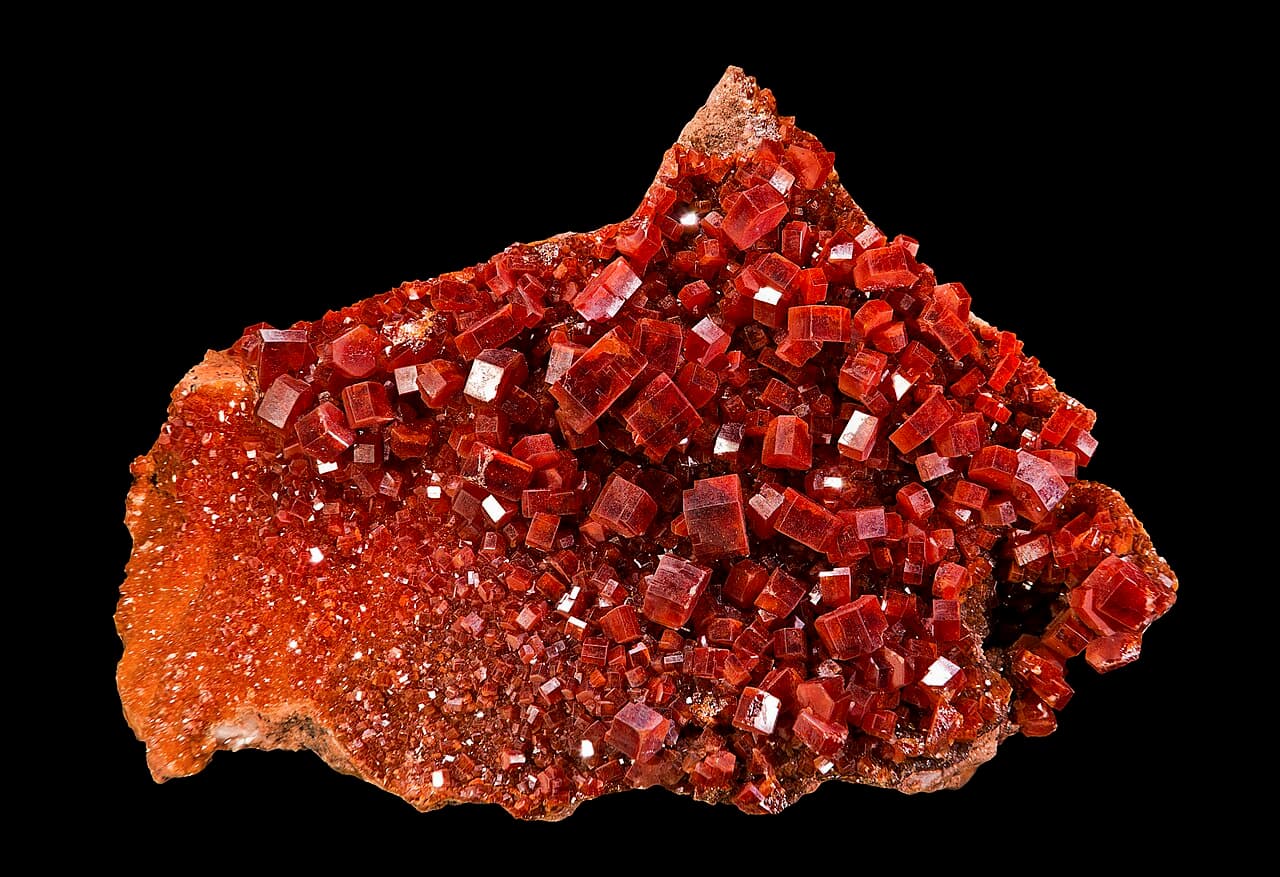
Vanadinite is one of the most photogenic minerals a collector can own: clusters of glassy, bright red to fiery orange hexagonal crystals, often perched like tiny barrels on a contrasting bed of white or tan barite. Chemically it is a lead vanadate with the formula Pb₅(VO₄)₃Cl, which immediately tells you two things—it is dense and heavy because of its lead content, and it is an important ore, mined both for vanadium (a metal used to harden steel) and for lead. The finest specimens come from the deserts of Morocco and the American Southwest, especially Arizona, where oxidizing lead deposits gave the mineral the conditions it needs to form.
Because it is a secondary mineral that forms in the weathered, oxidized upper zones of lead ore bodies, vanadinite is prized far more as a display piece than as a working gem; it is too soft and brittle for jewelry. Collectors chase it for the saturated color, the crisp hexagonal habit, and the dramatic way the crystals sit on matrix. One caution colors everything about handling it: vanadinite contains a great deal of lead, so it should be handled minimally, never ground or have its dust inhaled, and you should always wash your hands after touching it.
Vanadinite at a glance
- Classification
- Vanadate mineral (apatite group); lead vanadate
- Composition
- Pb₅(VO₄)₃Cl
- Hardness
- 3–4
- Luster
- Resinous to subadamantine (greasy-bright to nearly gemmy)
- Streak
- White to pale yellow or brownish yellow
- Colors
- Bright red, orange-red, orange, brown, yellow, occasionally near-colorless
- Crystal system
- Hexagonal
- Transparency
- Transparent to translucent to nearly opaque
How to identify it
Vanadinite is usually easy to recognize from a short list of features. Look first for color and habit: vivid red to orange, sharp hexagonal prisms—often short and barrel-like, sometimes hollow or tubular at the ends—that frequently grow as clusters on matrix. The crystals have a resinous to nearly adamantine luster that can look almost gemmy, and they feel noticeably heavy for their size because of the lead, with a specific gravity of roughly 6.8 to 7.1. A hardness of only 3 to 4 means they scratch easily, and the streak is white to a pale yellowish or brownish tint. Matrix is a strong clue too: classic Moroccan and Arizona specimens often sit on white-to-tan barite or on iron-stained rock.
A critical safety note belongs in identification itself: vanadinite is a lead mineral, so never test it by scraping a powdered streak you might inhale, and never grind, saw, or sand it. Handle specimens as little as possible, keep them away from food and drink, and wash your hands afterward. The minerals most often confused with vanadinite are wulfenite, mimetite, pyromorphite, and crocoite—see the look-alikes section—but its combination of bright red-orange color, hexagonal form, great density, and low hardness is distinctive once you have handled a few pieces.
Colors and varieties
The colors collectors prize most are the deep, saturated reds and the glowing red-oranges; these come largely from the vanadium in the structure. The same species also occurs in softer oranges, browns, yellows, and occasionally near-colorless to gray crystals, depending on the exact chemistry and the trace elements present. The brightest red Moroccan crystals on white barite are the classic "poster" look of the species, while Arizona localities are famous for both rich red and more brownish-orange forms.
Vanadinite belongs to the apatite group and forms a chemical series with two close relatives that swap which element fills part of the structure: when arsenic substitutes for vanadium the mineral grades toward mimetite, and when phosphorus does so it grades toward pyromorphite. An arsenic-bearing variety has historically been called "endlichite," sitting compositionally between vanadinite and mimetite. These relationships are exactly why the look-alikes below can be so hard to separate by eye—they are genuinely close chemical cousins.
Meaning and properties
Vanadinite is first and foremost a collector's and ore mineral, not a traditional metaphysical stone, and its lead content means it is not handled, worn, or used the way tumbled crystals are. In the small amount of crystal lore that mentions it, vanadinite is loosely associated with energy, focus, and grounding—ideas tied poetically to its dense, fiery appearance—but these are matters of belief, not science, and the mineral's toxicity makes the usual crystal-healing practices inappropriate for it. There are no proven medical or therapeutic effects, and nothing here should be taken as medical advice; enjoy vanadinite as a specimen behind glass rather than as a stone to carry or place on the body.
Value and price
Among collectors, vanadinite value is driven by color, crystal size and sharpness, luster, and the quality of the matrix arrangement. The most sought-after pieces show deep, even red crystals with bright resinous-to-adamantine faces, well-formed hexagonal terminations, and an attractive, undamaged perch on contrasting barite or host rock. Larger, thicker crystals are scarcer than the common thin platy or small barrel crystals and are valued accordingly, and aesthetic "specimen" qualities—balance, contrast, and lack of chips—matter as much as raw size.
Locality also influences desirability, with fine Moroccan clusters and historic Arizona pieces being especially collectible. Because vanadinite is an opaque, soft mineral rather than a faceted gem, it is sold as mineral specimens rather than by carat, and condition is everything—damage and dulled luster reduce value sharply. Prices vary widely with quality and the market, so buy from reputable mineral dealers who disclose the locality and any repairs or stabilization.
Real vs. fake
Outright fakes of vanadinite are uncommon, but two honest-mistake pitfalls are frequent: confusing it with its look-alike relatives (wulfenite, mimetite, pyromorphite, and crocoite), and buying specimens that have been enhanced or repaired without disclosure. Genuine vanadinite gives itself away through the combination of bright red-orange color, well-formed hexagonal crystals, a resinous luster, very high density from the lead, and a low hardness of 3 to 4. If a "vanadinite" feels light, is much harder than a knife can scratch, or forms square tabular plates rather than hexagonal prisms, treat the identification with suspicion.
Watch also for cosmetic tricks on specimens: artificial coloring, oiling or waxing to fake luster, and crystals glued back onto matrix. A magnifier helps spot glue lines, color that pools in crevices, and broken-and-rejoined contacts. Because vanadinite is genuinely abundant from classic localities, you rarely need to overpay or accept doubtful material—favor dealers who state the source and disclose any treatment or restoration, and remember that the safest way to examine any suspected piece is to handle it minimally and wash your hands afterward.
Care and cleaning
Vanadinite needs careful, hands-off treatment for two reasons: it is soft and brittle (hardness 3 to 4, so it scratches and chips easily), and it contains lead. Keep specimens in a stable display case away from dust, abrasion, and bumps, and handle them by the matrix rather than the crystals whenever possible. Avoid prolonged bright sunlight for some material, and never use ultrasonic cleaners, which can shatter the fragile crystals.
Most important is the safety side of care. Do not wash vanadinite under running water as a routine habit, and absolutely never sand, grind, saw, or otherwise create dust from it, because the dust contains lead and must not be inhaled or ingested. If a specimen needs dusting, use a soft, dry brush gently and do it away from food-preparation areas, then wash your hands thoroughly afterward. Keep vanadinite well out of reach of children and pets, and store it separately from softer and harder minerals alike to prevent mutual damage.
Vanadinite look-alikes
Frequently asked questions
Is vanadinite dangerous to handle?
Vanadinite contains a large amount of lead, so it should be handled with care and respect. It is safe to display and to pick up occasionally, but you should handle it minimally, never grind, saw, or sand it, and never create or inhale its dust. Keep it away from food and drink, store it out of reach of children and pets, and always wash your hands after touching it.
What is vanadinite used for?
Beyond being a popular display mineral for collectors, vanadinite is an important ore. It is mined as a source of vanadium, a metal mainly used to strengthen and harden steel alloys, and it also yields lead. Its bright crystals make it one of the most recognizable secondary minerals in oxidized lead deposits.
Why is vanadinite so heavy?
Vanadinite is dense because its structure is packed with lead, an exceptionally heavy element. Its specific gravity is roughly 6.8 to 7.1, far higher than common minerals like quartz, so even a small specimen feels surprisingly weighty in the hand—one of the quick clues that helps identify it.
How can I tell vanadinite from wulfenite?
Both can be brilliant orange to red, so rely on crystal shape. Vanadinite forms six-sided hexagonal prisms and short barrel shapes, while wulfenite forms thin, square to rectangular tabular plates. They are also different mineral classes—vanadinite is a lead vanadate and wulfenite is a lead molybdate—so when shape is ambiguous, the habit and locality usually settle it.
Is yours vanadinite? Find out from a photo
Photograph your mineral in good light and get an identification with an honest confidence level, the look-alikes to rule out and the at-home tests that confirm it.
Identify my mineral freeOn Android? Get the free rock identifier app
Related
More minerals in the field guide
Keep exploring
More on minerals: how to identify a mineral, the streak test and the full list of crystal types.
Last updated 2026-06-25. Identification guidance is educational — confirm important results with the diagnostic tests described or a qualified expert.