Kyanite
Also known as: Disthene, Cyanite
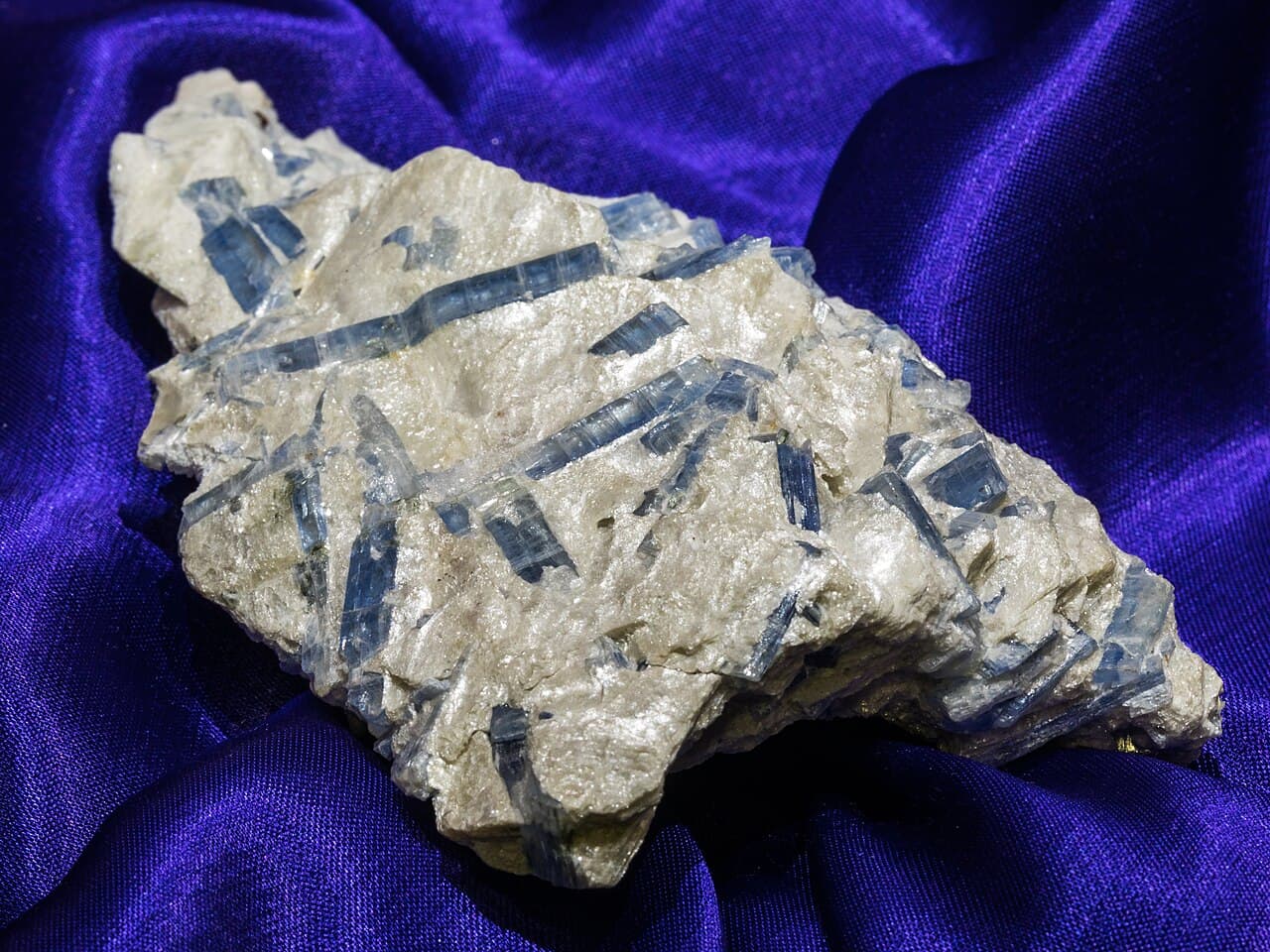
Kyanite is an aluminosilicate mineral, with the formula Al₂SiO₅, best known for the cool, sky-to-sapphire blue of its long, flattened crystals. It forms in metamorphic rocks created under high pressure, such as schists and gneisses, and almost always grows as thin, blade-like crystals — long, flat splinters that often fan out or splay across the host rock. The blades are frequently marked with fine lengthwise striations, and they can be pale at the edges and a deeper blue down the center, giving a single crystal an uneven, watercolor-like color. Its luster ranges from glassy (vitreous) on fresh faces to a soft, silky pearliness along cleavage surfaces.
What sets kyanite apart from nearly every other mineral is that its hardness changes depending on which direction you scratch it. This property, called anisotropism, is so distinctive that the old name for the mineral, "disthene," comes from Greek words meaning "two strengths." Along the length of a blade kyanite is fairly soft, roughly 4 to 5 on the Mohs scale, soft enough to be scratched by a steel point; but measured across the blade it is much harder, around 6 to 7. No common look-alike behaves this way, which makes the directional hardness, combined with the bladed habit, the single most reliable way to recognize kyanite in the field.
Kyanite at a glance
- Classification
- Mineral — aluminosilicate (nesosilicate), a polymorph of Al₂SiO₅
- Composition
- Al₂SiO₅
- Hardness
- Directional: about 4–5 along the blade, 6–7 across it (Mohs)
- Luster
- Vitreous to pearly (pearly to silky along cleavage)
- Streak
- White
- Colors
- Most often blue; also green, black, gray, white and colorless
- Crystal system
- Triclinic
- Transparency
- Transparent to translucent
How to identify kyanite
Start with the shape. Kyanite almost always forms long, flat, blade-like crystals — think of thin slats or splinters rather than chunky or rounded grains — and these blades often grow in splayed or fan-shaped groups embedded in a silvery metamorphic rock. The faces are commonly streaked with fine parallel striations running the length of the blade, and the color is frequently patchy, with paler edges and a stronger blue core. The classic appearance is a glassy, blue, slightly translucent blade with one or two clearly flat, easily split surfaces (kyanite has good cleavage in the long direction).
The decisive test is kyanite's directional hardness, the feature behind its old name "disthene." Try scratching gently along the length of a blade with a steel knife point or pin: it will mark fairly easily, behaving like a mineral of hardness 4 to 5. Then try scratching across the blade, at right angles to its length: here it resists, behaving more like hardness 6 to 7. A mineral that is noticeably softer one way and harder the other, in the same blue blade, is almost certainly kyanite — no common blue mineral shares this two-strengths behavior. A white streak and the bladed, splayed habit confirm it.
Color and varieties
Blue is by far the most familiar and sought-after color of kyanite, ranging from a pale, watery sky blue to a rich, sapphire-like blue, and the color is often distributed unevenly within a single crystal — deeper down the center of a blade and fading toward the edges. This patchiness, together with fine striations, gives gem and specimen kyanite a characteristic streaky look. The blue is caused chiefly by traces of iron and titanium within the aluminosilicate structure.
Kyanite is not only blue, however. Green kyanite, colored by traces of other elements, has become increasingly recognized, and the mineral also occurs in black, gray, white and fully colorless forms. Orange kyanite, owing its color to manganese, is known from a few localities and is comparatively rare. Whatever the color, the identifying features stay the same: the flattened bladed habit, the lengthwise striations, the white streak, and above all the directional hardness that distinguishes kyanite from similarly colored stones.
Meaning and properties
In modern crystal-working traditions kyanite is strongly associated with alignment, clear communication and calm. Its straight, blade-like crystals and serene blue color have led many people to link it with the throat and third-eye chakras, and to use it as a meditation and focus stone meant to help "line things up" and quiet mental noise. Blue kyanite in particular is often described as a stone of self-expression and honest speech. One belief repeated throughout crystal lore is unusual: kyanite is said to be a stone that "never needs cleansing" or recharging, supposedly not holding onto negative energy the way other crystals are thought to.
It is important to be clear that these are cultural and spiritual associations, not scientifically established medical effects. Kyanite is a rewarding mineral to collect, study and appreciate for its striking form and color, but it is not a treatment for any physical or mental health condition and should never replace advice or care from a qualified professional.
What kyanite is worth
For mineral specimens, value tends to follow the quality of the crystals: well-formed, undamaged blades with strong, even blue color and good luster, ideally splayed attractively across an interesting matrix, are the most prized. Color saturation matters a great deal — a deep, vivid sapphire-blue is worth more than a pale or grayish piece — as do crystal size, transparency and freedom from chips along the soft cleavage direction. Green kyanite and the rarer orange material can attract collector interest of their own.
Faceted gem kyanite exists and can be beautiful, but it is challenging to cut precisely because of the directional hardness and easy cleavage, which keeps fine cut stones relatively uncommon and rewards skilled lapidary work. As with all gemstones, value depends on the interplay of color, clarity, cut and size rather than any single figure, and condition is critical: because kyanite splits readily along its length, undamaged blades and clean cut stones command a clear premium over chipped or fractured material.
Care
Kyanite needs careful handling because of its perfect cleavage and its soft direction. Even though it can be hard across the blade, it splits easily along the length and can be scratched lengthwise by ordinary objects, so it should be protected from knocks and from being stored loose against harder gems. For jewelry, kyanite is best suited to protected settings and lower-impact pieces such as pendants and earrings rather than rings that take daily wear.
Clean kyanite gently with lukewarm water, a little mild soap and a soft brush or cloth, then rinse and dry it. Avoid ultrasonic and steam cleaners, which can drive the stone to split along its cleavage, and keep it away from hard knocks and sudden temperature changes. Store kyanite separately, ideally wrapped in a soft cloth or in its own compartment, so its blades are not scratched or cleaved by other specimens.
Kyanite look-alikes
Frequently asked questions
Why does kyanite have two different hardness values?
Kyanite's atomic structure is bonded more strongly across its blades than along their length, so it resists scratching differently in each direction. Along a blade it behaves like a soft mineral, about 4 to 5 on the Mohs scale, while across the blade it is much harder, around 6 to 7. This two-strengths behavior is the origin of its old name "disthene" and is the best single clue for identifying it.
How can I tell kyanite from sapphire?
Hardness and shape settle it. Sapphire is hardness 9 and cannot be scratched by a steel point in any direction, whereas kyanite scratches easily along the length of its blade. Sapphire also forms stubby barrel-shaped crystals, while kyanite grows as long, flat, often striated blades that frequently splay out across the rock.
What color is kyanite usually?
Kyanite is most often blue, anywhere from a pale sky blue to a deep sapphire blue, and the color is commonly uneven within a single crystal — stronger down the center of a blade and paler at the edges. It also occurs in green, black, gray, white and colorless forms, with rarer orange material colored by manganese.
Does kyanite really never need cleansing?
That is a belief from crystal lore, which holds that kyanite does not hold onto negative energy and so does not need cleansing or recharging like other crystals. It is a cultural and spiritual idea rather than a scientific fact, and it does not give the stone any proven physical or medical effect.
Is yours kyanite? Find out from a photo
Photograph your crystal in good light and get an identification with an honest confidence level, the look-alikes to rule out and the at-home tests that confirm it.
Identify my crystal freeOn Android? Get the free rock identifier app
Related
More crystals in the field guide
Keep exploring
More on crystals: the full list of crystal types, how to identify a crystal and crystals by color.
Last updated 2026-06-24. Identification guidance is educational — confirm important results with the diagnostic tests described or a qualified expert.