Lapis Lazuli
Also known as: Lapis, Lazward
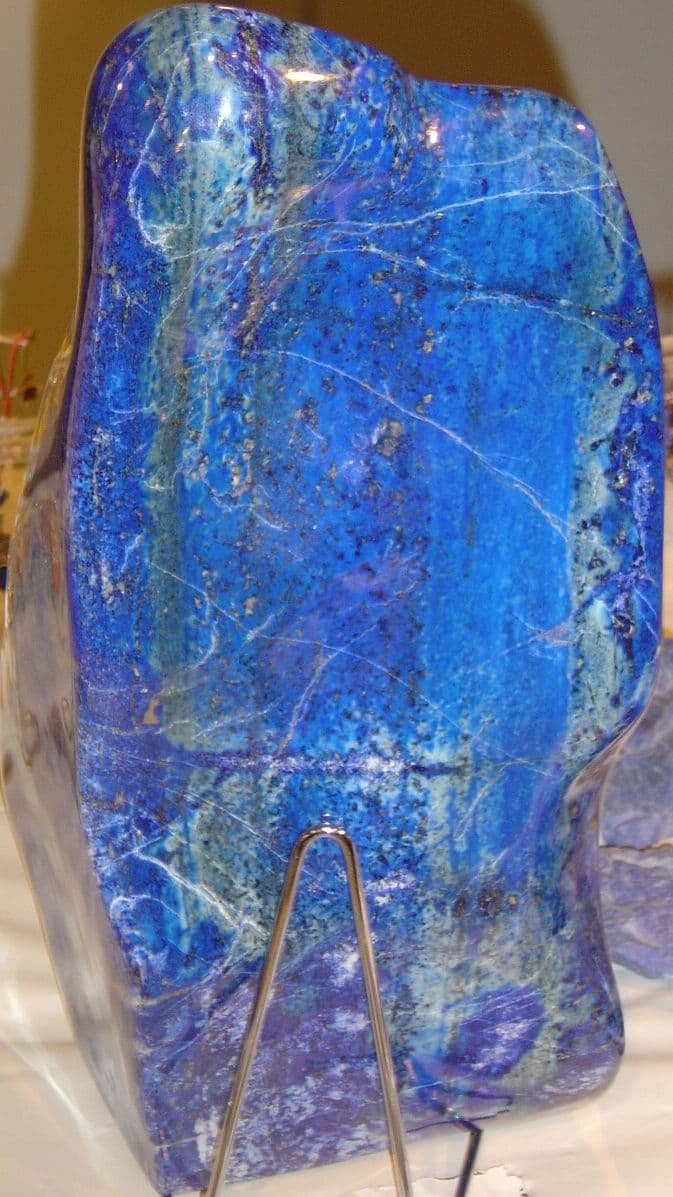
Lapis lazuli is the deep ultramarine-blue stone that has been prized for ornament, carving and pigment since antiquity. Despite often being grouped with crystals and gemstones, lapis lazuli is technically a rock rather than a single mineral: it is an aggregate of several minerals locked together. Its rich blue comes from lazurite, the dominant blue mineral, while the white streaks and patches are calcite and the brassy golden specks scattered through it are pyrite. That combination — saturated blue, white veining and metallic gold flecks — is what gives lapis its unmistakable look and makes it one of the easier blue stones to recognize by eye.
The stone has an extraordinarily long history. Ground into powder, the finest lapis was the source of "ultramarine," the most expensive blue pigment of the medieval and Renaissance world, reserved for the robes of important figures in paintings. Carved into beads, seals, inlay and amulets, it appears in artifacts from some of the earliest civilizations. Today lapis is still cut into cabochons, beads and ornamental objects, valued above all for the depth and evenness of its blue.
Lapis Lazuli at a glance
- Classification
- Rock (metamorphic) — an aggregate of lazurite, calcite and pyrite, not a single mineral
- Rock type
- Metamorphic
- Composition
- Mainly lazurite, (Na,Ca)₈(AlSiO₄)₆(S,SO₄,Cl)₂, with calcite and pyrite
- Hardness
- About 5–5.5 (Mohs)
- Luster
- Dull to vitreous; pyrite flecks are metallic
- Streak
- Light blue
- Colors
- Deep ultramarine to violet-blue, with white calcite and gold pyrite
- Crystal system
- Aggregate (lazurite component is cubic / isometric)
- Transparency
- Opaque
How to identify lapis lazuli
The single most reliable clue is the combination of features rather than any one of them. Look for a deeply saturated, slightly violet ultramarine blue, sprinkled with small brassy-gold specks of pyrite and broken up by irregular white or grayish veins and patches of calcite. The pyrite flecks are diagnostic: they are genuinely metallic, catching the light like tiny flecks of gold, and they sit within the blue rather than on the surface. The white calcite typically appears as cloudy streaks or marbling. A stone that is uniformly, flawlessly blue with no pyrite and no white is more likely to be sodalite or a dyed imitation than fine lapis.
A few physical checks support the visual ones. Lapis is opaque, so no light passes through it, and it is only moderately hard at about 5 to 5.5 on the Mohs scale — softer than quartz, so a steel knife point can scratch it and it should never scratch glass cleanly. It is a comparatively dense, cool-feeling stone. Because lapis is a rock made of several minerals, its surface is rarely perfectly even in color the way a single dyed mineral would be; the natural interplay of blue lazurite, white calcite and gold pyrite is exactly what distinguishes it.
Color and varieties
The most prized lapis is an intense, even ultramarine to slightly violet blue with a fine, well-distributed dusting of pyrite and little visible calcite. As the proportion of lazurite drops and calcite increases, the stone looks paler, grayer and more mottled, which lowers its quality. Some material carries so much pyrite that it reads almost greenish or heavily speckled, while the very best grades show a velvety, uniform blue. Material has historically been described by trade names tied to its appearance and source, but for identification the key variables are simply the depth of the blue, the amount of white calcite, and how much pyrite is present.
It is worth understanding lapis as a spectrum of these three components. A piece dominated by lazurite is the deep, sought-after blue; one with heavy calcite veining is more affordable and decorative; and one peppered with pyrite has a distinctive starry look that many people enjoy. None of these is "fake" — they are natural variations in the same rock — but they command very different values, which is why describing the blue, the veining and the pyrite accurately matters when identifying or buying a stone.
Meaning and properties
Across many cultures lapis lazuli has been associated with wisdom, truth, insight and royalty. Its deep celestial blue led ancient peoples to link it with the heavens and the divine, and it was set into the regalia and burial ornaments of rulers and priests. In modern crystal-working traditions it is often connected with self-expression, inner truth and the throat and third-eye chakras, and is used as a meditation and focus stone.
These associations are cultural, spiritual and historical rather than scientifically established medical effects. Lapis lazuli is wonderful to collect, wear and appreciate for its heritage and color, but it is not a treatment for any physical or mental health condition and should never replace advice or care from a qualified professional.
Value: what lapis lazuli is worth
Lapis is valued first and foremost on the quality of its blue. The most desirable stones show a deep, even, slightly violet ultramarine with a fine, sparing scatter of pyrite and minimal white calcite; these command a clear premium. Value drops as the blue becomes paler or grayer, as white calcite veining becomes more prominent and patchy, and as the surface looks dull rather than richly colored. Evenly distributed pyrite is generally seen as attractive, while large blank patches of calcite or a washed-out tone reduce desirability.
Most lapis on the market is cut into cabochons, beads and carvings rather than faceted, since it is opaque. Untreated stones with naturally strong color are prized; because dyeing and color enhancement are common in the trade, natural, undyed material of good color carries extra value. Workmanship matters too — a well-cut, well-polished cabochon with good color placement is worth more than rough or poorly finished material of the same grade.
Real vs. fake lapis lazuli
The most common imitations are dyed stones sold under misleading names. Dyed howlite and dyed jasper colored to mimic lapis have historically been marketed as "Swiss lapis" or "German lapis," and these are simply other minerals stained blue, not lapis at all. Dyed and reconstituted (powder-and-binder) lapis also circulates: low-grade lapis can be dyed to deepen pale color or to hide calcite. Tell-tale signs of dye include an unnaturally uniform, flat blue, color that concentrates in cracks and along grain boundaries, and a complete absence of the natural pyrite flecks and calcite veining that real lapis almost always shows.
A few simple checks help. Genuine lapis usually carries at least some metallic pyrite specks and some white calcite; a stone that is perfectly even blue with neither is suspect. Wiping the stone with a cotton swab lightly moistened with acetone or nail-polish remover can lift color from a dyed piece, leaving a blue stain on the swab — natural lapis will not bleed this way. Be aware that sodalite is also frequently mistaken for lapis: it is a more uniform blue and usually lacks pyrite, and it is a different, cheaper mineral rather than a fake as such.
Care
Lapis lazuli is relatively soft and porous, so it needs gentle care. Clean it only with a soft, slightly damp cloth and dry it promptly; avoid soaking it in water, and never use ultrasonic or steam cleaners, which can damage the stone and loosen any filler. Keep lapis away from household chemicals, solvents, perfumes and cosmetics, all of which can dull or attack the surface.
Take particular care around acids: the calcite within lapis is acid-sensitive and will react with even weak household acids such as lemon juice or vinegar, etching the surface. Store lapis separately from harder gems so it is not scratched, keep it out of prolonged harsh sunlight, and avoid sudden temperature changes. With this gentle handling, a polished lapis piece will keep its deep color and luster for generations.
Lapis Lazuli look-alikes
Frequently asked questions
Is lapis lazuli a crystal or a rock?
Technically it is a rock, not a single mineral or crystal. Lapis is an aggregate of several minerals — mainly the blue mineral lazurite, plus white calcite and brassy gold pyrite — which is exactly why it shows that mix of deep blue, white veining and metallic flecks.
How can I tell if lapis lazuli is real or fake?
Genuine lapis usually shows metallic gold pyrite specks and some white calcite, with a slightly uneven natural blue. Be suspicious of a perfectly uniform, flat blue with no pyrite, color pooling in cracks, or dye that lifts onto an acetone-moistened swab. Dyed howlite or jasper sold as "Swiss" or "German lapis" is not real lapis.
What is the difference between lapis lazuli and sodalite?
Sodalite is a single mineral with a more uniform blue and usually no pyrite, while lapis is a rock with a deeper ultramarine blue, gold pyrite flecks and white calcite. If you see brassy metallic specks scattered through the blue, you are most likely looking at lapis.
Can lapis lazuli get wet?
Keep it away from prolonged water and never use ultrasonic or steam cleaners. Lapis is porous and contains acid-sensitive calcite, so soaking, chemicals and even weak acids like lemon juice can dull or etch it. Clean it gently with a slightly damp cloth and dry it right away.
What does lapis lazuli symbolize?
Lapis lazuli has stood for truth, wisdom and royalty for more than six thousand years. Egypt set it into the funerary mask of Tutankhamun and ground it for eye paint; Sumerian texts prized it above almost every other stone; and Renaissance painters crushed it into ultramarine, the most expensive pigment in Europe, reserved for the robes of the Virgin Mary. Modern crystal practice links it to self-expression and inner truth, associating it with the throat and third-eye chakras. These meanings are cultural, historical and spiritual rather than medical: lapis is a stone with a genuinely royal history, but it treats no condition and is no substitute for professional care.
Is yours lapis lazuli? Find out from a photo
Photograph your crystal in good light and get an identification with an honest confidence level, the look-alikes to rule out and the at-home tests that confirm it.
Identify my crystal freeOn Android? Get the free rock identifier app
Related
More crystals in the field guide
Keep exploring
More on crystals: the full list of crystal types, how to identify a crystal and crystals by color.
Last updated 2026-07-19. Identification guidance is educational — confirm important results with the diagnostic tests described or a qualified expert.