Labradorite
Also known as: Spectrolite (a Finnish variety)
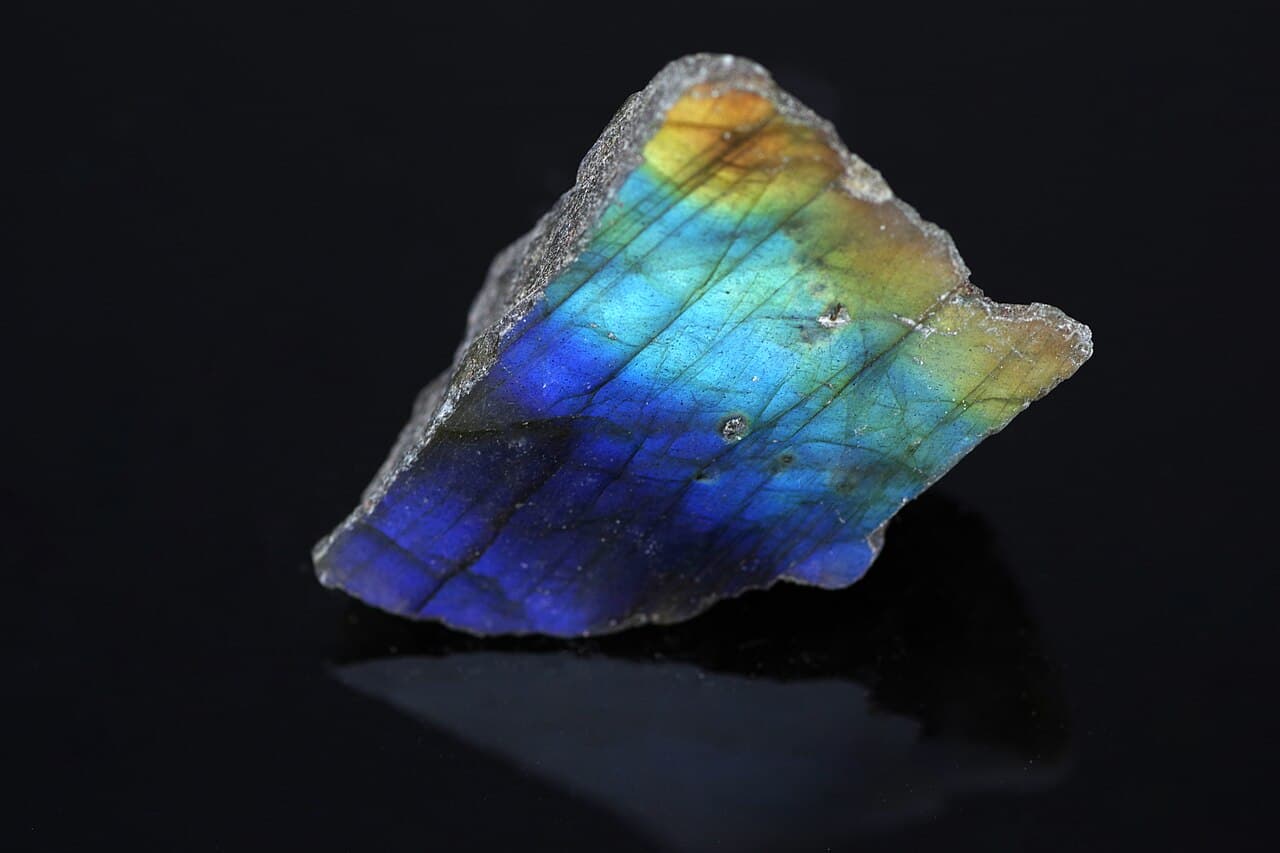
Labradorite is a plagioclase feldspar prized for one thing above all else: labradorescence, the dramatic flash of blue, green, gold, and occasionally orange or violet light that seems to float just beneath a gray surface. Turn a piece in the light and the color flares, fades, and leaps to a different patch as the angle changes. That optical fireworks display, not the stone's base color, is what makes labradorite instantly recognizable.
Chemically it sits in the middle of the plagioclase series, with a composition that blends calcium and sodium aluminosilicate. It was first described from Labrador, Canada, in the late 18th century, which is how it got its name, though gem-grade material now comes from several parts of the world. In its raw form it is an unassuming dark gray to nearly black rock; the magic only appears when light strikes internal layering at the right angle.
Because it is a feldspar rather than a quartz, labradorite is moderately hard but not bulletproof. It has good cleavage and will chip or split along flat planes if knocked, which matters for anyone wearing it or tumbling it. Despite that, it is one of the most popular ornamental stones in the world, cut into cabochons, beads, spheres, and freeform slabs that show the flash to best effect.
Labradorite at a glance
- Classification
- Mineral — plagioclase feldspar
- Composition
- (Ca,Na)(Al,Si)₄O₈
- Hardness
- 6–6.5 (Mohs)
- Luster
- Vitreous; pearly on cleavage surfaces
- Streak
- White
- Colors
- Gray to black body with blue, green, gold, and orange iridescent flash
- Crystal system
- Triclinic
- Transparency
- Translucent to opaque
How to identify labradorite
The single most reliable identifier is labradorescence. Hold the stone under a directional light and slowly tilt it: a sheet of color, usually blue or green, will sweep across the surface and then vanish as you keep tilting, reappearing somewhere else. This is not surface color and it is not the rainbow you see on an oil slick or a soap bubble. It comes from light bouncing off microscopically thin, alternating layers inside the crystal (the result of the feldspar separating into two compositions as it cooled). Because the effect depends on the angle between your eye, the light, and those internal layers, a labradorite that flashes brilliantly in one orientation can look like a flat gray rock when you rotate it 90 degrees. If a stone shows that directional, angle-dependent flash, you are almost certainly looking at labradorite.
Look at the body color too. Labradorite is typically smoky gray, gunmetal, or near-black, which is exactly why the bright flash reads so strongly against it. A pale, milky, or white stone showing a soft floating glow is more likely moonstone (see look-alikes below).
Feldspar cleavage is the second confirmation. Labradorite breaks along two flat planes that meet at close to 90 degrees, so broken or sawn surfaces tend to be flat and reflective rather than curved and glassy like the conchoidal fracture of quartz. On a clean cleavage face you may also see fine, straight parallel lines called striations, a classic plagioclase feature.
Hardness is a useful tiebreaker. At Mohs 6 to 6.5, labradorite is hard enough to scratch glass with effort but will itself be scratched by a quartz point or a hardened steel file. It is noticeably less hard than quartz (7), which helps separate it from quartz-family stones that have no flash.
Colors and varieties
The body of labradorite ranges from light gray through smoky gray to a dark gunmetal that can look black in low light. Against that backdrop, the labradorescent flash is what people actually buy the stone for. Blue and green are the most common flash colors; gold and bronze are frequent; full-spectrum stones that also throw orange, red, and violet are scarcer and more sought after.
Spectrolite is a well-known variety, originally from Finland, in which a very dark, near-black body produces an unusually broad and vivid range of flash colors. The name is essentially a trade and varietal label for the best high-color material rather than a separate mineral; it is still labradorite.
"Rainbow moonstone" is a name often applied in the trade to a near-colorless feldspar that shows blue flash. Mineralogically much of that material is closer to labradorite than to true moonstone, which is one reason the naming gets confusing. The honest way to describe any of these stones is by the optical effect (labradorescence versus adularescence) and the feldspar species, rather than by trade names alone.
Meaning and properties
In crystal and metaphysical traditions, labradorite is often called a stone of transformation and protection, and its shifting flash makes it an easy symbol for change, intuition, and "hidden light." It is commonly associated with imagination, mental clarity, and shielding one's energy, and it shows up frequently in jewelry meant to feel grounding yet a little magical.
These associations are spiritual and cultural, not medical. Labradorite cannot diagnose, treat, prevent, or cure any physical or mental health condition, and nothing here should be taken as health advice. If you enjoy the stone for its symbolism or simply because the flash is beautiful, that is reason enough to own it; just do not substitute it for care from a qualified professional.
Value
Labradorite is an affordable, widely available ornamental stone, and most pieces are inexpensive. What separates a cheap slab from a premium one is the quality of the flash: stones are valued for how bright the labradorescence is, how much of the surface lights up at once, how broad the color range is, and whether the flash appears across a wide viewing angle rather than only in a narrow sweet spot.
Full-spectrum material with strong blue-green-gold-to-orange flash on a dark body (the kind often labeled spectrolite) commands more than ordinary blue-only pieces. Cutting matters too, because a skilled cutter orients the stone so the internal layers face the surface and the flash fills the cabochon. Clean color, good polish, and the absence of distracting cracks all add value.
Care
Labradorite needs gentle handling because it has good feldspar cleavage and will chip or split along flat planes if it takes a sharp knock. At Mohs 6 to 6.5 it is also softer than quartz and the everyday grit (largely quartz dust) that scratches jewelry, so it can dull or scuff over time if treated carelessly. Store it separately from harder stones, and take rings off before heavy or rough work.
Clean it with warm water, a drop of mild soap, and a soft cloth or soft brush, then dry it. Avoid ultrasonic and steam cleaners, which can find and worsen cleavage cracks, and keep the stone away from harsh chemicals, acids, and prolonged heat. Sudden temperature changes are also best avoided.
Labradorite look-alikes
Frequently asked questions
What is labradorite?
Labradorite is a plagioclase feldspar mineral famous for labradorescence, a flash of blue, green, gold, or orange light that appears below a gray-to-black surface when light hits internal layering at the right angle. It is widely used as an ornamental and jewelry stone.
What makes labradorite flash with color?
The flash, called labradorescence, comes from light reflecting and interfering off microscopically thin, alternating internal layers that formed as the feldspar separated into two compositions while cooling. Because the effect depends on the angle between your eye, the light, and those layers, the color appears and disappears as you tilt the stone.
Is labradorite rare or valuable?
Labradorite is common and generally inexpensive. Value depends almost entirely on the quality of the flash, how bright it is, how much of the surface lights up, how broad the color range is, and the cut and polish. Full-spectrum, dark-bodied material (often sold as spectrolite) is the most prized.
How do I care for labradorite, and is it fragile?
It is moderately durable but does have feldspar cleavage, so it can chip or split if knocked, and at Mohs 6 to 6.5 it scratches more easily than quartz. Clean it with warm water and mild soap, avoid ultrasonic and steam cleaners and harsh chemicals, and store it away from harder stones.
What does labradorite symbolize?
Labradorite is widely regarded as a stone of transformation, intuition and protection — a reputation that follows directly from its optical trick of hiding brilliant color inside a plain grey stone. Inuit legend holds that the Northern Lights were once trapped in the rocks of Labrador's coast until a warrior struck them free, and modern crystal practice treats it as a stone of insight and change. These meanings are cultural and spiritual rather than medical: labradorite is a striking stone to own and wear, but it treats no condition and is no substitute for professional care.
Is rainbow moonstone the same as labradorite?
Essentially yes — 'rainbow moonstone' is a trade name for white labradorite, not true moonstone. Both are feldspars, but true moonstone is orthoclase showing adularescence (a soft, billowy sheen), while rainbow moonstone is a pale labradorite showing labradorescence (sharper, more spectral blue flashes from internal layering). The name persists because it sells; an honest seller will call it white labradorite or disclose the distinction.
Is yours labradorite? Find out from a photo
Photograph your crystal in good light and get an identification with an honest confidence level, the look-alikes to rule out and the at-home tests that confirm it.
Identify my crystal freeOn Android? Get the free rock identifier app
Related
More crystals in the field guide
Related reading
Keep exploring
More on crystals: the full list of crystal types, how to identify a crystal and crystals by color.
Last updated 2026-07-19. Identification guidance is educational — confirm important results with the diagnostic tests described or a qualified expert.