Sodalite
Also known as: Sodalith
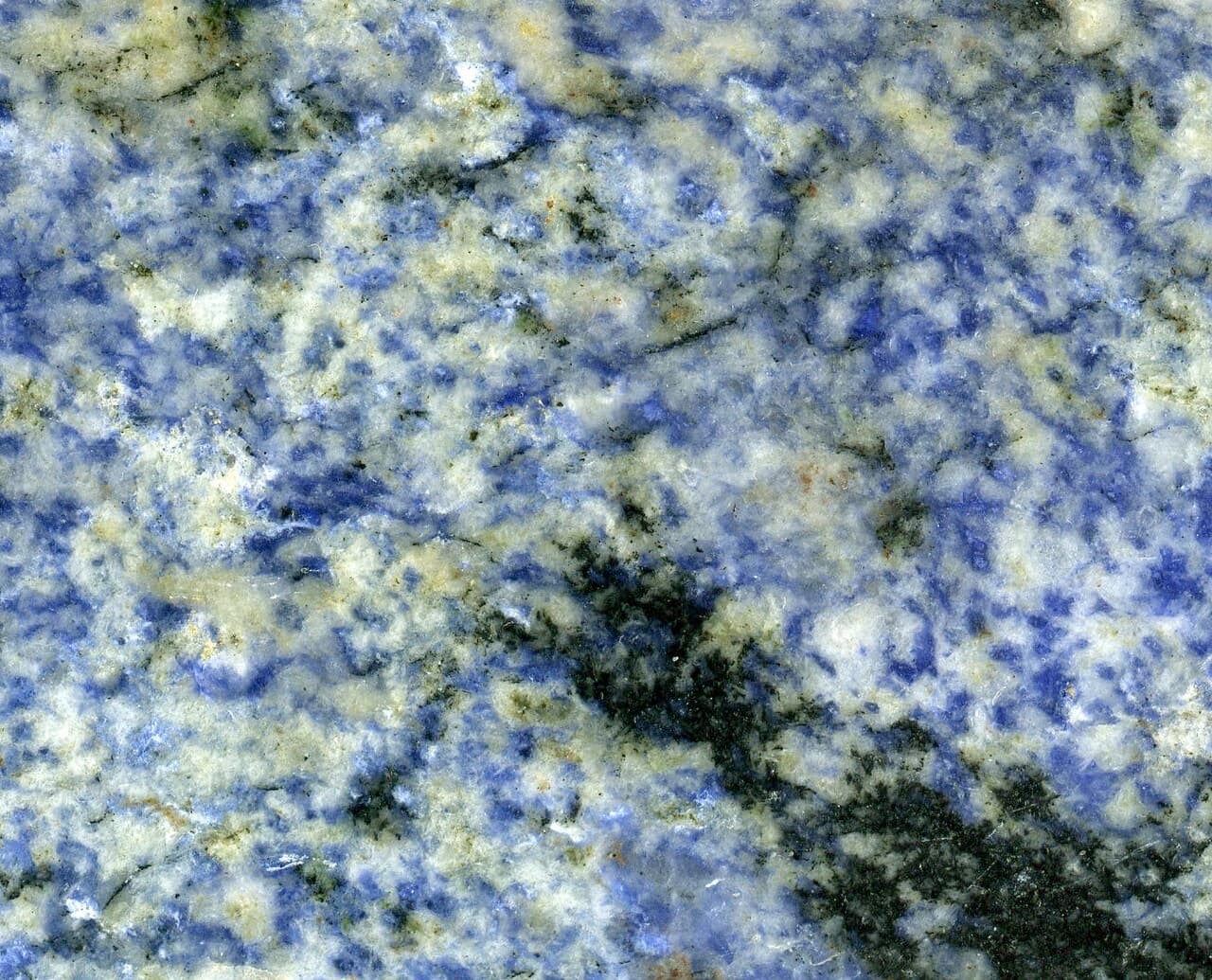
Sodalite is a rich royal-blue mineral belonging to the feldspathoid group — silicate minerals that are chemically related to feldspar but form when there isn't enough silica to make feldspar itself. Its formula is Na₈(Al₆Si₆O₂₄)Cl₂, a sodium aluminum silicate that also contains chlorine, and it is this composition (sodium plus chlorine) that gives the stone its name.
In rough and polished form sodalite is usually a deep, fairly uniform blue laced with irregular white veins of calcite, and sometimes flecks of gray or black. It is softer than quartz (Mohs 5.5–6) and is most often seen as tumbled stones, beads, carvings, and decorative slabs. It is frequently mistaken for the more famous lapis lazuli, but the two can be told apart with a few simple checks.
Sodalite at a glance
- Classification
- Mineral — feldspathoid (sodium aluminum silicate)
- Composition
- Na₈(Al₆Si₆O₂₄)Cl₂
- Hardness
- 5.5–6 (Mohs)
- Luster
- Vitreous to greasy
- Streak
- White (to very pale blue)
- Colors
- Royal to deep blue, with white veining; also gray, greenish, rarely pink or colorless
- Crystal system
- Cubic (isometric); well-formed crystals are rare, usually massive
- Transparency
- Translucent to opaque
How to identify sodalite
The classic look is a deep, even royal blue threaded with white calcite veins. The blue tends to be fairly uniform across the stone rather than mottled, and the white veining is irregular and often forms a network. Sodalite is translucent to opaque, with a glassy-to-slightly-greasy luster on polished surfaces.
Two tests help confirm it. First, hardness: sodalite is 5.5–6, so it can be scratched by a steel file and will not scratch glass cleanly the way quartz does — it sits just around the hardness of a knife blade. Second, and most telling, sodalite leaves a white streak when rubbed on an unglazed porcelain tile, even though the stone itself is blue. The lack of brassy pyrite specks is another clue: sodalite usually has no metallic gold flecks, which is one of the quickest ways to separate it from lapis lazuli.
Types and varieties
The most remarkable variety is hackmanite, a sodalite that shows tenebrescence — a reversible change of color when exposed to light. Freshly exposed or UV-lit hackmanite can appear pink to violet, then fade toward gray or white in daylight, and the color returns again after time in the dark or under ultraviolet light. This light-sensitive color change is a genuine and distinctive property of certain sodalites and a favorite among collectors.
Beyond hackmanite, sodalite is mostly distinguished by quality of color and patterning rather than formal varieties. Gem-grade material is a saturated, even blue with attractive white veining and few distracting gray patches; some sodalite also occurs in gray, green, and rarely near-colorless forms. Sodalite is closely related to other members of its mineral group, including lazurite — which is itself the main blue component of lapis lazuli — which is why the two stones look so similar.
Meaning and properties
Sodalite is often called the 'stone of logic' or the 'poet's stone' in modern crystal traditions, where its calm blue color leads people to associate it with clear thinking, communication, and a sense of inner quiet. It is commonly linked to the throat and third-eye chakras and used in meditation for focus.
Note: these metaphysical and crystal-healing associations are cultural and spiritual rather than scientifically established medical effects. Sodalite is a beautiful and meaningful stone to keep, but it is not a substitute for medical care, and nothing here should be taken as health advice.
Value: what sodalite is worth
Sodalite is an affordable stone. Tumbled pieces, beads, and small carvings are inexpensive, and even decorative slabs are modestly priced compared with lapis lazuli. This price gap is one reason sodalite is sometimes substituted for lapis — and one reason a true-blue, pyrite-flecked lapis usually costs considerably more.
Within sodalite, value is driven by color and pattern: a deep, even, saturated blue with clean, attractive white veining and minimal dull gray areas is worth more than pale or patchy material. Hackmanite that shows a strong, repeatable color change carries a premium with collectors because of its rarity and the novelty of its tenebrescence.
Real vs. fake and dyed
Because sodalite is itself inexpensive, it is not usually faked — instead, it is more often the cheaper material that other stones get dyed to resemble. The most common imitation in the blue-stone world is dyed howlite (or dyed magnesite): naturally white, porous howlite is dyed blue to mimic both sodalite and lapis lazuli. Tell-tale signs of dyed howlite are color that concentrates darkly along its natural gray veins, a too-even surface blue with a faint network of dyed lines, and softness — howlite is only about Mohs 3.5 and scratches very easily, whereas sodalite is 5.5–6.
Genuine sodalite shows a white streak, a glassy-to-greasy luster, and natural-looking irregular white calcite veining rather than dye pooled in cracks. If you suspect a dyed stone, a discreet swab with a little acetone (nail-polish remover) on an inconspicuous spot may pick up color from a dyed piece but will not affect natural sodalite. As always, buy from sellers who disclose treatments, and treat suspiciously uniform, intensely colored 'lapis' or 'sodalite' beads with caution.
Care
Sodalite is reasonably durable but softer and more prone to chipping than quartz, so treat it gently. Clean it with warm water, mild soap, and a soft cloth, and avoid ultrasonic cleaners, harsh chemicals, and prolonged direct sunlight, which can dull the color of some material over time. Store it separately so harder stones don't scratch it.
Sodalite look-alikes
Frequently asked questions
What is sodalite?
Sodalite is a royal-blue mineral in the feldspathoid group, with the formula Na₈(Al₆Si₆O₂₄)Cl₂. It is a sodium aluminum silicate that also contains chlorine, typically deep blue with irregular white calcite veins, and it has a hardness of 5.5–6 on the Mohs scale.
How do you tell sodalite from lapis lazuli?
Look for pyrite and check the price and color. Lapis usually has brassy gold pyrite flecks and a more intense, sometimes mottled blue, and it is significantly more expensive. Sodalite is more uniformly blue, normally has no pyrite, and is much cheaper. Both leave a pale streak, but the pyrite specks are the quickest visual giveaway.
Is sodalite ever dyed or fake?
Sodalite itself is cheap, so it is rarely dyed — but cheaper white howlite is often dyed blue and sold as sodalite or lapis. Dyed howlite is much softer (Mohs ~3.5), scratches easily, and shows color pooled along its gray veins. Genuine sodalite is harder, shows a white streak, and has natural irregular white veining.
Why does some sodalite change color?
That variety is called hackmanite, and the effect is tenebrescence — a reversible color change. Hackmanite can turn pink or violet under ultraviolet light or right after exposure, then fade toward gray or white in daylight, with the color returning after time in the dark. It is a genuine, well-documented property of certain sodalites.
What does sodalite symbolize?
Sodalite is associated with logic, calm and clear communication — modern crystal practice often calls it the 'stone of the mind' or 'poet's stone' and links it to the throat and third-eye chakras. Its deep blue, so close to lapis lazuli, carried some of the same decorative associations with truth and insight. These meanings are cultural and spiritual rather than medical, and sodalite treats no condition.
Is yours sodalite? Find out from a photo
Photograph your crystal in good light and get an identification with an honest confidence level, the look-alikes to rule out and the at-home tests that confirm it.
Identify my crystal freeOn Android? Get the free rock identifier app
Related
More crystals in the field guide
Related reading
Keep exploring
More on crystals: the full list of crystal types, how to identify a crystal and crystals by color.
Last updated 2026-07-19. Identification guidance is educational — confirm important results with the diagnostic tests described or a qualified expert.