Amazonite
Also known as: Amazon stone, Amazonstone, Microcline (green variety)
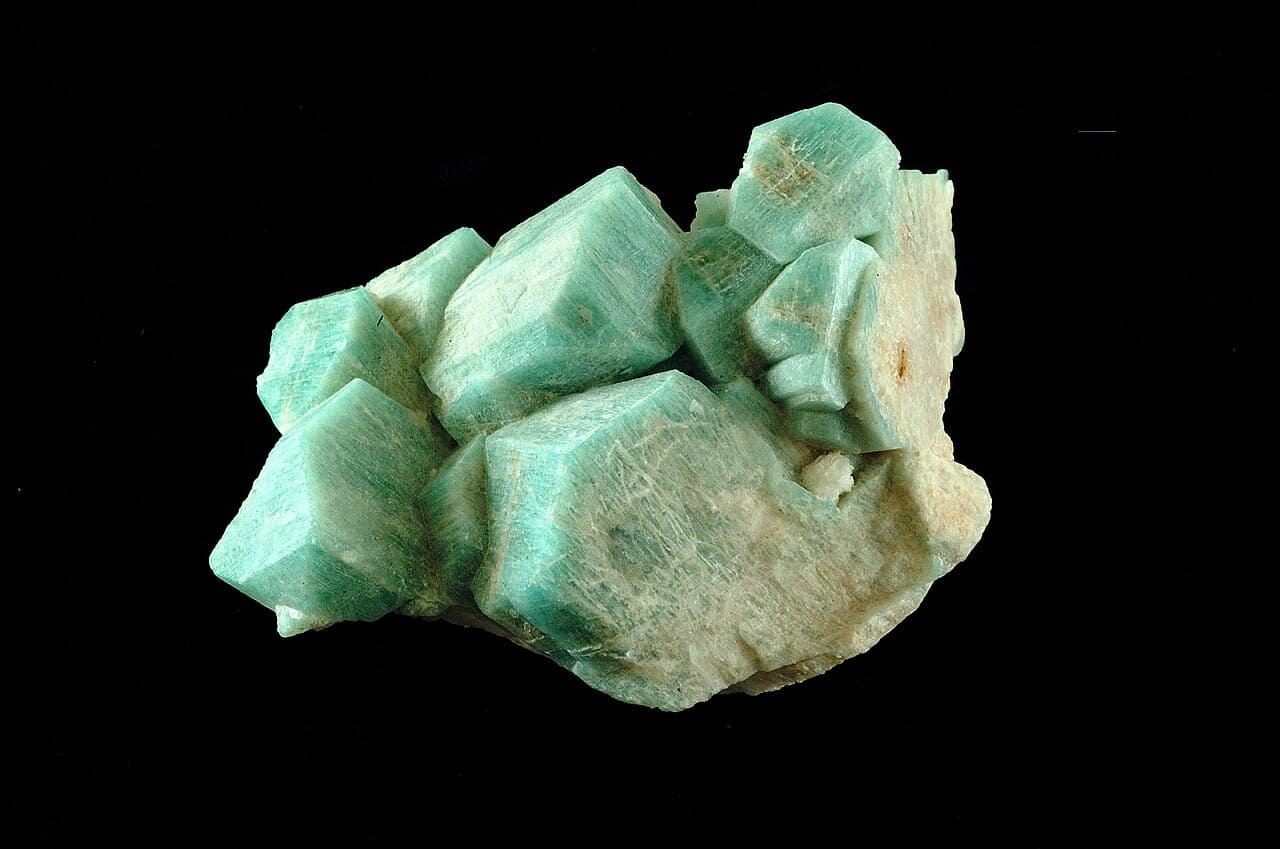
Amazonite is the green to blue-green variety of microcline, one of the potassium feldspars, and its calm aquatic color is its entire signature. Chemically it is a potassium aluminum silicate (KAlSi₃O₈) with the same composition as ordinary white or pink microcline; what sets amazonite apart is the soft turquoise-to-mint hue, which research has tied to trace lead together with water in the crystal structure rather than to copper as the look might suggest. The result is a stone that reads as gemmy and serene but is, mineralogically, a common rock-forming feldspar that happens to have picked up an unusual color. It is opaque to faintly translucent, takes a smooth vitreous-to-slightly-pearly polish, and leaves a white streak.
The feature that most reliably betrays amazonite is the patterning inside it. Most amazonite is crisscrossed by pale white streaks and a grid-like sheen produced by thin lamellae of intergrown albite, a sodium feldspar that separated out as the crystal cooled. This white gridding, combined with two cleavage directions that meet at close to ninety degrees, is the hallmark that distinguishes amazonite from softer blue-green stones it is often confused with. Once you learn to see the feldspar cleavage and the albite grid, amazonite becomes one of the more recognizable green stones rather than just another anonymous blue-green pebble.
Amazonite at a glance
- Classification
- Mineral — green variety of microcline (a potassium feldspar)
- Composition
- KAlSi₃O₈
- Hardness
- 6–6.5 (Mohs)
- Luster
- Vitreous, sometimes slightly pearly on cleavage surfaces
- Streak
- White
- Colors
- Green to blue-green, often with white streaks or grid-like patterning
- Crystal system
- Triclinic
- Transparency
- Opaque to translucent
How to identify amazonite
Begin with the color and the internal pattern, because together they are nearly diagnostic. Amazonite shows a soft green to blue-green that can range from minty pale to a deep teal, and it is very commonly broken up by pale white streaks, patches or a fine grid. That white gridding is intergrown albite, and it is one of the most useful single clues you have: turquoise and jade do not produce it. Look at the surface in raking light and you may also see a faint schiller or sheen shifting across cleavage planes, again a feldspar trait rather than something an imitation reproduces easily.
Physical properties confirm the identification. Amazonite is moderately hard at 6 to 6.5 on the Mohs scale, so a steel knife will not scratch it but quartz will leave no mark either way — importantly, it is distinctly harder than turquoise or chrysocolla. The decisive test is cleavage: as a feldspar, amazonite breaks along two flat directions that meet at roughly ninety degrees, and broken or chipped edges reveal stepped, mirror-like cleavage faces. Turquoise, jade and chrysocolla have no such cleavage and break with a more granular or splintery surface. A white streak, a vitreous luster, an opaque-to-translucent body and that blocky two-direction cleavage taken together point firmly at amazonite.
Color and varieties
Amazonite's color sits anywhere along a band from pale mint green through grass green to a saturated blue-green or teal, and the bluer, more even-toned material is generally the most prized. The hue is unusually durable for a colored stone in the sense that it comes from structural impurities — trace lead and water within the microcline lattice — rather than from a surface coating or dye, though strong, prolonged sunlight can still fade it over very long exposures. Because amazonite is a variety defined purely by color, two stones can be chemically identical while one is a plain pale microcline and the other a vivid collector's piece.
The most characteristic look is the white-streaked or grid-patterned stone, where intergrown albite forms pale bands, blotches or a fine plaid against the green. Some material is more uniform and gem-like, some is mottled and rock-like, and amazonite frequently grows alongside smoky quartz and other feldspars in coarse granitic rock, so specimens may show it studded among gray quartz and pink or white feldspar. For identification this is helpful: a green feldspar mingled with quartz and showing pale albite striping in granite-like rock is very likely amazonite, since few imitations occur in that natural setting.
Meaning and properties
In modern crystal-working traditions amazonite is often called a soothing or calming stone, associated with honest communication, the easing of worry, and the settling of an overactive mind. Its water-like color leads many to link it with the throat and heart, and it is a popular choice for meditation, journaling and pieces meant to encourage speaking one's truth. These associations are cultural and spiritual rather than physical, and they are part of why a common feldspar has become such a widely sold tumbled stone.
These meanings are spiritual and personal, not scientifically demonstrated medical effects. Amazonite is a pleasant stone to wear, carry or keep for reflection, but it does not cure, treat or prevent any physical or mental health condition and is not a substitute for professional medical or psychological care.
Value: what amazonite is worth
Amazonite is an affordable stone overall, which suits its status as a common feldspar, and its value is driven mostly by color, evenness and the quality of the polish. The most desirable material has a strong, even blue-green color with attractive but not muddy white patterning, good translucency at the edges, and a clean surface free of pits and fractures. Pale, chalky or heavily fractured stones are inexpensive, while well-colored teal pieces with a pleasing grid command more, especially when cut as cabochons or beads that show the color to advantage.
Because amazonite is plentiful and its color is natural rather than treated, it is not a stone that is heavily faked for profit, and value differences come down to grade rather than authenticity. Larger clean pieces, vivid color and an even distribution of the albite gridding raise desirability; dull color, cracks along the cleavage planes, and an overly bleached or washed-out appearance lower it. As always, the practical advice for a buyer is to judge the stone in hand for color and condition rather than to expect rarity to drive the price.
Real vs. fake amazonite
Amazonite is inexpensive enough that deliberate fakery is uncommon, so the usual problem is misidentification rather than fraud — green or blue-green stones such as dyed howlite, dyed quartzite, or other feldspars being sold as amazonite, or amazonite being confused with turquoise, jade or chrysocolla. Occasionally pale feldspar is dyed to deepen the green, and very rarely glass or plastic is offered, but most material sold as amazonite genuinely is the green microcline. The key is to verify the diagnostic feldspar traits rather than to assume.
Use hardness and cleavage as your anchors. Genuine amazonite is 6 to 6.5 on the Mohs scale, so it will not be scratched by a steel blade; a stone that scratches easily is more likely dyed howlite or a soft imitation. Examine a chipped edge or natural break under good light for the flat, stepped cleavage surfaces that meet at about ninety degrees, since that two-direction cleavage is a feldspar fingerprint absent in turquoise, jade and chrysocolla. The presence of pale albite gridding and a faint schiller further supports natural amazonite, while a suspiciously uniform color that pools darker in cracks suggests dye. Glass betrays itself with bubbles and a warm-not-cool feel, and plastic with a hot-pin test that yields an acrid smell.
Care
Amazonite is reasonably hard but, like all feldspars, it is brittle along its cleavage and can chip or split if knocked sharply or dropped, so it benefits from gentle handling. Clean it with warm water, a little mild soap and a soft cloth or brush, then rinse and dry it; this is enough for everyday dust and skin oils. Avoid ultrasonic and steam cleaners, which can drive vibration or heat into the cleavage planes and start a crack, and keep the stone away from harsh household chemicals and acids.
Store amazonite separately from harder gems such as quartz, topaz and sapphire that could scratch its surface, ideally wrapped in a soft pouch or kept in its own compartment. Prolonged, intense sunlight may slowly fade the green over long periods, so display pieces away from a hot, sunny window. With this modest level of care — gentle cleaning, no thermal shock, and protection from impacts and abrasion — amazonite keeps its color and polish for a lifetime.
Amazonite look-alikes
Frequently asked questions
Is amazonite the same as a feldspar?
Yes. Amazonite is the green to blue-green variety of microcline, which is one of the potassium feldspars, with the formula KAlSi₃O₈. Chemically it is the same as ordinary microcline; only the color, attributed to trace lead and water in the structure, makes it amazonite.
What causes amazonite's blue-green color?
Despite looking copper-colored, the green to blue-green hue is linked to trace amounts of lead together with water within the microcline structure, not to copper. Because the color comes from these structural impurities rather than a coating, it is reasonably stable, though very prolonged sunlight can slowly fade it.
How can I tell amazonite from turquoise?
Check hardness, cleavage and pattern. Amazonite is harder (6–6.5 Mohs versus turquoise's 5–6), breaks along flat feldspar cleavage planes that meet near ninety degrees, and usually shows white albite gridding. Turquoise has no cleavage, breaks with a granular surface, and is typically a more opaque sky blue without that grid.
Is amazonite expensive?
No. Amazonite is a common feldspar and is generally affordable. Price is driven by color, evenness, translucency and polish rather than rarity, so vivid, even teal stones with attractive white patterning cost more than pale, chalky or fractured material, but the stone as a whole is inexpensive.
Is yours amazonite? Find out from a photo
Photograph your crystal in good light and get an identification with an honest confidence level, the look-alikes to rule out and the at-home tests that confirm it.
Identify my crystal freeOn Android? Get the free rock identifier app
Related
More crystals in the field guide
Keep exploring
More on crystals: the full list of crystal types, how to identify a crystal and crystals by color.
Last updated 2026-06-24. Identification guidance is educational — confirm important results with the diagnostic tests described or a qualified expert.