Molybdenite
Also known as: Molybdenum sulfide, MoS₂
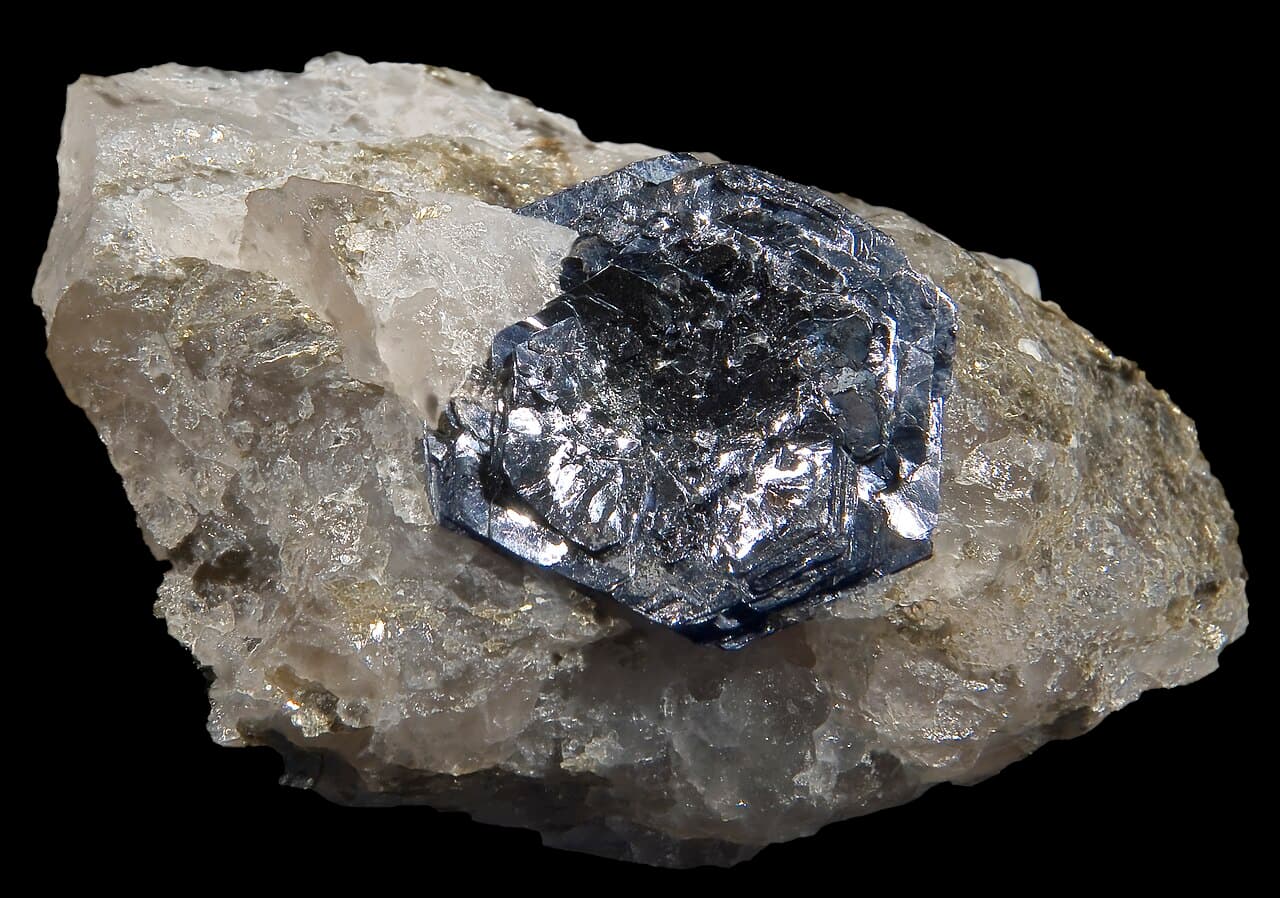
Molybdenite is the principal ore of the metal molybdenum, a soft, metallic-gray sulfide mineral with the chemical formula MoS₂ (molybdenum disulfide). It crystallizes in thin, flexible, foliated flakes and platy masses that have a bright, almost silvery metallic luster with a faint bluish cast. What makes it instantly memorable in the hand is how extraordinarily soft and greasy it is: at just 1 to 1.5 on the Mohs scale it is softer than your fingernail, it leaves a mark on paper like a pencil, and it feels slick and soapy between the fingers.
Although molybdenite is the world's most important source of molybdenum — a metal used to harden and strengthen steel — it is not a flashy specimen mineral, and it is rarely sold for metaphysical use. Most collectors prize it instead for its scientific interest and its near-perfect resemblance to graphite, which makes telling the two apart a small but satisfying mineralogical puzzle. It is typically found in granitic and porphyry ore deposits, in quartz veins, and in contact-metamorphic zones, usually in small flakes scattered through rock rather than as large showy crystals.
Molybdenite at a glance
- Classification
- Mineral — sulfide (molybdenum disulfide)
- Composition
- MoS₂
- Hardness
- 1–1.5 (Mohs) — softer than a fingernail
- Luster
- Metallic, lead-gray with a slight bluish tone
- Streak
- Bluish-gray (greenish-gray on glazed porcelain; leaves a bluish mark on paper)
- Colors
- Lead-gray to silvery gray, often with a bluish cast
- Crystal system
- Hexagonal
- Transparency
- Opaque
- Magnetic
- Not magnetic
How to identify it
The first thing to test is hardness, because molybdenite is one of the softest of all metallic minerals. At Mohs 1 to 1.5 it is softer than a fingernail, so a gentle scratch with your nail will dent or smear it, and it will draw a gray streak across a sheet of paper much like a soft pencil. Combine that with the feel: molybdenite has a distinctly greasy, soapy slipperiness when you rub it between your fingers, and its thin flakes are flexible — they bend without snapping back and without springing into a brittle crumble. The luster is a bright lead-gray metallic with a subtle bluish tint, and the mineral typically occurs as platy, foliated flakes or rosette-like aggregates.
Because molybdenite looks so much like graphite, the streak is the decisive test. Rub the mineral on unglazed porcelain (a streak plate): molybdenite gives a bluish-gray streak, whereas graphite gives a brownish-black to black one. The same difference shows on paper, where molybdenite tends to leave a slightly bluer, more metallic mark. Density is the other clincher — molybdenite is noticeably heavier for its size (specific gravity roughly 4.7) than graphite (around 2.2), so a flake of molybdenite feels surprisingly heavy in the hand. Taken together, extreme softness, a greasy feel, flexible flakes, a bluish-gray streak, and high density confirm molybdenite over its look-alikes.
Colors and varieties
Molybdenite is consistently lead-gray to silvery gray, and its most diagnostic optical feature is the faint bluish tone that distinguishes it from the more neutral or slightly brownish gray of graphite. On a freshly cleaved flake the surface is bright and reflective; with handling and exposure it can take on a slightly duller, more matte gray. The color does not vary much from specimen to specimen, which is why mineralogists rely on hardness, streak, and density rather than color alone to make the identification.
There are no true color varieties of molybdenite, but it does occur in different habits that collectors distinguish: thin individual hexagonal plates, books of stacked foliated flakes, and curved rosette or fan-shaped aggregates. A closely related but separate mineral, jordisite, is the rare amorphous (non-crystalline) form of molybdenum disulfide. Molybdenite is also the natural source of the synthetic molybdenum disulfide used as an industrial dry lubricant, which is itself the same gray, slippery substance refined to a fine powder.
Meaning and properties
Molybdenite is first and foremost a collector's and industrial mineral rather than a crystal-healing stone, so it carries little traditional metaphysical lore compared with quartz or amethyst. When it is mentioned in metaphysical contexts at all, it is loosely associated with grounding, mental clarity, and helping one cut through confusion — a fitting symbolism given the mineral's role as a refined, purpose-built material. These associations are matters of belief and folklore.
Any spiritual or wellness properties attributed to molybdenite are not medical claims and are not supported by scientific evidence; this information is offered for general and cultural interest only and is not a substitute for professional medical, psychological, or financial advice. If you handle raw molybdenite, treat it as you would any soft sulfide specimen — wash your hands after handling, as the flakes smear easily, and keep it away from young children who might mouth small pieces.
Value and price
Molybdenite is valued far more as an industrial ore than as a collectible, and its worth as a specimen depends almost entirely on crystal quality rather than rarity of the mineral itself. The vast majority of molybdenite mined worldwide is processed for its molybdenum content, where the price tracks the global metals market rather than anything a collector would pay. As a result, ordinary flakes and ore samples are inexpensive and widely available.
Specimen value rises with well-formed, sizeable hexagonal plates, attractive rosettes, and aesthetic associations with quartz or other minerals on a clean matrix. Sharp, large, undamaged crystals from notable localities command the most interest among collectors, while typical scattered flakes in host rock are modest. Because molybdenite is so soft and easily damaged, specimens in excellent, undented condition are disproportionately more desirable than worn or smeared ones.
Real vs. fake
Molybdenite is not a mineral that attracts deliberate faking — there is little incentive to counterfeit an inexpensive ore mineral. The real risk is misidentification rather than fraud, and by far the most common error is confusing molybdenite with graphite, which it resembles almost exactly in color, softness, greasy feel, and flexible flakes. The reliable way to tell them apart is the streak (molybdenite bluish-gray, graphite brownish-black) backed up by density, since molybdenite is roughly twice as heavy for its size.
To confirm a specimen is genuine molybdenite, run the standard diagnostic suite: check that it is extremely soft (scratched by a fingernail), feels greasy, has flexible rather than brittle flakes, shows a metallic lead-gray color with a bluish cast, and gives a bluish-gray streak with a high heft. If a piece is far harder than your fingernail, has cubic cleavage, or is much lighter, it is not molybdenite. When in doubt, a heft-versus-graphite comparison and a streak test on porcelain settle the question quickly.
Care and storage
Molybdenite is one of the most fragile minerals you can own, so handle it as little as possible. Its extreme softness means a fingernail, a harder mineral, or even rough handling will scratch, smear, or flatten the flakes, and the greasy surface readily transfers gray marks to fingers, labels, and storage trays. Hold specimens by the matrix rather than the molybdenite itself, and avoid rubbing the crystals.
Clean only with a soft, dry brush or a gentle puff of air; do not scrub, and avoid water and harsh chemicals where possible, since wet handling encourages smearing and can loosen delicate flakes. Store each specimen separately in a padded box or lined compartment so harder minerals cannot scratch it, keep it out of direct sunlight and away from heat, and keep small loose flakes away from children. With careful, hands-off storage, a good molybdenite specimen will keep its bright metallic surface indefinitely.
Molybdenite look-alikes
Frequently asked questions
How can I tell molybdenite from graphite?
They look nearly identical, so use the streak and the heft. Molybdenite gives a bluish-gray streak on unglazed porcelain (and a bluer mark on paper), while graphite gives a brownish-black to black streak. Molybdenite is also about twice as dense, so a flake feels noticeably heavier in the hand than graphite of the same size.
Is molybdenite valuable?
Molybdenite is far more important as an industrial ore — it is the chief source of the metal molybdenum used to harden steel — than as a collectible. Ordinary flakes and ore samples are inexpensive, and specimen value depends mainly on the size, sharpness, and condition of the crystals rather than on the mineral being rare.
Why is molybdenite so soft and greasy?
Molybdenite has a layered atomic structure in which sheets of molybdenum and sulfur atoms are only weakly bonded to one another, so the layers slide apart easily. That sliding gives the mineral its Mohs 1–1.5 softness, its slick, soapy feel, and its flexible flakes, and it is the same property that makes refined molybdenum disulfide a useful dry lubricant.
Is molybdenite magnetic?
No. Molybdenite (MoS₂) is not magnetic and will not respond to a magnet. Its identifying features are its extreme softness, greasy feel, flexible lead-gray flakes with a bluish cast, bluish-gray streak, and relatively high density — not magnetism.
Is yours molybdenite? Find out from a photo
Photograph your mineral in good light and get an identification with an honest confidence level, the look-alikes to rule out and the at-home tests that confirm it.
Identify my mineral freeOn Android? Get the free rock identifier app
Related
More minerals in the field guide
Keep exploring
More on minerals: how to identify a mineral, the streak test and the full list of crystal types.
Last updated 2026-06-25. Identification guidance is educational — confirm important results with the diagnostic tests described or a qualified expert.