Quartz
Also known as: Silica, Rock crystal (clear variety)
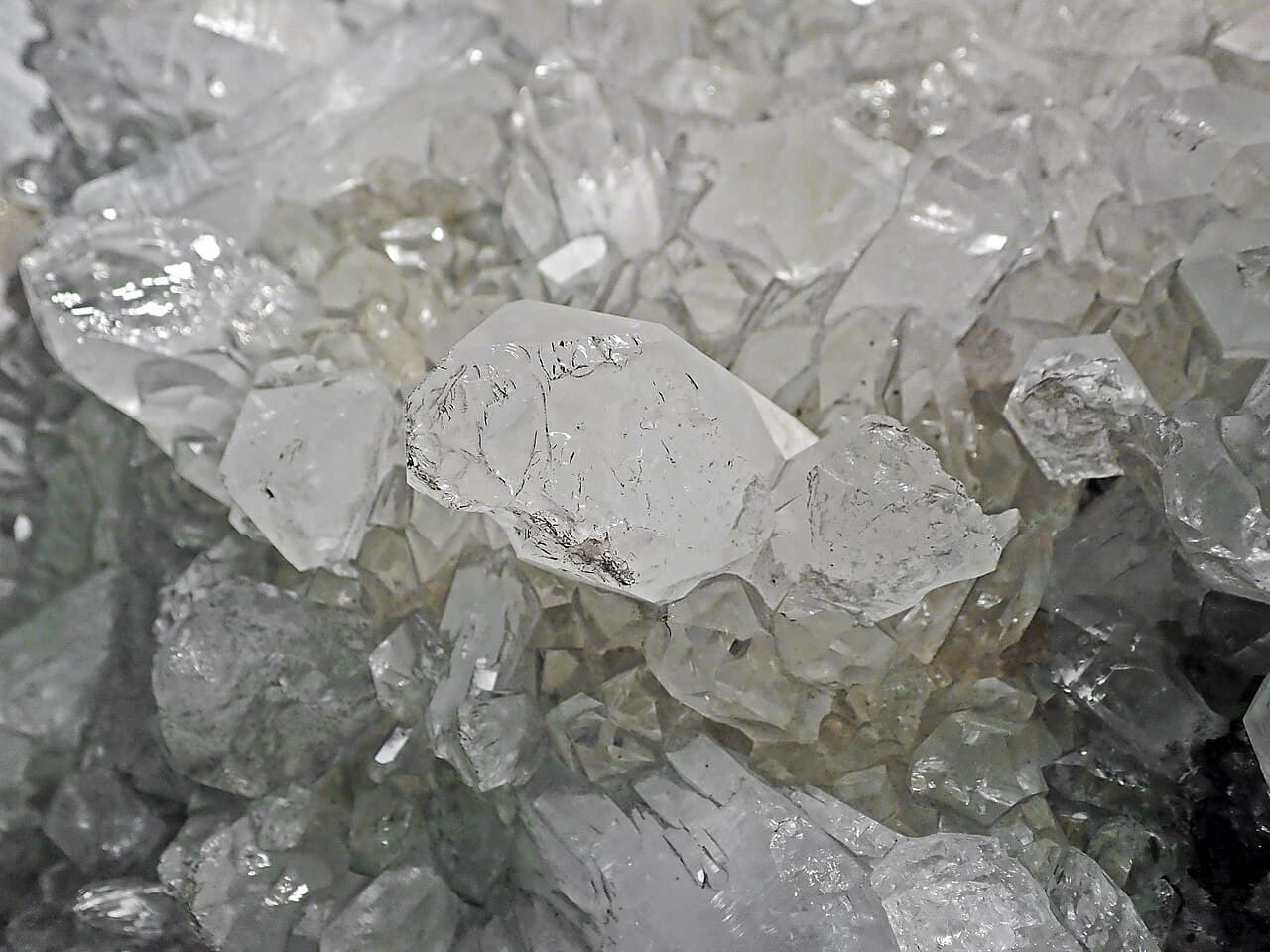
Quartz is silicon dioxide (SiO₂) and the single most abundant mineral in the Earth's continental crust. It is a framework of silicon and oxygen atoms locked into a hard, durable structure, which is why grains of quartz survive being weathered out of rock and end up as the bulk of ordinary sand. Quartz turns up almost everywhere — as veins through other rock, as a major ingredient of granite, as the clear points prized by collectors, and as the fine-grained material behind agate and jasper.
Two features make quartz easy to recognize and explain why it is so widely used. First, it is hard: at 7 on the Mohs scale it scratches glass and steel easily and resists scratching by almost anything you would find around the house. Second, it has no cleavage — instead of splitting along flat planes, it breaks along curved, shell-like (conchoidal) surfaces. Well-formed quartz grows as six-sided (hexagonal) prisms capped by pyramid-shaped points, has a glassy (vitreous) luster, and leaves a white streak. Pure quartz is colorless, but trace impurities and radiation produce a whole family of named color varieties.
Quartz at a glance
- Classification
- Mineral — silicate (silica group)
- Composition
- SiO₂
- Hardness
- 7 (Mohs)
- Luster
- Vitreous (glassy)
- Streak
- White
- Colors
- Colorless when pure; purple, yellow, pink, brown, gray, milky white, and many more depending on variety
- Crystal system
- Trigonal (hexagonal prisms with pyramidal terminations)
- Transparency
- Transparent to translucent to opaque
How to identify quartz
The two most reliable tests are hardness and the way it breaks. Quartz is a 7 on the Mohs scale, so it will readily scratch a piece of glass and a steel knife blade, while almost nothing in a normal household scratches it back. And because quartz has no cleavage, broken pieces show smooth, curved conchoidal fractures rather than flat cleavage faces — a key way to separate it from minerals like calcite, feldspar and fluorite that split along flat planes.
Then look at form and luster. When it has room to grow, quartz forms six-sided prisms topped by a pyramid-shaped point, a shape that is hard to mistake. It has a bright glassy luster and a white streak, and it is not magnetic. A clear quartz point will feel cool to the touch and, unlike glass, will not contain trapped round bubbles. Take all of these together: a hard, glassy, non-cleaving mineral with a white streak and (where visible) hexagonal points is almost certainly quartz.
Varieties of quartz
Quartz comes in more named varieties than almost any other mineral, and several of them are popular enough to have their own pages. The transparent, well-crystallized 'macrocrystalline' varieties are distinguished mainly by color: colorless quartz is clear quartz or rock crystal; purple is amethyst; pale yellow to golden is citrine; pink is rose quartz; and smoky brown to gray-black is smoky quartz. Milky quartz is the common cloudy-white form, colored by countless tiny fluid inclusions.
There is also a whole 'microcrystalline' branch, made of quartz crystals too small to see, known collectively as chalcedony. This includes banded agate, red-to-orange carnelian, and the opaque, solid-colored jasper. All of these — the gemmy crystals and the fine-grained stones alike — share the same SiO₂ chemistry and 7 hardness; they differ in crystal size, trace impurities and how they formed. For the colored crystal varieties, see the dedicated pages for amethyst, citrine, rose quartz, smoky quartz and clear quartz, and for the banded microcrystalline form see agate.
Meaning and properties
Clear quartz is the centerpiece of many crystal traditions, where it is often called the 'master healer' and an 'amplifier' — believed to clarify thought, boost energy and magnify the effect of other stones. Different colored varieties carry their own associations (amethyst with calm, rose quartz with love, citrine with abundance), but clear quartz is treated as the all-purpose, programmable stone. Its long human history as a carving and ornamental material adds to its symbolic weight.
These are cultural and spiritual beliefs, not scientifically demonstrated effects. There is no medical evidence that quartz heals the body or mind, and it should never replace professional medical care. Quartz does have very real, well-understood physical properties — notably piezoelectricity, the ability to generate a tiny electric charge under pressure, which is why precisely cut quartz is used to keep time in watches and electronics — but that is a property of engineered crystals in circuits, not of a tumbled stone in your pocket.
Value: what quartz is worth
Plain quartz is one of the most affordable minerals there is — it is extremely common, so ordinary clear points, milky quartz and tumbled pieces cost very little. Value comes from the exceptions: large, flawless, water-clear crystals; well-formed clusters with undamaged points; rare or vivid colors; and specimens with attractive inclusions (such as needles of rutile in 'rutilated' quartz). Among the colored varieties, deep natural amethyst and fine rose quartz command more than common clear quartz, while exceptional gem-clear, eye-clean cut stones are worth the most.
Condition matters more than size for everyday pieces: undamaged terminations, good clarity and clean color drive value, while chips, cloudiness and dull surfaces lower it. Because quartz is so abundant, beware of paying gem prices for ordinary material; genuine rarity, not just bulk, is what carries a premium.
Real vs. fake: quartz vs. glass
The most common imitation of clear quartz is ordinary glass, and several quick tests separate them. Quartz is harder (Mohs 7) and will scratch glass, whereas glass cannot scratch quartz. Quartz tends to feel colder to the touch and warms up more slowly than glass. And because quartz has a higher density, a quartz piece feels slightly heavier than a same-sized piece of glass.
Look inside, too. Manufactured glass commonly contains small, perfectly round trapped air bubbles and may show mold seams or swirl marks; natural quartz does not have round bubbles, though it can contain angular mineral inclusions, fractures or fluid 'veils.' Real quartz crystals also tend to show flat hexagonal faces and may have small natural imperfections, while molded glass 'crystals' look unnaturally flawless and uniform. As always, combine several clues rather than relying on any single test.
Care and handling
Quartz is hard and durable, so day-to-day care is simple: clean it with warm water, mild soap and a soft brush or cloth. Despite its hardness it has no cleavage but is still brittle, so avoid sharp knocks and drops, which can chip points or crack a crystal. Store it apart from softer stones it could scratch (calcite, fluorite and the like) and away from harder material such as topaz that could mar its surface.
Some colored varieties need extra care with light: amethyst, smoky quartz and rose quartz can fade with prolonged exposure to strong sunlight, so display colored quartz out of direct sun. Avoid harsh chemicals and sudden temperature changes, and there is no need for special 'recharging' beyond keeping the stone clean and undamaged.
Quartz look-alikes
Frequently asked questions
Is quartz a rock or a mineral?
Quartz is a mineral — naturally occurring silicon dioxide (SiO₂) with a definite crystal structure. It is also a major ingredient in many rocks, such as granite and sandstone, but on its own it is classed as a mineral.
How can I tell if something is quartz?
Test its hardness and how it breaks. Quartz is a 7 on the Mohs scale, so it scratches glass and steel; it has a glassy luster and a white streak; it has no cleavage and breaks along curved (conchoidal) surfaces; and well-formed crystals are six-sided prisms with pyramid tips.
What are the different types of quartz?
The transparent varieties are distinguished by color — clear quartz (colorless), amethyst (purple), citrine (yellow), rose quartz (pink) and smoky quartz (brown). The fine-grained 'microcrystalline' branch (chalcedony) includes agate, carnelian and jasper. All share the same SiO₂ chemistry.
Is quartz valuable?
Most quartz is inexpensive because it is so common. Value comes from exceptions — large flawless clear crystals, vivid or rare colors, undamaged clusters, and attractive inclusions like rutile needles. Fine cut gem-quality stones and deep natural amethyst are worth the most.
Is yours quartz? Find out from a photo
Photograph your mineral in good light and get an identification with an honest confidence level, the look-alikes to rule out and the at-home tests that confirm it.
Identify my mineral freeOn Android? Get the free rock identifier app
Related
Compare quartz with look-alikes
More minerals in the field guide
Related reading
- How Accurate Is AI at Identifying Rocks?
- How to Identify a Geode: 5 Signs Before You Crack It Open
- How to Tell if a Crystal Is Real vs Fake
- Raw Crystals: What They Are and How to Identify Them
- Rocks That Look Like Gold: Real Gold vs Fool's Gold
- Types of Quartz: The Complete Variety Guide
- Where to Find Crystals: A Beginner's Rockhounding Guide
Keep exploring
More on minerals: how to identify a mineral, the streak test and the full list of crystal types.
Last updated 2026-06-24. Identification guidance is educational — confirm important results with the diagnostic tests described or a qualified expert.