Pyrite
Also known as: Fool's gold, Iron pyrite
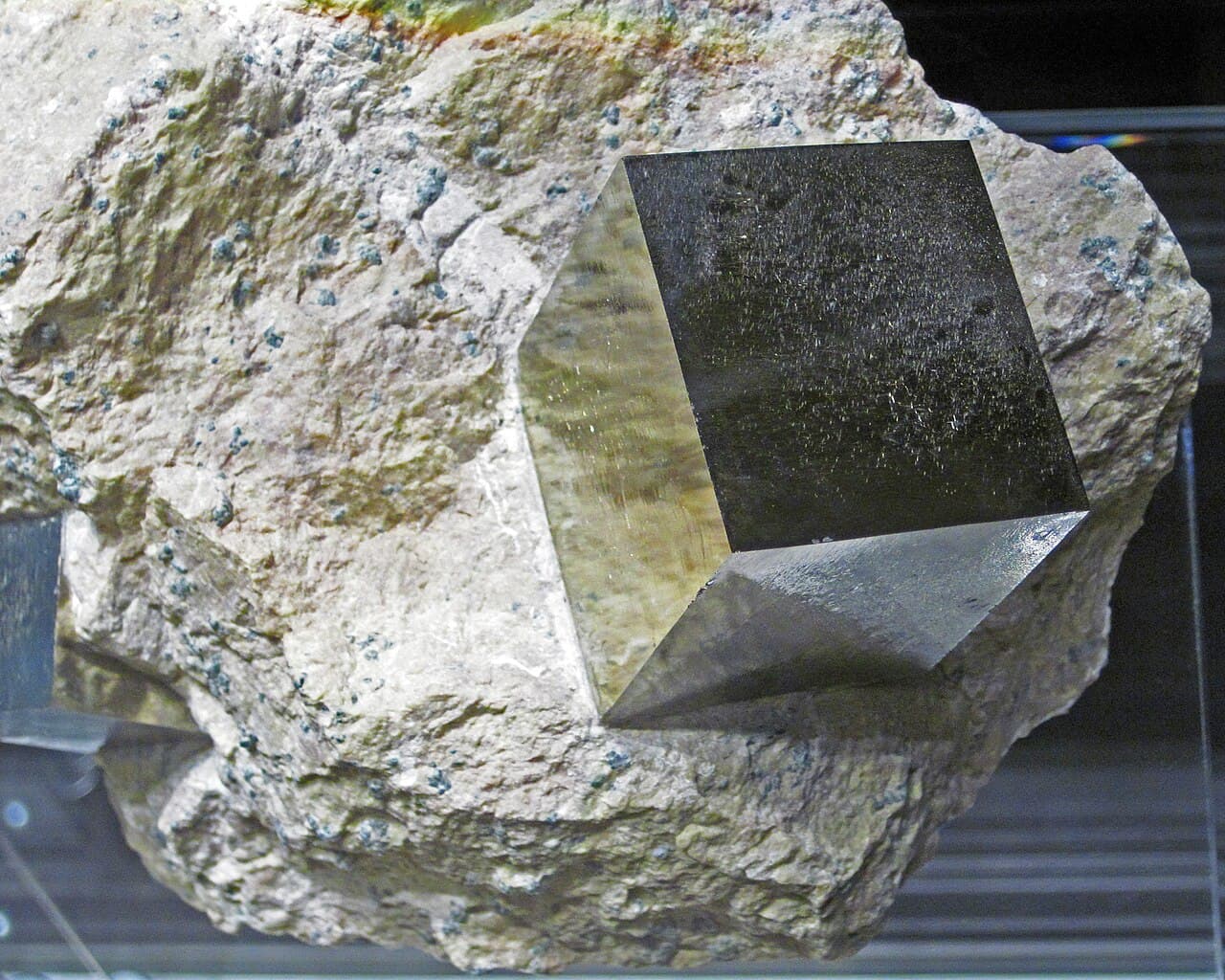
Pyrite is iron sulfide (FeS₂), the most common and widespread sulfide mineral on Earth. Its pale brass-yellow color and bright metallic shine have fooled prospectors for centuries, which is why it earned the nickname "fool's gold." Despite the resemblance, it is a completely different mineral from gold and is worth a tiny fraction of the price.
Pyrite is best known for its remarkable crystals: sharp, mirror-faced cubes and twelve-sided pyritohedrons that look almost machine-made, often with fine parallel grooves (striations) across the faces. It is hard, brittle and surprisingly heavy, and it is the classic teaching example of how a streak test and a hardness test can instantly separate a look-alike from the real thing.
Pyrite at a glance
- Classification
- Mineral — iron sulfide (the sulfide class)
- Composition
- FeS₂ (iron disulfide)
- Hardness
- 6–6.5 (Mohs)
- Luster
- Metallic
- Streak
- Greenish-black to brownish-black
- Colors
- Pale brass-yellow, often with a brown to iridescent tarnish
- Crystal system
- Cubic (isometric)
- Transparency
- Opaque
- Magnetic
- Not magnetic when fresh (a strongly magnetic "pyrite" specimen is usually altered or mislabeled)
How to identify pyrite
Three quick tests settle nearly every pyrite identification. First, the streak: drag the mineral across an unglazed porcelain tile and pyrite leaves a greenish-black to brownish-black mark — never a yellow one. Second, hardness: pyrite is hard (6–6.5), so a steel knife or nail will not scratch it, and it will scratch glass. Third, brittleness: pyrite is brittle and shatters or powders under a sharp blow, rather than denting or flattening the way a soft metal would.
Color and luster get you to a short list. Pyrite is a pale, brassy yellow with a bright metallic luster, frequently dulled by a brown, blue or rainbow tarnish on exposed surfaces. The strongest visual clue is crystal shape: well-formed pyrite grows as cubes, octahedra and pyritohedrons, and many cube faces carry fine parallel striations that run at right angles to those on the neighboring face.
Pyrite is also noticeably dense — heavier in the hand than a quartz pebble of the same size — and it is opaque, so no light passes through even thin edges. Struck hard against steel it can throw sparks and gives off a faint sulfur (rotten-egg) smell, a nod to its sulfide chemistry.
Pyrite vs. gold (fool's gold)
This is the comparison pyrite is famous for, and a handful of tests make it foolproof. The single most reliable check is the streak. Rubbed on unglazed porcelain, pyrite leaves a greenish-black to brownish-black streak, while real gold leaves a soft, shiny yellow streak. A metallic-yellow grain that streaks dark is not gold.
Hardness and behavior are just as telling. Gold is soft (about 2.5–3 on the Mohs scale) and malleable: a pin or knife point dents and carves it, and a hammer flattens it into a sheet. Pyrite is hard (6–6.5) and brittle: it cannot be scratched by a knife, and instead of flattening it crumbles into a grayish powder. So if a "nugget" can be cut or squashed like soft metal, it is gold; if it shatters, it is pyrite.
Shape and color help confirm. Pyrite tends to form crisp geometric crystals — cubes and pyritohedrons with striated faces — whereas gold occurs as rounded grains, flakes, wires and irregular nuggets, almost never as sharp cubes. Pyrite's color is a paler, brassier yellow that often tarnishes, while gold holds a richer, buttery yellow that never tarnishes or rusts. Finally, gold is dramatically denser (roughly four times as heavy as pyrite for the same size), which is why panning works: gold sinks and stays put while pyrite washes away. Note that the related mineral chalcopyrite is the other common "fool's gold," and the same streak and hardness tests separate it too.
How pyrite forms and where it is found
Pyrite forms across an enormous range of geologic settings, which is why it is found almost everywhere. It crystallizes from hot, metal-rich fluids in hydrothermal veins (commonly alongside quartz and other sulfides), settles out of mineral-rich water in sedimentary rocks, and grows in low-oxygen muds where bacteria help convert iron and sulfur into iron sulfide. It is a frequent accessory mineral in shale, coal seams, limestone and many ore deposits.
Because it grows in so many environments, pyrite turns up as everything from microscopic grains scattered through rock, to brassy cubes embedded in slate and shale, to dramatic radiating "pyrite suns" and the rounded nodules sometimes split open to reveal a starburst of crystals. It commonly keeps company with gold, copper and other sulfide minerals, which historically made it a useful indicator that prospectors were near valuable ore even when the pyrite itself was worthless.
Meaning and uses
In crystal and metaphysical traditions, pyrite's gold-like shine has made it a symbol of wealth, abundance and protection, and it is often kept as a "prosperity" or confidence stone. These associations are cultural and spiritual rather than scientifically established medical effects — pyrite is no substitute for medical or financial advice, and it should be enjoyed for its history and striking appearance.
Practically, pyrite has a long industrial history: it was once a major source of sulfur for producing sulfuric acid, and centuries ago its ability to throw sparks made it useful for striking fire and in early firearm mechanisms. Today it is valued mostly by mineral collectors for its near-perfect natural crystals, and as a decorative stone, though its tendency to tarnish and decay limits its use in fine jewelry.
Value and care: the "pyrite disease" problem
Pyrite is an inexpensive, abundant mineral, and most specimens are modestly priced. Value is driven by crystal quality rather than rarity: sharp, lustrous, untarnished crystals, well-formed cubes and pyritohedrons, striking "pyrite sun" disks, and clean specimens on attractive matrix command the most interest from collectors. Tarnished, crumbling or partly decomposed pieces are worth far less.
Pyrite's biggest weakness is that it is not stable forever. In humid air it can slowly react with oxygen and moisture in a process collectors call "pyrite disease" (or pyrite decay), breaking down into iron sulfates. The signs are a white, yellow or greenish powdery crust, a sour sulfur smell, cracking, and crumbling — and the damage can spread to nearby specimens and even corrode labels and storage materials.
To slow this down, keep pyrite cool, dry and away from high humidity; avoid washing it in water; and store affected pieces away from other minerals. There is no way to reverse advanced decay, so dry, stable storage is the best protection. This same instability is why pyrite is a poor choice for everyday jewelry, where skin moisture and air accelerate tarnishing.
Pyrite look-alikes
Frequently asked questions
What is pyrite?
Pyrite is iron sulfide (FeS₂), the most common sulfide mineral. It is a hard, brittle, brass-yellow mineral with a metallic shine and a greenish-black streak, famous for its sharp cubic crystals and its "fool's gold" nickname.
How can I tell pyrite from real gold?
Use the streak and a hardness test. Pyrite leaves a greenish-black streak on unglazed porcelain and is hard and brittle (it shatters and can't be scratched by a knife). Gold leaves a yellow streak, is soft and malleable (it dents and flattens), never tarnishes, and is much heavier. Sharp cubes point to pyrite; rounded flakes and nuggets point to gold.
Is pyrite magnetic?
Fresh pyrite is essentially not magnetic — it is not attracted to an ordinary magnet. That helps separate it from magnetite, which is strongly magnetic. A "pyrite" sample that responds strongly to a magnet has usually altered to other iron minerals or is mislabeled.
What is pyrite worth and what is it used for?
Pyrite is abundant and inexpensive; price depends on crystal quality, with sharp, untarnished cubes and "pyrite suns" being the most collectible. Historically it was mined for sulfur and used to make sparks for fire-starting; today it is mainly a collector's mineral and decorative stone.
What does pyrite symbolize?
Pyrite is treated as a stone of confidence, willpower and abundance — its brassy, sun-like shine tied it to vitality and protection in older traditions, and modern crystal practice frames it as a stone of motivation. The 'fool's gold' history cuts both ways, giving it a second folk reputation as a reminder that not everything glittering is what it appears to be. These meanings are cultural and spiritual rather than medical or financial: pyrite is a striking mineral to keep, but it treats no condition and is no substitute for professional advice.
Is yours pyrite? Find out from a photo
Photograph your mineral in good light and get an identification with an honest confidence level, the look-alikes to rule out and the at-home tests that confirm it.
Identify my mineral freeOn Android? Get the free rock identifier app
Related
Compare pyrite with look-alikes
More minerals in the field guide
Related reading
Keep exploring
More on minerals: how to identify a mineral, the streak test and the full list of crystal types.
Last updated 2026-07-19. Identification guidance is educational — confirm important results with the diagnostic tests described or a qualified expert.