Smithsonite
Also known as: Zinc spar, Bonamite (green-blue variety), Turkey fat ore (yellow variety)
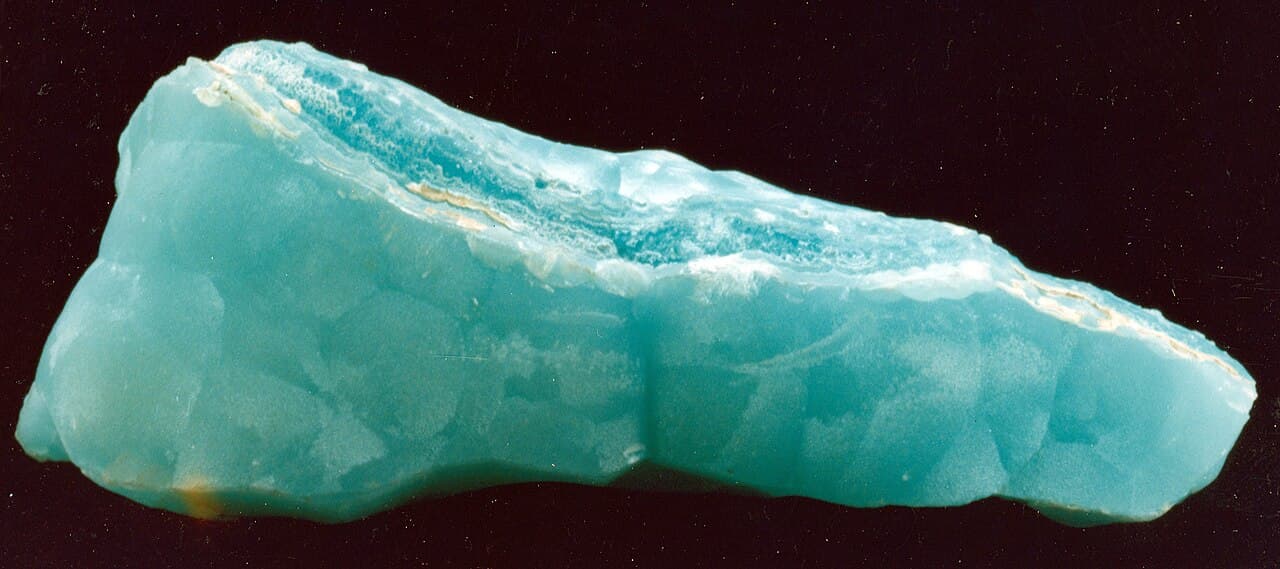
Smithsonite is zinc carbonate (ZnCO₃) and was historically an important ore of zinc, but among collectors it is loved for something far more photogenic: its soft, botryoidal crusts that look like clusters of tiny grapes or bunches of frozen bubbles. The most coveted smithsonite is a glowing blue-green to teal, draped over rock in smooth, rounded mounds with a satiny, almost luminous sheen — a luster mineralogists describe as silky to pearly. It also occurs in pink, lavender, yellow, brown, gray, and near-colorless, but it is the candy-like blue-green material that made the mineral famous and that most people picture when they hear its name.
The mineral is named after James Smithson (1765–1829), the English chemist and mineralogist whose bequest founded the Smithsonian Institution, and it forms in the weathered, oxidized upper zones of zinc ore deposits, where circulating water alters primary zinc minerals into this carbonate. That origin explains its typical look: rather than sharp, free-standing crystals, smithsonite usually appears as encrusting, grape-like (botryoidal) or kidney-shaped masses lining cavities and coating other rock. Because it is a carbonate, it shares one quick, reliable behavior with calcite and its kin — it fizzes in warm, dilute acid — and that single reaction is one of the keys to telling it apart from the silicate look-alikes it is most often confused with.
Smithsonite at a glance
- Classification
- Mineral — zinc carbonate (the calcite group of carbonates)
- Composition
- ZnCO₃
- Hardness
- 4–4.5 (Mohs)
- Luster
- Silky to pearly on botryoidal crusts; vitreous on crystal faces
- Streak
- White
- Colors
- Famously blue-green to teal; also pink, lavender, yellow, brown, gray, and colorless
- Crystal system
- Trigonal
- Transparency
- Translucent to opaque
- Magnetic
- Not magnetic
How to identify it
Start with the look and feel. Classic smithsonite forms smooth, botryoidal (grape-like) or kidney-shaped crusts with a distinctive silky-to-pearly sheen, most strikingly in glowing blue-green and teal but also in pink, yellow, and lavender. That rounded, bubbly habit combined with the soft satiny glow is the first strong clue. Next, check hardness and weight: smithsonite is 4 to 4.5 on the Mohs scale — harder than calcite but still scratched by a steel knife — and it feels noticeably heavy for its size because zinc is a fairly heavy element, giving it a high specific gravity around 4.4.
The decisive confirmation is the acid test. Because smithsonite is a carbonate, a drop of warm, dilute hydrochloric acid makes it fizz and release carbon dioxide bubbles (the reaction is weak in cold acid and brisker when the acid is warmed). This single behavior separates it cleanly from its most common impostor, hemimorphite, which is a zinc silicate and does not fizz at all. A heavy, knife-soft, botryoidal blue-green crust with a silky luster that effervesces in warm acid is almost certainly smithsonite. A white streak and the absence of magnetism round out the picture.
Colors and varieties
Pure smithsonite is white or colorless, but trace impurities produce a remarkable spread of colors, and several have earned their own collector names. Copper tints it the prized apple-green to blue-green and teal — the so-called "bonamite" material that is the most sought-after of all. Cobalt and manganese give pink to lavender and purple shades; iron and cadmium produce the yellow to honey-brown "turkey fat ore"; and other specimens are simply gray, tan, or brown. Whatever the hue, the diagnostic combination stays the same: a silky-pearly luster, a botryoidal habit, real heft, and a fizz in warm acid.
Smithsonite is far more often seen as encrusting, grape-like, or stalactitic masses than as distinct crystals. When crystals do form they are small rhombohedral or scalenohedral shapes, sometimes curved or saddle-like, but the mineral's signature is the rounded, bubbly botryoidal crust draped over its host rock. Collectors particularly prize smooth, evenly colored blue-green and teal cabinet pieces, the soft pinks and lavenders, and gemmy yellow material; dull, crumbly, or earthy ore-grade smithsonite is far more common and far less valued.
Meaning and properties
In modern crystal-working traditions smithsonite is described as a soothing, comforting stone associated with calm, emotional security, and gentle self-care, with its soft colors and rounded shapes taken as symbols of nurturing and ease. These associations come from folklore and personal practice rather than any measurable physical effect of the mineral, and smithsonite's documented importance is mineralogical and historical — as a zinc ore and as a museum-quality specimen — rather than metaphysical.
It is fine to enjoy, display, and collect smithsonite, but it should never be treated as a remedy for any physical or mental health condition; it is not a substitute for advice or treatment from a qualified professional. A practical note follows from its softness and its carbonate chemistry: because acids dissolve it, smithsonite is unsuitable for any use involving skin contact with sweat or for the now-discredited practice of making "crystal-infused" water, and as with any mineral it is best simply appreciated and kept out of the mouth.
Value
Smithsonite's value splits sharply between bulk ore and display specimens. As a zinc ore it has little individual worth and is valued only by chemical grade, but as a mineral specimen the best material can be highly desirable. Collector value follows color, luster, and form: glowing, evenly colored blue-green and teal botryoidal pieces with a strong silky sheen are the most prized, followed by clean pinks, lavenders, and gemmy yellows, while gray, brown, or crumbly material is common and inexpensive. Size, an undamaged surface, and a notable locality all add to desirability.
As jewelry, smithsonite is a fragile choice. At 4 to 4.5 on the Mohs scale it is too soft to resist everyday scratching and abrasion, and it has perfect rhombohedral cleavage that makes it prone to chipping, so it is usually cut as cabochons for collectors and protective settings rather than for hard-wearing rings. Faceted smithsonite exists but is a delicate curiosity. As with all minerals, worth depends on the interplay of color, clarity, size, condition, and locality rather than any single fixed figure, and intact, vividly colored specimens command a clear premium over dull or damaged material.
Real vs. fake
Outright synthetic smithsonite is uncommon, so the real challenge is honest identification — chiefly telling true smithsonite from the similar minerals it is sold alongside, and watching for dyed or color-enhanced pieces. The most important comparison is with hemimorphite, a zinc silicate that forms nearly identical blue-green botryoidal crusts. The clean separator is the acid test: smithsonite is a carbonate and fizzes in warm, dilute acid, while hemimorphite does not react at all. Smithsonite is also slightly heavier and a touch softer.
Confirm a specimen with a few simple checks. Genuine smithsonite is heavy for its size (high specific gravity), is soft enough to be scratched by a knife but not by a coin, gives a white streak, and effervesces in warm dilute acid. Because the prized blue-green and pink colors command a premium, be alert to enhancement: watch for color that looks unnaturally uniform or that pools and concentrates in cracks, dye that rubs off on a damp cloth, or a suspiciously low price for an intensely colored "teal" piece. When in doubt, the fizz-versus-no-fizz test against hemimorphite is the quickest and most reliable distinction.
Care
Smithsonite needs gentle handling on two counts: it is soft and cleaves easily, and it is chemically reactive. At 4 to 4.5 on the Mohs scale with perfect cleavage, its botryoidal crusts and any crystal faces chip and abrade readily, so store it away from harder minerals, support delicate pieces by the base, and keep it from knocking against other specimens. Some smithsonite may also fade slightly in prolonged strong light, so keep prized colored pieces out of harsh, direct sunlight.
Crucially, never clean smithsonite with anything acidic. Because it is a carbonate, acids — including vinegar and many commercial cleaners — will etch and dissolve the surface and destroy its luster. Clean it only by light dusting with a soft brush, or at most a quick wipe with a barely damp cloth of plain water followed by prompt, thorough drying. Avoid soaking, harsh chemicals, and ultrasonic or steam cleaners, whose vibration and heat can split the stone along its cleavage. Store smithsonite separately, cushioned in soft cloth or its own padded compartment.
Smithsonite look-alikes
Frequently asked questions
How can I tell smithsonite from hemimorphite?
They look almost identical — both form glowing blue-green botryoidal crusts — so collectors confuse them constantly. The reliable test is acid: smithsonite is zinc carbonate and fizzes when a drop of warm, dilute hydrochloric acid is applied, releasing carbon dioxide bubbles, while hemimorphite is a zinc silicate and shows no reaction at all. Smithsonite is also slightly heavier for its size and a touch softer.
Why is smithsonite so prized by collectors?
Mostly for its rare combination of color and texture. The best smithsonite drapes over rock in smooth, grape-like botryoidal mounds with a soft silky-to-pearly glow, and the copper-tinted blue-green and teal material is especially coveted. Add the pinks, lavenders, and gemmy yellows it can show, and well-formed, vividly colored cabinet specimens become genuinely sought-after, while ordinary gray or brown ore-grade material is common and inexpensive.
Is smithsonite hard enough to wear as jewelry?
Only with care. At 4 to 4.5 on the Mohs scale smithsonite is fairly soft and has perfect cleavage, so it scratches and chips more easily than durable gem stones like quartz or topaz. It is usually cut as cabochons for collectors and set in protective mountings rather than used in hard-wearing rings. It also dissolves in acid, so it should be kept away from sweat, perfume, and household cleaners.
Why does smithsonite fizz in acid?
Because it is a carbonate. Smithsonite is zinc carbonate (ZnCO₃), and carbonate minerals react with acid to release carbon dioxide gas, which appears as fizzing bubbles. The reaction is weak in cold acid and noticeably brisker when the dilute acid is warmed. This fizz is one of the quickest ways to confirm smithsonite and to separate it from non-carbonate look-alikes such as hemimorphite, chrysocolla, and prehnite, which do not react.
Is yours smithsonite? Find out from a photo
Photograph your mineral in good light and get an identification with an honest confidence level, the look-alikes to rule out and the at-home tests that confirm it.
Identify my mineral freeOn Android? Get the free rock identifier app
Related
More minerals in the field guide
Keep exploring
More on minerals: how to identify a mineral, the streak test and the full list of crystal types.
Last updated 2026-06-25. Identification guidance is educational — confirm important results with the diagnostic tests described or a qualified expert.