Moonstone
Also known as: Adularia, Hecatolite, Ceylon moonstone, Rainbow moonstone (trade name for labradorite)
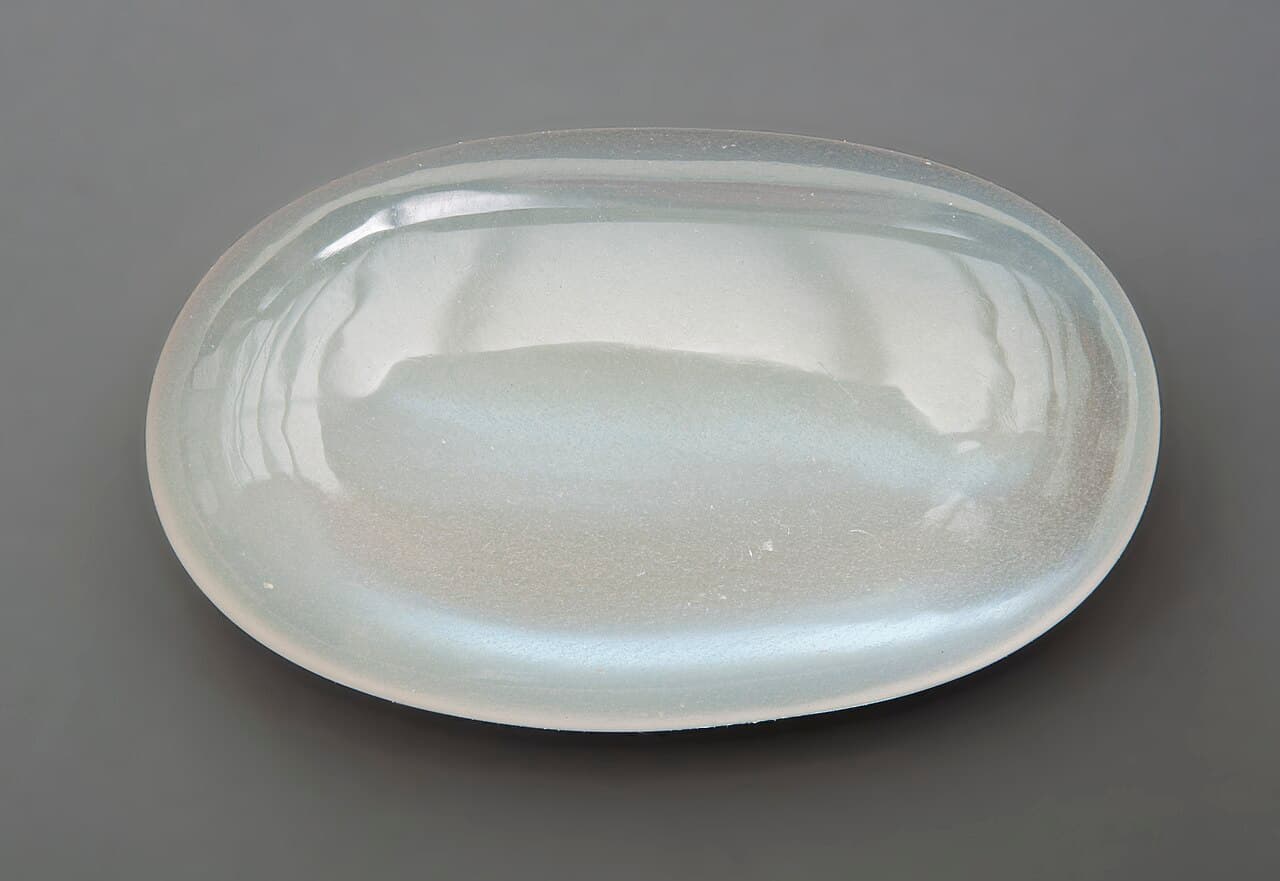
Moonstone is a gem variety of feldspar prized for one optical trick above all else: a soft, floating glow of light that drifts across the stone as you tilt it, like moonlight seen through thin cloud. Most classic moonstone belongs to the orthoclase–albite series of potassium-sodium feldspars, sitting close to the mineral adularia, with a hardness of about 6 to 6.5 on the Mohs scale and the two intersecting cleavage directions typical of all feldspars. The body is usually colorless to milky white and semi-transparent, but the stone itself is almost beside the point — what buyers pay for is the billowy sheen riding on top of it.
That sheen has a name, adularescence, and it is the single most diagnostic thing about moonstone. As the gem formed and slowly cooled, it separated into alternating microscopic layers of two slightly different feldspars; light striking those ultra-thin layers scatters and recombines, producing a glow that appears to hover just beneath the surface and slide as the viewing angle changes. The finest material shows this glow in a cool electric blue against a nearly transparent body, while more common stones show a white or silvery sheen on a cloudier base. Learn to recognize adularescence and you can tell true moonstone from the many imitations that try to fake a glow they cannot truly reproduce.
Moonstone at a glance
- Classification
- Gemstone — adularescent variety of feldspar (orthoclase–albite series, near adularia)
- Composition
- (K,Na)AlSi₃O₈
- Hardness
- 6–6.5 (Mohs)
- Luster
- Vitreous to slightly pearly, with a floating internal sheen (adularescence)
- Streak
- White
- Colors
- Colorless to white body, most often with a blue or silvery-white sheen; also peach, gray, green and multicolored 'rainbow' material
- Crystal system
- Monoclinic (orthoclase) to triclinic (albite-rich and 'rainbow' types)
- Transparency
- Transparent to translucent
How to identify it
The defining test for moonstone is adularescence. Hold the stone under a single light source and rock it slowly: genuine moonstone shows a soft, billowy sheen that appears to float beneath the surface and glide across the gem as the angle changes, rather than sitting flat on the surface like a polished shine. In the best stones this glow is a cool blue and seems to come from deep inside an almost water-clear body; in more ordinary material it is a milky white or silvery cloud on a hazier base. The key is that the light moves and seems three-dimensional — a fixed, even, all-over glow that never shifts is the signature of glass or plastic imitation, not feldspar.
Physical properties confirm the call. Moonstone is a feldspar, so it is moderately hard at 6 to 6.5 on the Mohs scale, leaves a white streak, and breaks along two cleavage directions that meet at close to ninety degrees — chipped or worn edges may reveal those flat, stepped cleavage faces. Many moonstones also contain tiny internal stress cracks, often called centipede inclusions because they look like a row of fine fissures, and these natural flaws are actually reassuring evidence that the stone is real feldspar rather than flawless manufactured glass. Taken together, a floating blue-to-white sheen, a hardness near 6.5, two-direction cleavage and faint internal cracks point firmly at moonstone.
Colors and varieties
Classic moonstone has a colorless to white body, and it is graded mainly by the color and strength of its sheen rather than the body color. The most coveted variety, historically associated with Sri Lanka, combines a near-transparent, almost glassy body with a vivid blue adularescence — the so-called blue moonstone, the rarest and most valuable type. Below that sit stones with a white or silvery sheen on a slightly cloudier base, which are far more common and more affordable. Beyond the colorless range, moonstone also occurs with warm peach or apricot body color and with smoky gray bodies, the latter sometimes marketed as gray or 'cat's eye' moonstone when it shows a sharp line of light.
One important point of confusion belongs here: much of the multicolored material sold as 'rainbow moonstone' is not orthoclase moonstone at all but a variety of labradorite, a different feldspar that flashes broad sweeps of blue, gold and violet. It is a beautiful and legitimate gem, but mineralogically it is closer to labradorite than to true moonstone, and a careful seller will note the distinction. Some moonstones additionally show a moving band of light (chatoyancy, the cat's-eye effect) or a four-rayed star (asterism) when cut as a smooth domed cabochon, both caused by light reflecting off oriented internal structures.
Meaning and properties
Across many cultures moonstone has been tied to the moon, to night, and to cycles of renewal, and it remains one of the most romantic of gems — long given as a token of love and considered a traveler's stone, especially for journeys by water or by night. In modern crystal-working traditions it is often described as a stone of intuition, calm, new beginnings and feminine energy, popular for meditation and for marking transitions and fresh starts. As the June birthstone it also carries a gentle, sentimental association that has kept it in steady demand for jewelry.
These meanings are cultural, spiritual and personal rather than scientifically demonstrated medical effects. Moonstone is a lovely gem to wear or keep for reflection and intention, but it does not diagnose, cure, treat or prevent any physical or mental health condition, and it is not a substitute for professional medical or psychological care.
Value
Moonstone's value is driven almost entirely by the quality of its adularescence, the clarity of its body, and the absence of distracting cracks. The most prized stones combine a transparent, nearly colorless body with a strong, mobile blue sheen that seems to billow from deep inside; these top blue moonstones are genuinely scarce and sit far above ordinary material. Stones with a silvery-white sheen, a cloudier body, or a sheen that only appears at a narrow angle are much more modestly priced, and heavily cracked or chalky pieces are inexpensive. Good cutting matters too: a well-oriented, well-domed cabochon centers the glow over the top of the stone, whereas a poorly cut one buries it off to one side.
Color varieties and special effects can shift desirability in either direction. A clean peach moonstone or a sharp, well-centered cat's-eye can command a premium for its character, while a gray or off-white stone with weak sheen will be among the least costly. Because moonstone is found in several countries and quality ranges enormously, the practical guidance for a buyer is to judge the individual stone in hand — strength and color of the sheen, transparency of the body, and how cleanly it is cut — rather than to rely on the name alone, since 'moonstone' covers everything from collector-grade blue gems to humble milky tumbles.
Real vs. fake
The most common moonstone imitation is opalite, a man-made glass (sometimes called 'sea opal' or 'opalized glass') engineered to glow milky blue-white. The tell is the quality of the glow: opalite produces an even, all-over, slightly artificial sheen that does not truly float or shift, and against a dark background it often looks faintly blue while against a light background it looks warm orange, an optical behavior typical of glass rather than feldspar. Genuine moonstone instead shows a billowy adularescence that moves and seems to come from within, usually has tiny natural internal cracks, and feels cool to the touch and slightly heavier in hand, whereas glass warms up quickly and may show gas bubbles or molded edges under magnification.
Beyond glass, moonstone is most often confused with other natural stones rather than deliberately faked, so identification is mostly a matter of telling them apart. Milky chalcedony can mimic the cloudy body but lacks any moving sheen and shows no cleavage. White labradorite and 'rainbow moonstone' are real feldspars but tend to flash broader, more colorful sweeps of light rather than the soft single glow of true orthoclase moonstone. Girasol quartz, a hazy quartz with a faint inner light, is harder (about 7 on the Mohs scale, so it resists scratching better) and shows no feldspar cleavage. When in doubt, anchor on the three feldspar fingerprints — a hardness near 6.5, two-direction cleavage on a chipped edge, and a floating rather than fixed glow.
Care
Moonstone is only moderately hard and, like all feldspars, brittle along its cleavage, so it needs more care than a tougher gem such as quartz or sapphire. It can scratch against harder stones and can chip or split if knocked sharply, dropped, or set where it takes daily impact, which makes it better suited to earrings, pendants and occasional-wear rings than to an everyday ring exposed to constant bumps. The natural internal cracks many moonstones carry are also potential weak points, so avoid sudden temperature changes that could stress them.
Clean moonstone gently with warm water, a drop of mild soap, and a soft cloth or soft brush, then rinse and pat it dry. Steer clear of ultrasonic and steam cleaners, which can drive vibration or heat into the cleavage planes and existing fractures and start a crack, and keep the stone away from harsh chemicals, acids and abrasive cleaners. Store it on its own in a soft pouch or a lined compartment so harder gems cannot scratch its surface. With gentle cleaning, protection from knocks, and no thermal shock, moonstone keeps its glow and polish for generations.
Moonstone look-alikes
Frequently asked questions
What makes moonstone glow?
The glow is an optical effect called adularescence. As the gem cooled it separated into alternating microscopic layers of two slightly different feldspars; light striking those ultra-thin layers scatters and recombines, producing a soft sheen that appears to float beneath the surface and move as you tilt the stone. It is the single most reliable sign of genuine moonstone.
Is rainbow moonstone real moonstone?
Not exactly. Most material sold as 'rainbow moonstone' is a variety of labradorite, a different feldspar that flashes broad sweeps of blue, gold and violet rather than the soft single glow of true orthoclase moonstone. It is a genuine, beautiful gem, but mineralogically it is closer to labradorite, and careful sellers note the distinction.
How can I tell real moonstone from opalite glass?
Watch the glow and check hardness. Real moonstone shows a billowy sheen that floats and shifts from within, has tiny natural internal cracks, shows feldspar cleavage on a chipped edge, and feels cool and slightly heavy. Opalite is man-made glass with an even, fixed glow that looks blue over dark and orange over light, may contain bubbles, and warms quickly in the hand.
Is moonstone a birthstone?
Yes. Moonstone is one of the traditional birthstones for June, alongside pearl and alexandrite. It has long been linked to the moon, to new beginnings and to travel, which has helped keep it a popular and sentimental choice for jewelry.
What does moonstone symbolize?
Moonstone has been linked to the moon, intuition and new beginnings across many cultures — Roman lore held that it was solidified moonlight, and Indian tradition treated it as a sacred stone of good fortune. Modern crystal practice associates it with emotional balance and fresh starts, and as a June birthstone it stands for intuition and renewal. These meanings are cultural and spiritual rather than medical; moonstone is meaningful to wear, but it treats no condition.
What are peach, black and blue moonstone?
They are body-color varieties of the same feldspar. Classic moonstone has a white-to-colorless body with a blue-white sheen; blue moonstone — the most prized — shows a vivid blue adularescence floating over a near-transparent body; peach (or yellow) moonstone has a warm apricot body with a softer, honeyed glow; and 'black moonstone' is a dark grey-to-black feldspar, often from Madagascar, with a subtle silvery flash. Rainbow moonstone, despite its name, is technically labradorite.
Is yours moonstone? Find out from a photo
Photograph your gemstone in good light and get an identification with an honest confidence level, the look-alikes to rule out and the at-home tests that confirm it.
Identify my gemstone freeOn Android? Get the free rock identifier app
Related
Compare moonstone with look-alikes
More gemstones in the field guide
Keep exploring
More on gemstones: the full list of crystal and gem types, how to identify gemstones and the polished-stone identifier.
Last updated 2026-07-19. Identification guidance is educational — confirm important results with the diagnostic tests described or a qualified expert.