Scapolite
Also known as: Wernerite, Marialite-Meionite series
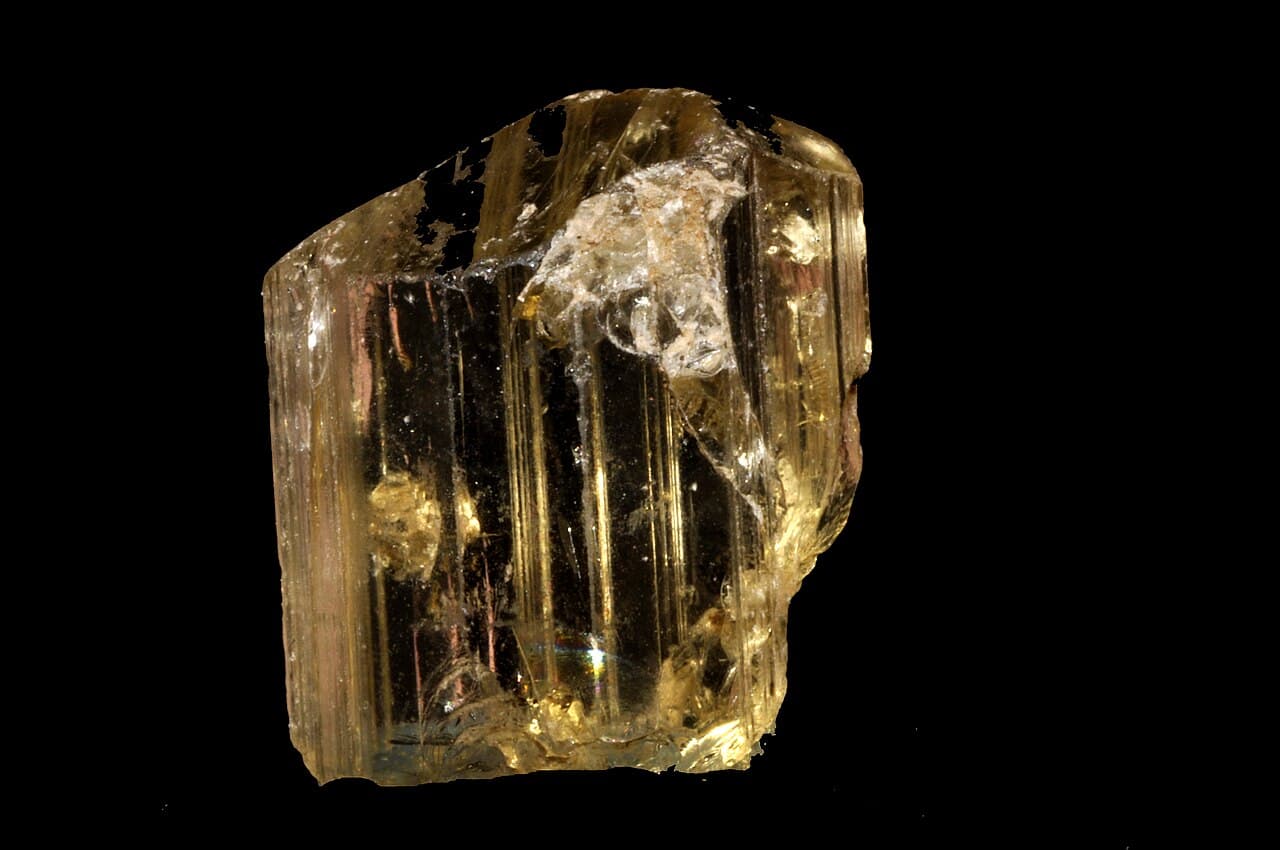
Scapolite is the name for a group of closely related aluminosilicate minerals rather than a single fixed species, and that is the first thing to understand about it. It forms a continuous series between two end members, sodium-rich marialite and calcium-rich meionite, with most natural stones falling somewhere in between, so its exact chemistry shifts from specimen to specimen. As a gemstone it is something of a connoisseur's choice: less famous than the stones it resembles, but loved by collectors for its warm yellows, soft violets and pinks, its often dramatic pleochroism, and its frequent ability to show a cat's-eye when cut as a cabochon. The older name wernerite is still encountered for the group, especially in mineral collections.
What gives scapolite its character as a gem is a combination of moderate hardness and lively optical behavior. At roughly 5.5 to 6 on the Mohs scale it is softer than quartz, which makes it more of a collector's and occasional-wear stone than a rugged everyday ring gem. But it more than compensates with personality: many scapolites are strongly pleochroic, showing noticeably different colors or intensities as the stone is turned, they commonly contain fine parallel inclusions that produce a sharp chatoyant eye, and many fluoresce in vivid colors under ultraviolet light. Those optical traits, taken together, are exactly what help separate scapolite from the better-known yellow and purple gems it is so often mistaken for.
Scapolite at a glance
- Classification
- Silicate mineral group (tectosilicate, marialite-meionite series)
- Composition
- (Na,Ca)4[(Al,Si)3Si3O24](Cl,CO3,SO4)
- Hardness
- 5.5 to 6 (Mohs)
- Luster
- Vitreous to slightly pearly or resinous
- Streak
- White
- Colors
- Yellow, violet to purple, pink, colorless, gray, and brown
- Crystal system
- Tetragonal
- Transparency
- Transparent to translucent
- Magnetic
- Not magnetic
How to identify it
Scapolite is best identified by a cluster of optical and physical clues rather than color alone, because its colors overlap so heavily with more common gems. Start with hardness: at about 5.5 to 6 on the Mohs scale it is distinctly softer than quartz, so a stone in scapolite's color range that is scratched more easily than expected is a candidate. Then look for pleochroism. Many scapolites visibly change color or depth of tone as you rotate the stone, a yellow stone may shift in saturation, and a violet stone can swing between purplish and bluish or near-colorless, an effect that is much stronger than in citrine or most quartz. A glassy vitreous luster and a white streak round out the basics.
Two further features are especially diagnostic. First, chatoyancy: scapolite very commonly contains fine parallel hollow tubes or needle inclusions, so when cut as a cabochon it frequently shows a sharp cat's-eye band of light, and a chatoyant yellow or pinkish stone of moderate hardness is a strong scapolite suspect. Second, fluorescence: many scapolites glow in bright colors under ultraviolet light, often yellow, orange, pink, or red, which can help separate them from look-alikes that stay dark. Because scapolite is a series rather than one mineral and shares ground with quartz, beryl, and others, confident identification of a faceted stone usually rests on combining these traits, hardness, strong pleochroism, frequent chatoyancy, and fluorescence, and a gemological refractive-index reading is the surest confirmation.
Colors and varieties
Gem scapolite spans a warm and gentle palette. The most familiar colors are yellow to golden, ranging from pale honey to rich amber-yellow, and violet to purple, from soft lilac to deeper amethyst-like tones, while pink, colorless, gray, and brown stones also occur. The yellow material is colored largely by iron, and many of the purple and pink stones owe their tone partly to natural irradiation, with color that can be pale or, in fine examples, pleasingly saturated. Because scapolite is so often strongly pleochroic, a single cut stone can present two noticeably different faces of color as it is turned, which is part of its appeal to those who know it.
Rather than trade-named color varieties, scapolite is better thought of in terms of its series and its optical forms. Chemically it grades from sodium-rich marialite to calcium-rich meionite, with most gem material lying between the two. The standout optical variety is cat's-eye scapolite, a translucent stone, often yellow, pink, or gray, cut as a cabochon to display a sharp single band of light from its parallel inclusions, and fine chatoyant scapolite is among the most collectible forms of the mineral. Transparent faceted yellows and violets are the other main category. Some scapolite on the market has had its color altered or deepened by treatment, so it is wise to assume color may be enhanced unless a stone is specifically described as untreated.
Meaning and properties
In crystal and metaphysical traditions, scapolite is sometimes described as a stone of problem-solving, self-discipline, and positive change, and its warm yellow and soft violet tones are linked in those practices with clarity, motivation, and a sense of moving forward through obstacles. Because it is a relatively obscure gem outside collector circles, its lore is less developed than that of mainstream crystals, and the meanings attached to it draw on spiritual, cultural, and personal belief systems rather than on scientific evidence. Scapolite should not be used to diagnose, treat, or cure any physical or mental health condition, and it is not a replacement for professional medical or mental health care.
As a practical matter, scapolite is a pleasant and rewarding stone to own and admire, especially for its pleochroism and cat's-eye effect, but its moderate hardness means it is more of a collector's gem or an occasional-wear piece than a stone for daily knocks. If you are drawn to its symbolic associations with focus and positive change, enjoy it as a beautiful natural object while keeping it safely set or stored, and turn to qualified professionals for any genuine health or wellbeing concern rather than relying on a gemstone.
Value
Scapolite is a collector-oriented gem, and its value is driven by color, transparency, the quality of any cat's-eye, cut, and size. Among faceted stones, clean transparent material with a vivid, saturated color, whether a rich golden yellow or a strong violet to purple, brings the most, while pale, grayish, or heavily included stones are more modest. The strength and attractiveness of pleochroism can add to a stone's appeal, and well-proportioned cuts that show the best face-up color are preferred. Because scapolite is relatively soft, very clean large stones suitable for jewelry are less common, which adds interest to fine examples.
For cat's-eye scapolite, the quality of the eye is the leading value factor: the band should be sharp, bright, well-centered, and straight, and it should open and close cleanly as the stone is rocked, with a strong, even body color adding desirability. As with most colored stones, larger sizes raise per-carat value when color and clarity hold up. Two practical notes affect price: scapolite color may be enhanced by treatment, and untreated stones with strong natural color can be more sought after, while accurate distinction from look-alike gems matters because a stone correctly identified as fine scapolite is judged on its own merits. For an important or high-value stone, an independent gemological report is worthwhile. No specific price figures are offered here.
Real vs. fake
With scapolite the bigger risk is usually misidentification rather than outright fakery, because its yellow and purple stones look so much like more familiar gems. Yellow scapolite is easily confused with citrine quartz, golden beryl, or chrysoberyl, and violet scapolite with amethyst, so the practical safeguards are the diagnostic tests: scapolite is softer than quartz (about 5.5 to 6 versus 7), it is typically more strongly pleochroic than citrine or amethyst, it frequently shows a cat's-eye when cut as a cabochon, and it often fluoresces in bright colors under ultraviolet light. A refractometer reading is decisive, since scapolite's optical values differ from those of quartz, beryl, and chrysoberyl. Glass imitations betray themselves with bubbles, swirl marks, mold seams, and the lack of true pleochroism or a genuine sharp eye.
Treatment is the other thing to be aware of. Some scapolite has its color produced or deepened by irradiation or heating, and such color is generally stable but means a stone described simply as deeply colored may not be entirely natural in tone, so look for material specifically sold as untreated if that matters to you. There is no large-scale synthetic scapolite trade comparable to that for mainstream gems, so the everyday concerns are confusion with other species and enhanced color rather than lab-grown copies. Because separating scapolite from its yellow and purple look-alikes carries real value consequences, and because treatment affects desirability, a laboratory report is the surest confirmation for any significant scapolite, cat's-eye or faceted.
Care
Scapolite needs more protection than the harder gems it resembles. At about 5.5 to 6 on the Mohs scale it is softer than quartz and can be scratched by everyday dust and many common materials, so it is best reserved for earrings, pendants, brooches, and occasional-wear rings rather than a ring worn through daily knocks. It also has distinct cleavage, meaning a sharp blow in the wrong direction can split it, so guard it against impacts and store it separately from harder stones that could scratch it, ideally in its own soft pouch or compartment.
Clean scapolite the gentle way: warm water, mild soap, and a soft brush, then rinse and dry. Avoid ultrasonic and steam cleaners, which can be risky for a stone with cleavage and any internal inclusions, and this caution applies especially to cat's-eye scapolite, whose chatoyancy comes from fine internal tubes that harsher cleaning could exploit. Keep scapolite away from harsh chemicals and prolonged intense heat, and store irradiated or strongly colored stones out of long, harsh sunlight as a sensible precaution. With modest, mindful care, scapolite keeps its color, pleochroism, and sharp cat's-eye for many years.
Scapolite look-alikes
Frequently asked questions
Is scapolite one mineral or a group?
Scapolite is a mineral group, not a single fixed species. It forms a continuous series between sodium-rich marialite and calcium-rich meionite, and most natural stones fall somewhere between the two end members, so the exact chemistry varies from specimen to specimen. The older name wernerite is sometimes used for the group as a whole.
How can I tell scapolite from citrine or amethyst?
Use a combination of tests rather than color. Scapolite is softer than quartz (about 5.5 to 6 versus 7), it is usually much more strongly pleochroic (it shows different colors or intensities as you turn it), it frequently shows a cat's-eye when cut as a cabochon, and it often fluoresces in bright colors under ultraviolet light. A refractive-index reading from a jeweler is the surest way to confirm it.
Why does some scapolite show a cat's-eye?
Scapolite commonly contains many fine, parallel hollow tubes or needle-like inclusions. When the stone is cut as a smooth domed cabochon with those inclusions running the right way, they reflect light into a single sharp band that glides across the surface, producing the cat's-eye effect (chatoyancy). Sharp, well-centered cat's-eye scapolite is among the most collectible forms of the mineral.
Is scapolite durable enough for everyday jewelry?
It is moderately durable but better suited to careful or occasional wear than daily knocks. At about 5.5 to 6 on the Mohs scale it is softer than quartz and can scratch, and it has distinct cleavage that makes it vulnerable to a sharp blow. Earrings, pendants, and brooches are ideal; if worn in a ring, scapolite should be protected from impacts and abrasion.
Is yours scapolite? Find out from a photo
Photograph your gemstone in good light and get an identification with an honest confidence level, the look-alikes to rule out and the at-home tests that confirm it.
Identify my gemstone freeOn Android? Get the free rock identifier app
Related
More gemstones in the field guide
Keep exploring
More on gemstones: the full list of crystal and gem types, how to identify gemstones and the polished-stone identifier.
Last updated 2026-06-25. Identification guidance is educational — confirm important results with the diagnostic tests described or a qualified expert.