Peridot
Also known as: Gem olivine, Chrysolite (historical)
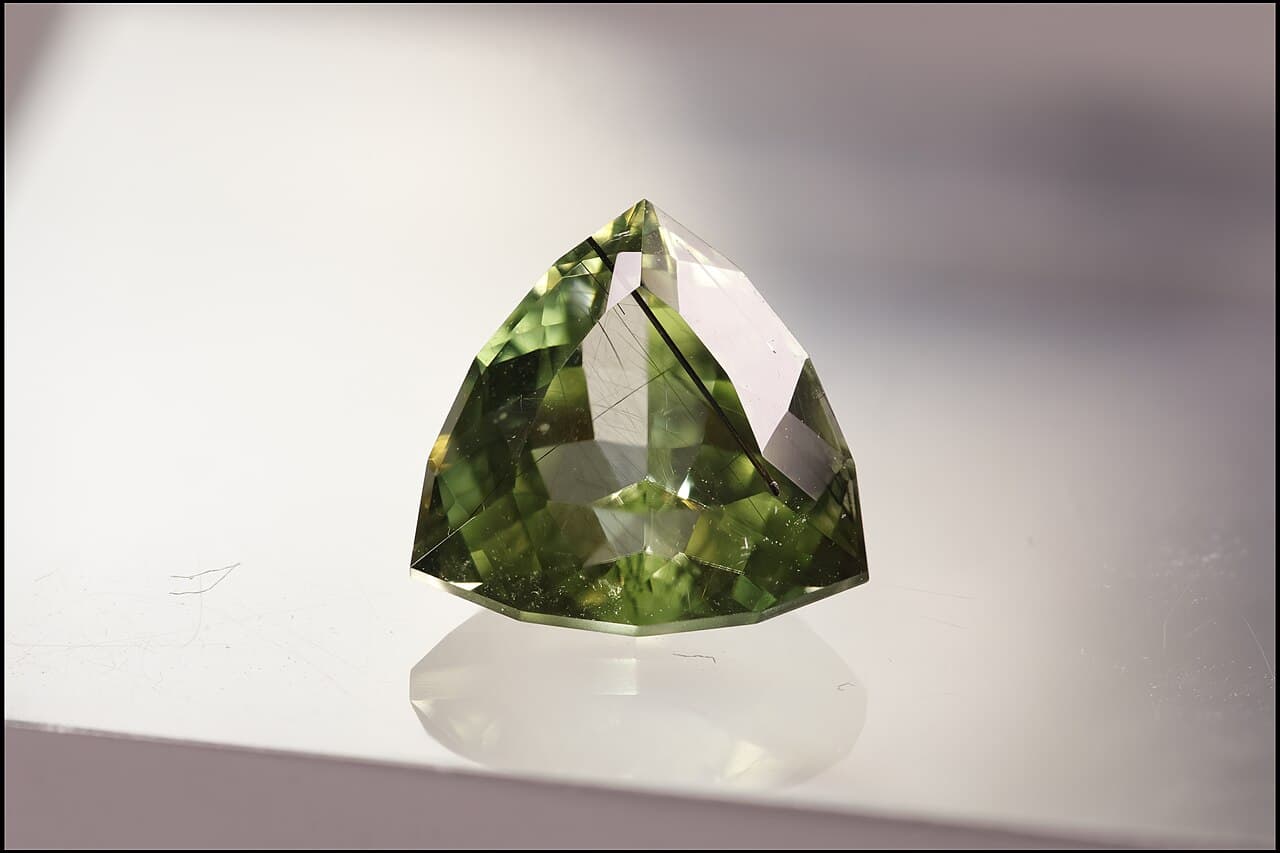
Peridot is the gem-quality variety of the mineral olivine, a magnesium-iron silicate with the formula (Mg,Fe)₂SiO₄. It is one of the few gemstones that comes in essentially a single color: a distinctive yellowish to olive green, sometimes described as "lime" or "bottle" green. Unlike many gems whose hue varies widely, peridot's green is a built-in feature of the mineral itself, caused by iron that is part of olivine's basic chemistry rather than a trace impurity, so the stone does not occur in blue, red, or other colors. It is moderately hard at about 6.5 to 7 on the Mohs scale, crystallizes in the orthorhombic system, and shows a bright vitreous (glassy) luster when faceted.
Peridot has a long and unusual history. The ancient Egyptians mined it from a remote island in the Red Sea and called it the "gem of the sun," and for centuries it was sometimes confused with emerald. Geologically it is a deep-earth gem: olivine forms in iron- and magnesium-rich igneous rocks such as basalt and in peridotite from the Earth's mantle, and it is occasionally carried to the surface in volcanic eruptions. Remarkably, gem-quality olivine has even been found in certain meteorites — the stony-iron pallasites — making peridot one of very few gemstones known to exist beyond our own planet. Today it is best known as the traditional birthstone for August.
Peridot at a glance
- Classification
- Mineral — gem variety of olivine (forsterite–fayalite series)
- Composition
- (Mg,Fe)₂SiO₄
- Hardness
- 6.5–7 (Mohs)
- Luster
- Vitreous (glassy)
- Streak
- White to colorless
- Colors
- Yellowish-green to olive green (essentially one signature color)
- Crystal system
- Orthorhombic
- Transparency
- Transparent to translucent
How to identify peridot
Color is the first and strongest clue, because peridot has essentially one: a warm, slightly yellowish green that distinguishes it from the bluer or grass-greens of emerald, tourmaline, and tsavorite garnet. A transparent stone in this lime-to-olive green, with a bright glassy luster, is already a strong candidate for peridot. The most diagnostic feature, though, appears under a jeweler's loupe: peridot has strong double refraction, which means that when you look through the table of a faceted stone you can often see the edges of the back facets appear doubled or slightly blurred, as if printed twice. Few other green gems of this color show such obvious doubling, so this single observation is one of the best quick confirmations available.
Physical properties round out the identification. Peridot is moderately hard at 6.5 to 7, so it will scratch glass and resist scratching by a steel knife, ruling out soft green glass imitations. It has a white streak and a moderate density that feels solid but not unusually heavy. Many peridots also contain a characteristic inclusion that gemologists nickname "lily pads" — small disc-shaped stress fractures surrounding a tiny crystal — which, where present, is highly diagnostic. Taken together, the single signature green, the strong facet doubling, and the lily-pad inclusions make peridot one of the more straightforward transparent green gems to recognize.
Colors and varieties
Peridot is, almost uniquely among gemstones, a single-color stone. Its hue runs from a light yellowish-green through a pure grassy green to a deeper olive or brownish-green, but it never strays into blue, pink, or other colors, because the green is intrinsic to olivine's iron-bearing chemistry rather than the result of a trace element that could vary. The most prized color is a rich, pure green with as little yellow or brown as possible, an effect best seen in larger stones; smaller peridots and iron-rich material tend to look more yellowish or muddy. Because the color is so consistent, peridot is sometimes marketed simply as "the green gem," and unlike beryl or quartz it has essentially no differently colored sister varieties.
What variation exists is mostly a matter of saturation, clarity, and origin rather than hue, and peridot is generally not treated to alter its color — the green you see is almost always natural. Historically the stone was called chrysolite, and very fine, intensely green material has at times been described as such, but the modern trade simply uses "peridot" for all gem olivine. Stones large enough to show a deep, saturated green are scarcer and more sought after, while the abundant smaller, paler material keeps peridot accessible. Eye-clean transparent gems are the norm at small sizes, with more visible inclusions appearing as stones get larger.
Meaning and properties
Peridot's sunny green has long given it associations with warmth, light, and positivity. The ancient Egyptians who mined it called it the "gem of the sun" and believed it offered protection against the terrors of the night, and across later traditions peridot has been linked to good fortune, friendship, and the lifting of dark or anxious moods. In modern crystal-working practice it is often regarded as a cheerful, uplifting stone connected with renewal, openness, and emotional warmth, and as the August birthstone it carries the bright symbolism of late summer.
These associations are cultural, historical, and spiritual rather than scientifically demonstrated medical effects. Peridot is a beautiful and uplifting stone to wear and to keep, but it does not cure, treat, or prevent any physical or mental health condition and is not a substitute for professional medical or psychological care.
Value: what peridot is worth
Peridot value is led by color and size, with clarity and cut close behind. Because the stone comes in only one hue, value tracks the quality of that green: a pure, vivid, moderately deep green with little yellow or brown is most prized, while pale, yellowish, or brownish stones sit lower. Size matters more for peridot than for many gems precisely because the color deepens and improves in larger stones — small peridots often look pale, so a sizable gem with a rich, saturated green commands a clear premium. Buyers generally expect eye-clean stones at smaller sizes, and visible inclusions reduce value as stones grow larger.
Peridot is, on the whole, an affordable and accessible gemstone, especially in the smaller, lighter material that is widely available, which makes it a popular choice for everyday jewelry and for the August birthstone. Larger stones with fine, deep color are the genuinely scarce and valuable end of the range. Since the color is almost always natural and untreated, treatment disclosure is rarely the issue it is for many other gems; here the reliable levers for judging a stone are simply the richness and purity of the green, the clarity, and the quality of the cut. No specific localities or price figures are offered here.
Real vs. fake peridot
The most common imitation is green glass, which can be molded and colored to mimic peridot's lime-green tone. Glass is softer than peridot and is given away by the usual signs under magnification: small round gas bubbles, swirl marks, and a mold seam, plus a warmer feel to the touch, since peridot, like most crystals, draws heat from the skin and feels cool. Crucially, glass is singly refractive and shows none of peridot's strong facet doubling, so looking through the table of a suspect stone for doubled back-facet edges separates real peridot from glass almost immediately. A simple scratch test against glass also rules out the softest fakes.
Among genuine gemstones, peridot can be confused with several green stones, but each can be told apart. Green tourmaline and demantoid garnet share a similar color but differ in their optics: demantoid is singly refractive and famous for intense, fiery dispersion that peridot lacks, while tourmaline shows different doubling behavior and stronger pleochroism. Chrysoberyl and green sapphire are noticeably harder and denser, and green zircon shows even stronger doubling and fire. Peridot's particular combination of a single yellowish-green hue, obvious facet doubling, lily-pad inclusions, and only moderate hardness is distinctive, but for an important purchase a gemological report remains the surest confirmation of species.
Care
Peridot is only moderately hard at 6.5 to 7 and is relatively soft and brittle compared with gems like sapphire, so it needs more careful handling than its everyday popularity might suggest. It can scratch and abrade over time in a ring worn daily, and a sharp knock can chip a faceted edge, so protective settings and occasional re-polishing help for ring stones, and earrings or pendants are gentler options for fine material. Clean peridot with warm water, mild soap, and a soft brush, then rinse and dry it.
Peridot is notably sensitive to acids and to sudden temperature changes, more so than many gems. Avoid contact with household chemicals, and never use steam cleaners or ultrasonic machines, both of which can crack the stone through thermal shock or vibration, especially where lily-pad fractures are present. Keep peridot away from prolonged high heat, remove it before using cleaning products, and store it apart from harder gems that could scratch it. With gentle care it keeps its bright, sunny green indefinitely.
Peridot look-alikes
Frequently asked questions
What color is peridot?
Peridot comes in essentially one color: a yellowish to olive green, often described as lime or bottle green. The green is built into the mineral olivine's iron-bearing chemistry rather than added by a trace element, so peridot does not occur in blue, red, or other colors.
How can I tell real peridot from glass?
Look through the top of the stone with a loupe: peridot has strong double refraction, so the back facet edges appear doubled, while glass shows no doubling. Peridot also scratches glass, feels cool to the touch, and lacks the round bubbles, swirl marks, and mold seams common in glass imitations.
Is peridot found in meteorites?
Yes. Gem-quality olivine — peridot — occurs in a class of stony-iron meteorites called pallasites, where green olivine crystals are set in metallic iron-nickel. This makes peridot one of the very few gemstones known to exist beyond Earth, alongside its origins in volcanic basalt and the planet's mantle.
Is peridot durable enough for everyday rings?
It is wearable but needs care. At 6.5 to 7 on the Mohs scale peridot is relatively soft and brittle, so it can scratch or chip with daily ring wear. It is also sensitive to acids and to sudden heat, so avoid chemicals, steam, and ultrasonic cleaners; earrings and pendants are gentler choices for fine stones.
How do you pronounce peridot?
Both common pronunciations are accepted: PAIR-uh-doe, with a silent 't' following the stone's French origin, and PAIR-uh-dot, with the 't' sounded. PAIR-uh-doe is the more traditional gemological pronunciation, while PAIR-uh-dot is widely used in everyday American English. Neither is wrong.
What birthstone is peridot?
Peridot is the modern birthstone for August, and the month's most familiar stone. August also carries two other official birthstones — spinel, added in 2016, and the traditional sardonyx — but peridot's distinctive olive-green is the color most charts use for the month, and it is the one most people mean by 'the August birthstone.'
Is peridot valuable?
Peridot is affordable across most sizes and qualities, which is part of its appeal — clean, well-cut stones are accessible in a way emerald never is. Value rises with a richer, purer green (the common yellowish-olive tones are cheaper), with clarity, and sharply with size, because large stones holding deep color are much scarcer. The rare exceptions are historic Zabargad Island material and gem-quality peridot from pallasite meteorites, both of which carry collector premiums well above ordinary stones.
Is yours peridot? Find out from a photo
Photograph your gemstone in good light and get an identification with an honest confidence level, the look-alikes to rule out and the at-home tests that confirm it.
Identify my gemstone freeOn Android? Get the free rock identifier app
Related
More gemstones in the field guide
Keep exploring
More on gemstones: the full list of crystal and gem types, how to identify gemstones and the polished-stone identifier.
Last updated 2026-07-19. Identification guidance is educational — confirm important results with the diagnostic tests described or a qualified expert.