Turquoise
Also known as: Turquois, Callais
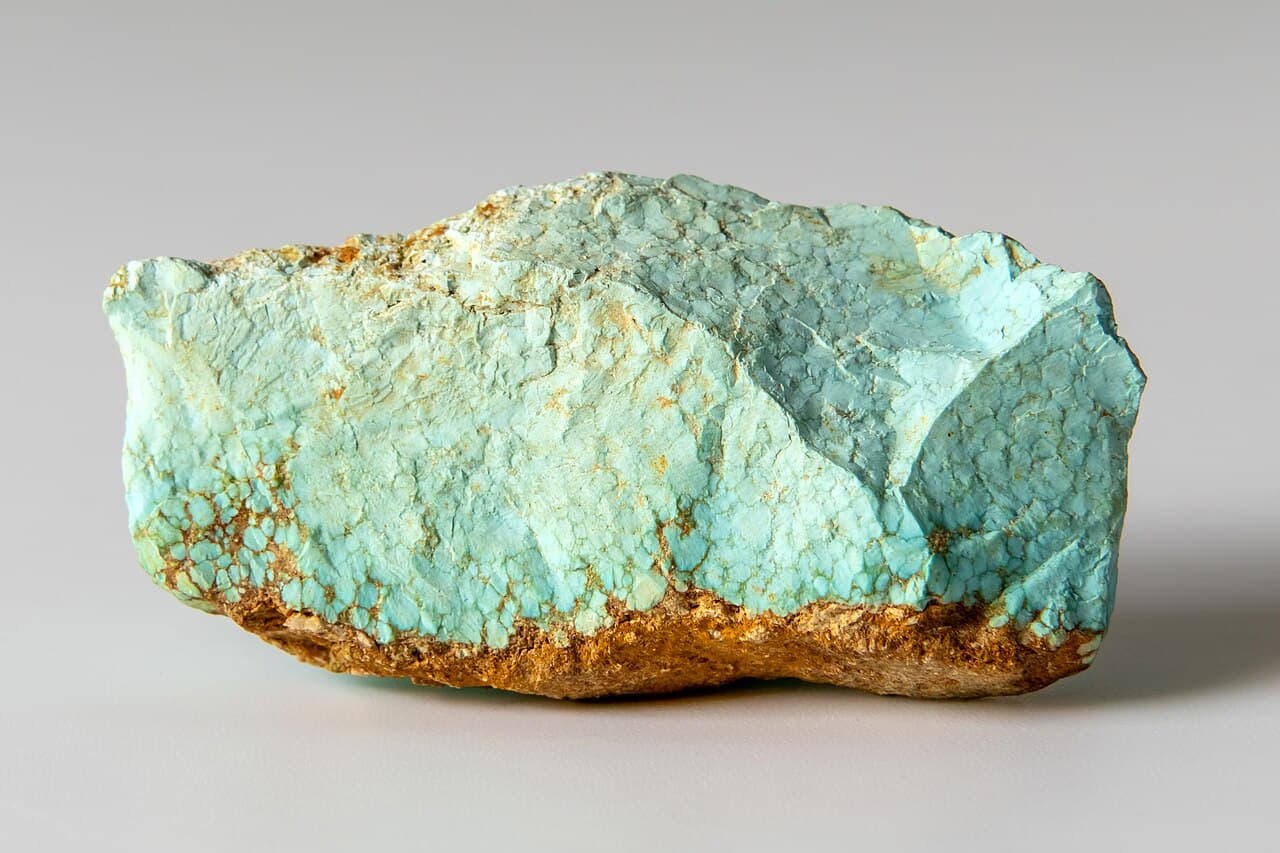
Turquoise is the famous sky-blue to blue-green gemstone that has been treasured for adornment and ritual for thousands of years, from ancient Egypt and Persia to the Indigenous cultures of the American Southwest. Chemically it is a hydrated copper aluminum phosphate, and its color comes directly from that copper: purer blue stones are richer in copper, while iron pushes the color toward green. Turquoise is opaque with a soft, waxy-to-subvitreous luster, and it is very often crossed by a "matrix" — a network of brown or black webbing inherited from the host rock it grew in. When that matrix forms a fine, even network it is called spiderweb turquoise, one of the most distinctive looks in all of gemology.
What makes turquoise both beloved and tricky is that it is one of the most imitated and treated gemstones on the market. Genuine, fully natural and untreated turquoise of good color is relatively uncommon and commands high prices, so a great deal of the turquoise sold is enhanced or simply imitated. Understanding the difference between natural, stabilized, reconstituted and outright fake material is the single most important thing a buyer or identifier can learn about this stone, and it is the focus of much of the guidance below.
Turquoise at a glance
- Classification
- Mineral — hydrated copper aluminum phosphate
- Composition
- CuAl₆(PO₄)₄(OH)₈·4H₂O
- Hardness
- 5–6 (Mohs)
- Luster
- Waxy to subvitreous; dull when unpolished
- Streak
- White to pale greenish
- Colors
- Sky blue to blue-green and green, often with brown or black matrix
- Crystal system
- Triclinic (almost always massive, not in visible crystals)
- Transparency
- Opaque
How to identify turquoise
Start with color and luster: turquoise is opaque, with a characteristic robin's-egg blue to blue-green tone and a soft, slightly waxy sheen rather than a glassy sparkle. The most helpful single feature is the matrix — the brown, tan or black veining that runs through many stones in irregular lines or a fine web. This matrix is a remnant of the surrounding host rock and is hard for imitations to reproduce convincingly. A stone that is a flawless, uniform turquoise blue with no matrix at all is not impossible, but it should raise the question of whether it is enhanced or imitation material.
Physical properties narrow it down further. Turquoise is moderately hard at about 5 to 6 on the Mohs scale — harder than the common howlite imitation but still soft enough to be scratched by quartz or a hardened steel point. It is opaque, so no light passes through, and it feels cool and fairly dense. Because natural turquoise is porous, an unsealed surface can feel very slightly tacky or absorbent, whereas a plastic-treated or resin-block imitation feels distinctly like plastic. Genuine natural stones also tend to vary subtly in color across a piece, while many imitations are suspiciously uniform.
Color and varieties
Turquoise spans a continuous range from pure sky blue through blue-green to a frank green, and the exact hue is governed by chemistry. Copper produces the prized clear blue, while iron substituting into the structure shifts the color toward green; aluminum content and trace elements also play a part. The most classic and sought-after color is an even, medium sky blue, sometimes called "robin's-egg" blue. Greener stones are common and can be very attractive in their own right, but the market has traditionally favored the cleaner blues. Color can also change over time as a porous stone absorbs oils and moisture, which is one reason care matters so much.
Beyond color, turquoise is described by its matrix. Stones with little or no matrix show pure color; others display brown to black veining that ranges from coarse blotches to the delicate, even network of spiderweb turquoise, which is especially prized when the web is fine and regular. Different deposits are known for characteristic colors and matrix patterns, and these traits, rather than any single grading scale, are how collectors usually distinguish material. For identification, the practical point is that natural matrix is integral to the stone and continuous with the host rock, while dyed or assembled imitations often have matrix that looks painted on or sits only on the surface.
Meaning and properties
Turquoise has served as a protective talisman across an unusually wide range of cultures. Ancient Egyptians set it into funerary jewelry, Persian tradition regarded it as a guardian against misfortune, and many Native American peoples of the Southwest have long held it as a sacred stone tied to sky, water and protection. In modern crystal-working traditions it is associated with protection, healing, communication and calm, and is often worn as an amulet or used as a grounding meditation stone.
These meanings are cultural, spiritual and historical, not scientifically demonstrated medical effects. Turquoise is a beautiful and meaningful stone to wear and collect, but it does not cure or treat any physical or mental health condition and is not a substitute for professional medical care.
Value: what turquoise is worth
The value of turquoise is driven by color, hardness, matrix and — crucially — the degree of treatment. The most valuable stones are natural and untreated, with an even, vivid sky-blue color and a hard, durable texture that takes a good polish on its own. An attractive, fine spiderweb matrix can add value, while large blank or chalky patches and a dull, washed-out color reduce it. Because so much turquoise is enhanced, fully natural untreated material of high color is comparatively scarce and sits at the top of the market.
Treatment level largely defines the price tiers. Natural untreated stones are the most prized; stabilized turquoise (porous stone impregnated with resin to harden it and fix its color) is far more common and more affordable; and reconstituted or "block" turquoise — made from powdered turquoise or imitation bound with plastic — sits lower still and shades into outright imitation. Honest sellers disclose treatment, and for identification it is essential to ask, because two stones of identical appearance can differ enormously in value depending on whether the color is natural or the result of dye and resin.
Real vs. fake turquoise
Turquoise is among the most faked gemstones, so skepticism is warranted. The biggest imitation by far is dyed howlite (and the similar mineral magnesite), which is naturally white and porous and dyes readily to a convincing turquoise blue. The giveaway is that dyed howlite is much softer — around 3.5 on the Mohs scale, so it scratches easily — and the dye tends to pool darker along its natural veins, giving a slightly artificial, painted look. Other imitations include dyed chalcedony, resin or plastic blocks, and reconstituted turquoise made from compressed powder and binder. Glass and enamel imitations turn up as well, often betrayed by tiny bubbles and a too-perfect, glassy blue.
Several simple checks help separate real from fake, though none is foolproof. A hardness check distinguishes genuine turquoise (5–6) from soft dyed howlite (about 3.5). An acetone or nail-polish-remover swab rubbed on an inconspicuous spot can lift dye from a colored imitation, leaving a blue stain on the cotton; natural turquoise will not bleed. A hot-pin test on a hidden area can reveal plastic or resin in block and reconstituted material, which gives off an acrid, plastic smell and may melt or bead, whereas solid stone simply gets warm. Even so, distinguishing fine stabilized turquoise from natural turquoise can require a gemological lab, so for valuable purchases, treatment disclosure and expert testing are the safest route.
Care
Turquoise is porous and chemically sensitive, so it needs careful handling. Keep it away from water, perfume, hairspray, lotions, cosmetics and household chemicals, all of which can be absorbed into the stone and discolor it; the safest practice is to put turquoise jewelry on last and take it off first. Clean it only by wiping gently with a soft, barely damp cloth and drying it immediately, and never use ultrasonic cleaners, steam or chemical jewelry dips.
Heat and dryness are also a concern: prolonged sunlight and high heat can fade the color or cause the stone to dry out, and sudden temperature changes can crack it. Because absorbed oils — even the natural oils of your skin — can gradually shift turquoise toward green over years of wear, store pieces away from heat and chemicals, keep them separate from harder gems that could scratch them, and handle them gently to preserve their original color.
Turquoise look-alikes
Frequently asked questions
How can I tell if turquoise is real or fake?
Check hardness, color and matrix. Real turquoise is 5–6 on the Mohs scale, while the common dyed-howlite fake is much softer (about 3.5) and its dye pools along the veins. An acetone swab can lift dye from a fake, and a hot-pin test on a hidden spot can reveal plastic in block or reconstituted material. Natural turquoise will not bleed dye or smell of plastic.
What is stabilized turquoise?
Stabilized turquoise is natural but porous turquoise that has been impregnated with resin to harden it and lock in its color. It is genuine turquoise and very common on the market, but it is more affordable than fully natural untreated stones, so honest sellers disclose the treatment.
Why does turquoise turn green?
Turquoise is porous and can absorb oils, lotions, perfume and even the natural oils from your skin over time, which gradually shifts a blue stone toward green. Chemistry also matters — more iron makes turquoise greener to begin with. Keeping it away from chemicals and oils helps preserve the original color.
Can turquoise get wet?
Avoid it. Turquoise is porous and chemically sensitive, so water, perfume, cosmetics and household chemicals can soak in and discolor the stone. Never use ultrasonic or steam cleaners; instead wipe it with a soft, barely damp cloth and dry it immediately.
Is turquoise a birthstone?
Yes — turquoise is the traditional birthstone for December, one of the oldest birthstones of all, sharing the month with the modern additions tanzanite and zircon (and, on older lists, lapis lazuli). See our December birthstone guide for how the month came to have several blue stones.
What is the most valuable turquoise, and what are Kingman and Sleeping Beauty?
Value rises with an even, deep sky-blue color, a hard natural (untreated) texture, and — for many collectors — an attractive matrix, the web of host-rock veining. Kingman and Sleeping Beauty are two famous American mines: Kingman (Arizona) is known for strong blue with black or silver matrix, while Sleeping Beauty (Arizona, now closed) produced clean, matrix-free robin's-egg blue that became highly sought after. Rare untreated spiderweb turquoise from historic mines such as Lander Blue can rival fine gemstones in price.
Is turquoise a stone or a color?
Both — and the stone came first. Turquoise the mineral has been prized for over 5,000 years, and its distinctive blue-green was so identified with it that the color was named after the stone (the word means 'Turkish,' for the trade route it traveled). Teal, a frequent point of confusion, is a related but greener, darker shade named after the duck — not the same as true turquoise blue.
Is yours turquoise? Find out from a photo
Photograph your gemstone in good light and get an identification with an honest confidence level, the look-alikes to rule out and the at-home tests that confirm it.
Identify my gemstone freeOn Android? Get the free rock identifier app
Related
Compare turquoise with look-alikes
More gemstones in the field guide
Related reading
Keep exploring
More on gemstones: the full list of crystal and gem types, how to identify gemstones and the polished-stone identifier.
Last updated 2026-07-19. Identification guidance is educational — confirm important results with the diagnostic tests described or a qualified expert.