Basalt
Also known as: Basaltic lava, Trap rock (commercial)
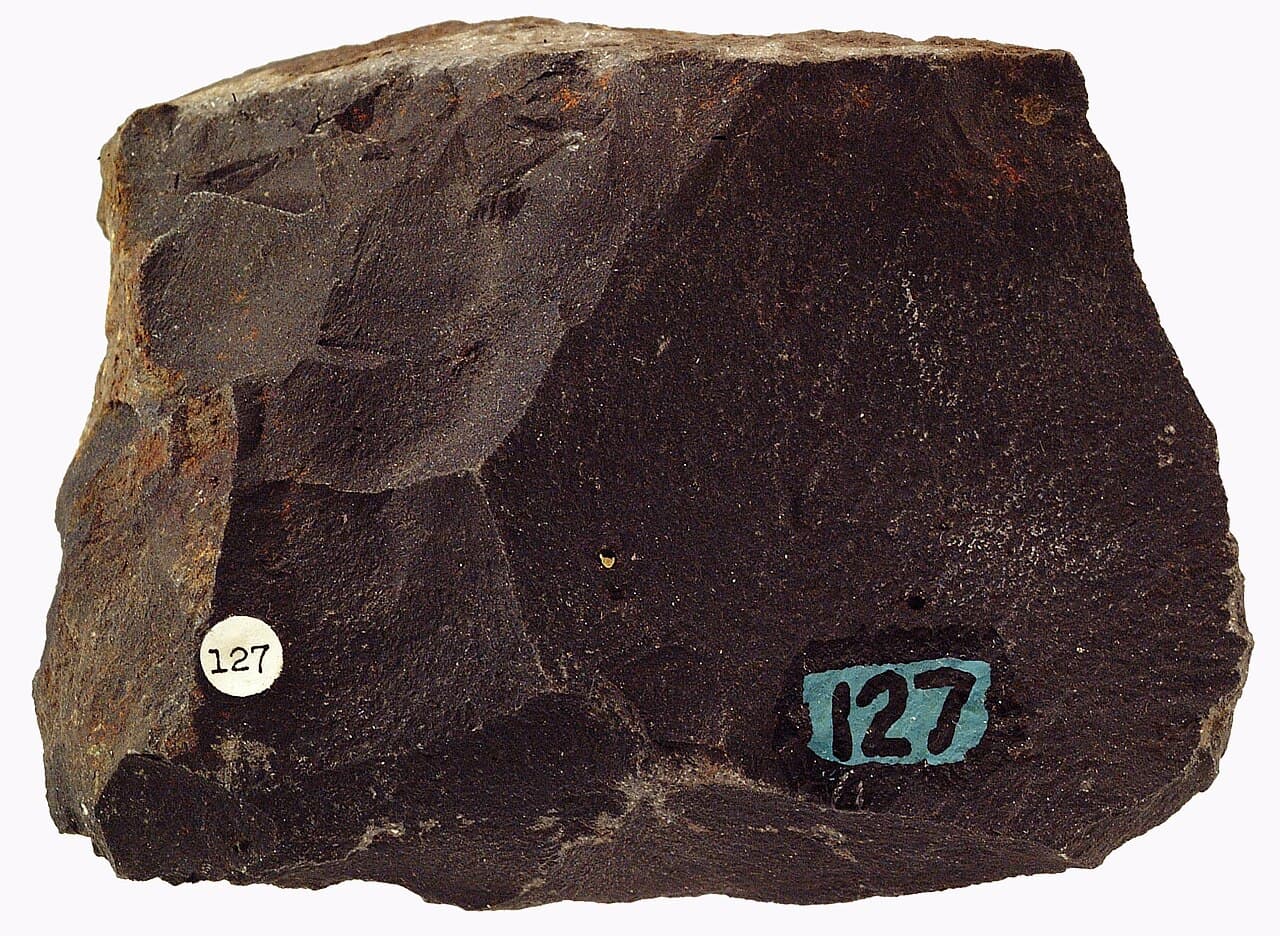
Basalt is a dark, fine-grained igneous rock formed from cooled lava. It is the most common volcanic rock on Earth and, in fact, the most abundant rock in the entire crust, because it makes up the bulk of the ocean floor as well as vast continental lava plateaus. To the eye it is usually a dense, heavy, dark gray to black stone with no visible crystals — the grains are simply too small to make out without magnification — and it often shows little round holes left behind by gas bubbles, or scattered green or dark specks that are larger early-formed crystals.
Basalt forms when low-silica (mafic) lava erupts at or near the surface and chills quickly. That rapid cooling is the key to its character: the minerals had almost no time to grow, so instead of granite's coarse, grainy texture, basalt sets into a compact, almost uniform dark mass. Recognizing basalt is mostly a matter of spotting that fine-grained, dark, dense combination and ruling out look-alikes such as its coarse-grained twin gabbro and the shiny volcanic glass obsidian.
Basalt at a glance
- Classification
- Igneous rock — mafic, extrusive (volcanic)
- Rock type
- Igneous
- Composition
- Plagioclase feldspar and pyroxene (± olivine)
- Hardness
- About 6, though grains are too fine to test individually
- Colors
- Dark gray to black; weathers to brown or reddish
- Texture
- Fine-grained (aphanitic); often vesicular or with scattered phenocrysts
What type of rock is basalt?
Basalt is an igneous rock — it solidified from molten rock. It is the extrusive or volcanic kind, meaning the lava cooled at or very near the Earth's surface rather than deep underground. That rapid, near-surface cooling is what gives basalt its fine grain: crystals had little time to grow, so the rock looks compact and almost featureless compared with a coarse plutonic rock like granite.
People sometimes wonder whether such a dark, dense stone could be sedimentary or metamorphic. It is neither. Basalt is not made of cemented sediment grains, and it has not been recrystallized by heat and pressure from a parent rock. The most useful comparison is to gabbro, which has the exact same chemical composition but is coarse-grained because it cooled slowly underground. Basalt is, in effect, the fast-cooled surface version of gabbro — same recipe, different texture.
How basalt forms
Basalt forms from the eruption and rapid cooling of mafic lava — lava that is relatively low in silica and rich in iron and magnesium. Because this lava is hot and runny, it flows easily and spreads out in broad sheets before chilling. When it reaches the surface and loses heat quickly, the dissolved minerals crystallize almost simultaneously into a dense network of tiny grains, mainly plagioclase feldspar and pyroxene, often with some olivine.
Most of the world's basalt is erupted along the mid-ocean ridges, where it continuously paves the ocean floor, and it also forms huge continental flood-basalt provinces and the lava flows of many volcanoes. Two textures commonly result from how the lava cools. Trapped gas escaping from the lava leaves rounded cavities called vesicles, producing vesicular basalt. And where some crystals began growing in the magma before eruption, the rock contains scattered larger grains — phenocrysts, often pale green olivine — set in the fine-grained groundmass. Thick flows can also crack into striking polygonal columns as they contract while cooling.
How to identify basalt
Begin with texture and color. Basalt is fine-grained and dark: you should not be able to pick out individual crystals with the naked eye, and the rock should read as gray to black overall. It also feels noticeably heavy and dense for its size, a consequence of its iron- and magnesium-rich minerals. These three traits together — fine grain, dark color, high density — are the core signature of basalt.
Then look for the extra clues. Many basalts are vesicular, dotted with small rounded holes where gas bubbles were frozen in place; this pitted surface is a strong hint of a volcanic rock. Some pieces contain scattered larger crystals, classically small glassy green olivine grains, standing out from the dark matrix. To separate basalt from its look-alikes, check the grain: if the rock is dark but clearly coarse-grained with visible interlocking crystals, it is gabbro, not basalt; if it is dark but glassy and shiny with smooth, curved (conchoidal) fracture surfaces and sharp edges, it is obsidian, a volcanic glass rather than a grainy rock.
What basalt is used for
Basalt's hardness, toughness and abundance make it a workhorse construction material. Crushed basalt — often sold in the trade as "trap rock" — is one of the most common aggregates, used as road base, in concrete and asphalt, and as railway ballast, where its strength and angular fracture help it lock together and bear heavy loads. Larger blocks are used as armor stone and riprap to protect shorelines and embankments from erosion.
Beyond aggregate, basalt is also melted and spun into rock wool and basalt fiber for insulation and reinforcement, and it has long been cut for paving stones, cobbles and durable building blocks. Its combination of being extremely common, very hard and resistant to weathering is exactly what makes it such a practical, widely used stone.
Basalt look-alikes
Frequently asked questions
What type of rock is basalt?
Basalt is an igneous rock — specifically an extrusive (volcanic) one that cooled quickly from lava at or near the surface. It is not sedimentary or metamorphic. The fast cooling is why it is fine-grained and dark rather than coarsely crystalline.
How can I identify basalt?
Look for a dark gray-to-black, fine-grained, dense rock with no crystals visible to the naked eye. Round gas holes (vesicles) or scattered small green olivine crystals are strong hints. If it is dark but coarse-grained it is gabbro, and if it is glassy and shiny it is obsidian.
What is the difference between basalt and gabbro?
They have the same chemical composition, but basalt cooled fast at the surface and is fine-grained, while gabbro cooled slowly underground and is coarse-grained with visible crystals. Basalt is the volcanic version; gabbro is the plutonic one.
What is basalt used for?
Basalt is crushed for aggregate used in road base, concrete, asphalt and railway ballast (often called trap rock), and larger blocks are used as armor stone, paving and building stone. It is also processed into basalt fiber and rock-wool insulation.
Is yours basalt? Find out from a photo
Photograph your rock in good light and get an identification with an honest confidence level, the look-alikes to rule out and the at-home tests that confirm it.
Identify my rock freeOn Android? Get the free rock identifier app
Related
More rocks in the field guide
Related reading
Keep exploring
More on rocks: how to identify a rock, what kind of rock is this and the Mohs hardness scale.
Last updated 2026-06-24. Identification guidance is educational — confirm important results with the diagnostic tests described or a qualified expert.