Stilbite
Also known as: Stilbite-Ca, Desmine
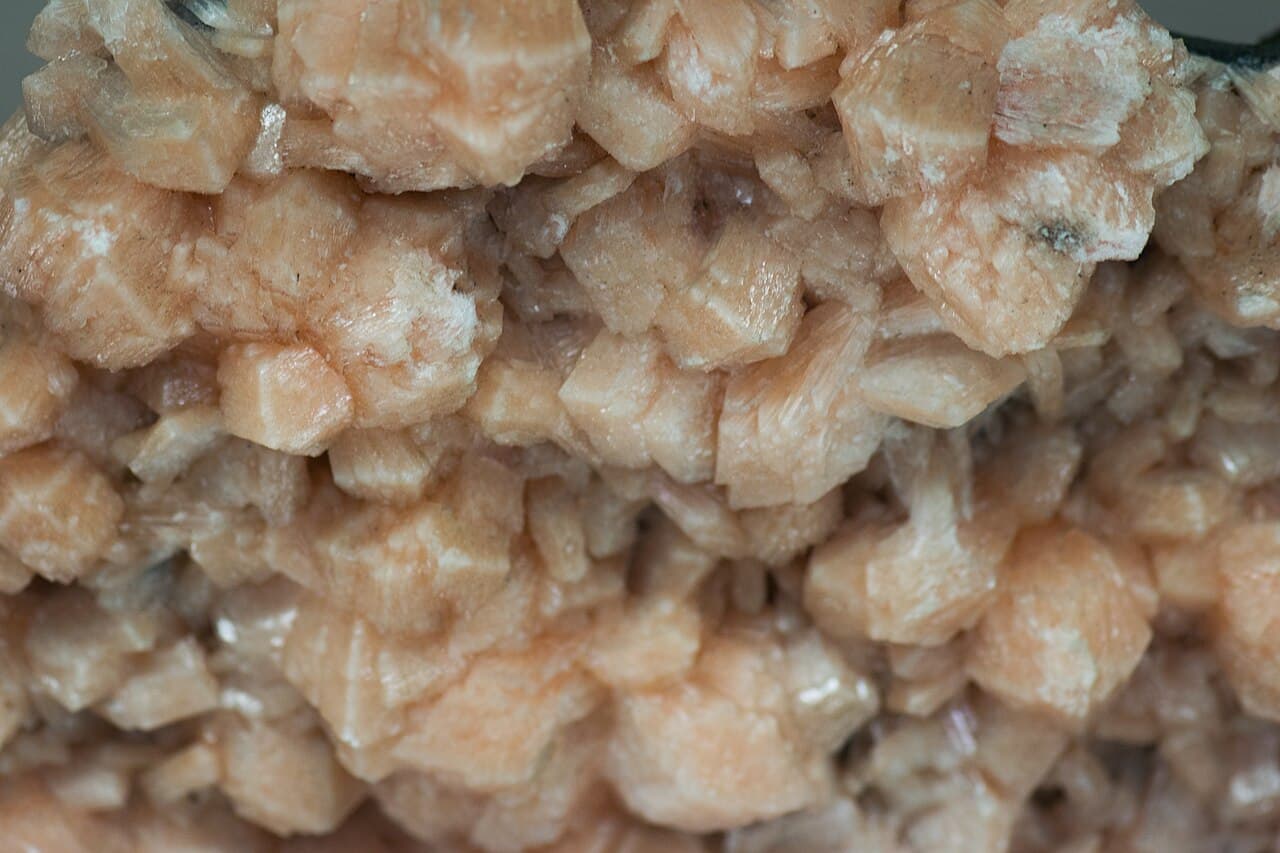
Stilbite is a member of the zeolite group, a family of hydrated aluminosilicate minerals that grow in the gas cavities of volcanic rock. Chemically it is a hydrated calcium-sodium aluminosilicate, and like other zeolites it holds water molecules within an open, cage-like crystal structure. What makes stilbite instantly recognizable is its habit: instead of single blocky crystals, it grows in bundled, sheaf-like clusters that fan out at both ends, a shape collectors often call a bowtie or wheat-sheaf. These soft peach, salmon, pink, or white sprays have a gentle pearly to glassy sheen and are among the most beloved display zeolites in the world.
By far the most famous stilbite comes from the ancient basalt lava flows of the Deccan Traps in Maharashtra, India, where quarrying near Pune, Nashik, and Jalgaon has produced vast numbers of fine specimens. There stilbite frequently grows alongside the glassy cubes and pyramids of apophyllite and the white needles of other zeolites, making striking combination pieces. Stilbite is soft (about 3.5 to 4 on the Mohs scale) and contains structural water, so it is admired as a mineral specimen rather than cut for jewelry. Once you have seen its characteristic bowtie clusters and warm peach color, stilbite becomes one of the easier zeolites to identify on sight.
Stilbite at a glance
- Classification
- Zeolite-group silicate (tectosilicate); hydrated calcium-sodium aluminosilicate
- Composition
- NaCa4(Si27Al9)O72 26H2O (stilbite-Ca, approximate)
- Hardness
- 3.5 to 4 (Mohs)
- Luster
- Vitreous to pearly, often silky on crystal faces
- Streak
- White
- Colors
- Peach, salmon, pink, white, cream, occasionally pale yellow or orange
- Crystal system
- Monoclinic
- Transparency
- Transparent to translucent
How to identify it
The most reliable way to recognize stilbite is by its distinctive habit. Stilbite almost always grows in bundled, sheaf-like or fan-shaped clusters of thin tabular crystals that pinch in at the middle and spread out at both ends, producing the classic bowtie or wheat-sheaf shape. Single tabular crystals also occur, but the bundled sprays are the signature. Combine that habit with its typical warm peach to salmon or white color and a soft pearly-to-glassy luster, and you have a strong first identification, especially if the specimen sits in a basalt cavity.
Supporting properties confirm it. Stilbite is soft, only about 3.5 to 4 on the Mohs scale, so a steel knife scratches it easily, ruling out harder look-alikes like quartz. It has good cleavage in one direction that gives its broad faces a pearly shine, and its streak is white. Context helps too: stilbite is a zeolite that forms in volcanic gas pockets, so finding it lining a basalt vug, often with glassy apophyllite or other zeolites, supports the identification. The bowtie habit plus low hardness plus a basalt-cavity setting together make stilbite hard to confuse once learned.
Colors and varieties
Stilbite is best known for its warm, soft colors. The most prized and recognizable specimens are peach to salmon and pink, but the mineral also occurs in white, cream, and occasionally pale yellow or orange, with color often coming from tiny iron inclusions. The gentle peach tones combined with the silky, light-catching sheen of the bundled crystals are exactly what makes stilbite so popular on the display shelf. Color can vary across a single cluster, with deeper salmon centers fading to paler tips.
The species most collectors encounter is stilbite-Ca, the calcium-dominant form, which is what the famous Indian material is. Beyond color, the main variation is in habit and association: some pieces are tight, well-formed bowties, others are broad fans or rosette-like aggregates, and many are mounted on a bed of contrasting minerals. The most sought-after combination specimens pair peach stilbite with colorless or green apophyllite or with white zeolite needles, creating the layered, cabinet-quality pieces that the Deccan Traps are renowned for.
Meaning and properties
In crystal and metaphysical traditions, stilbite is often described as a calming, heart-opening stone, with its soft peach color said by practitioners to encourage relaxation, creativity, and gentle emotional release. Some people keep it for meditation or place it in a quiet space as a soothing display piece. These associations come from spiritual and cultural belief systems and personal practice, not from scientific evidence, and stilbite should not be used to diagnose, treat, or cure any physical or emotional condition, nor as a substitute for professional care.
If you enjoy the symbolic side of minerals, stilbite's delicate clusters and warm color make it a popular meditation and decor stone, and you can treat that as a personal or spiritual practice rather than a remedy. Just keep the practical cautions in mind: stilbite is soft, fragile, and holds water in its structure, so it is far better admired as a specimen than handled roughly or worn. For any genuine health or wellbeing concern, consult a qualified healthcare professional instead of relying on a crystal.
Value and what affects price
Because the Indian basalt quarries have produced stilbite in great quantity, common single sprays are inexpensive and widely available, and value is driven mainly by quality and presentation rather than rarity. The most desirable pieces show well-formed, undamaged bowtie or sheaf clusters with a rich peach to salmon color, a bright pearly luster, and good transparency. Larger crystals, sharp symmetrical fans, and clusters with no broken or abraded tips bring noticeably higher prices than dull, pale, or damaged examples.
Association and aesthetics add a great deal of value. Combination specimens that pair peach stilbite with glassy apophyllite or white zeolites, arranged attractively on matrix, are far more collectible than a lone crystal, and well-balanced cabinet pieces can be quite valuable. Condition is critical because stilbite is soft and brittle: chipped tips, scratches, and contact damage reduce value quickly. Judge a stilbite specimen on the quality of its crystal form, the depth of its color, the brightness of its luster, the appeal of any associated minerals, and its overall condition.
Real vs. fake
Stilbite is rarely faked outright because natural specimens are abundant and inexpensive, so the realistic concerns are misidentification with other zeolites and, occasionally, color enhancement. The strongest identity clue is the unmistakable bowtie or sheaf habit combined with low hardness: real stilbite is soft (about Mohs 3.5 to 4) and a steel knife scratches it, whereas a hard, glassy look-alike that resists scratching is not stilbite. The species is most easily confused with its close relative heulandite, which forms more blocky, coffin-shaped tabular crystals rather than fanning sprays.
Watch for artificial color: most genuine stilbite is a natural soft peach, salmon, or white, so intensely dyed or unnaturally vivid colors (bright blue or green, for instance) suggest treatment rather than natural material, and a hidden or freshly broken surface may reveal paler stone underneath. Because stilbite contains structural water and is fragile, be wary of pieces that have been heavily glued or repaired; check for unnatural seams or filler around the base. Relying on the diagnostic sheaf habit, the white streak, and the soft hardness is the most dependable way to confirm a real stilbite.
Care
Stilbite needs careful handling because it is both soft and structurally delicate. At about Mohs 3.5 to 4 it scratches easily, and its thin bundled crystals chip readily, so store specimens where their tips cannot knock against other minerals, ideally in a padded box or a dust-protected case. Handle pieces by the matrix rather than the fragile sprays, and support larger specimens from underneath. Clean stilbite only with a soft, dry brush or gentle air to remove dust; do not scrub the crystal faces.
Avoid water, heat, and chemicals. As a hydrated zeolite, stilbite holds water within its crystal structure, and prolonged soaking, strong heat, or rapid temperature change can damage or cloud it over time, so keep it dry and away from heaters and direct, intense sunlight, which can also fade color. Skip ultrasonic cleaners and acidic or harsh solutions entirely. Treated as a display specimen and protected from dust, impact, and moisture, stilbite keeps its delicate peach color and silky luster for the long term.
Stilbite look-alikes
Frequently asked questions
What kind of mineral is stilbite?
Stilbite is a zeolite, part of a family of hydrated aluminosilicate minerals that grow in the gas cavities of volcanic rock. Specifically it is a hydrated calcium-sodium aluminosilicate with an open, cage-like crystal structure that holds water molecules. The most common species is stilbite-Ca, the calcium-rich form, which is what the famous peach specimens from India are.
Why does stilbite grow in bowtie shapes?
Stilbite's crystals naturally bundle together and grow outward at both ends while staying pinched in the middle, producing the sheaf-like or wheat-sheaf form that collectors call a bowtie. This fanning, bundled habit is a property of how the mineral crystallizes, and it is one of the most reliable ways to recognize stilbite at a glance, especially in its warm peach color.
Where does most stilbite come from?
The most famous stilbite comes from the Deccan Traps basalt flows of Maharashtra, India, where quarries near Pune, Nashik, and Jalgaon have produced enormous numbers of fine peach and salmon specimens. There it commonly grows in basalt cavities alongside glassy apophyllite and other zeolites, which is why so many display-quality combination pieces come from that region.
Can stilbite get wet or be worn as jewelry?
It is best to keep stilbite dry. As a hydrated zeolite it holds water in its structure, and prolonged soaking, heat, or rapid temperature changes can damage it over time, so clean it only with a soft dry brush. Stilbite is also soft (about Mohs 3.5 to 4) and very fragile, with thin crystals that chip easily, so it is not suited to jewelry and is best kept as a protected display specimen.
Is yours stilbite? Find out from a photo
Photograph your crystal in good light and get an identification with an honest confidence level, the look-alikes to rule out and the at-home tests that confirm it.
Identify my crystal freeOn Android? Get the free rock identifier app
Related
More crystals in the field guide
Keep exploring
More on crystals: the full list of crystal types, how to identify a crystal and crystals by color.
Last updated 2026-06-25. Identification guidance is educational — confirm important results with the diagnostic tests described or a qualified expert.