Tektite
Also known as: Impact glass, Indochinite (Southeast Asian tektites), Australite (Australian tektites), Bediasite, Georgiaite
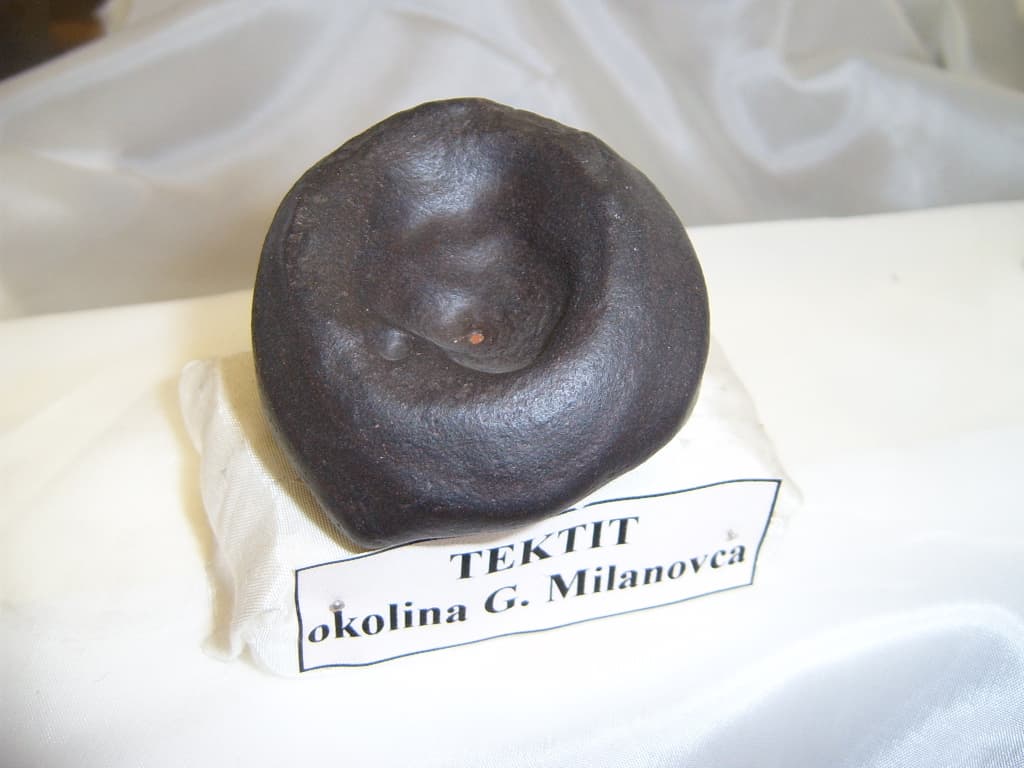
A tektite is a natural glass born from violence: when a large meteorite slams into the Earth, the impact melts the rocks at the surface and flings molten droplets high into the atmosphere, where they chill into glass and rain back down, sometimes hundreds of miles from the crater. The single most important and most misunderstood fact about tektites is that they are made of terrestrial rock, not the meteorite itself. The incoming body supplies the energy; the glass is melted Earth. So although tektites are intimately tied to a cosmic event, calling a tektite a meteorite is incorrect, and it is the first misconception to clear up when learning to identify one.
Most tektites are black to dark brown or, in a few famous cases, bottle-green, and they are typically small, often the size of a pebble or marble. Their surfaces are their calling card: pitted, grooved, gouged and frequently shaped into rounded, flattened or teardrop forms by their flight and ablation through the air. With a hardness of roughly 5 to 6 on the Mohs scale and a glassy, sometimes greasy luster, a tektite handled in the hand reads as a dark, oddly sculpted, surprisingly light piece of natural glass. Moldavite, the translucent green tektite from the Czech Republic, is the celebrated gem of the group and the form most people have heard of.
Tektite at a glance
- Classification
- Natural impact glass (mineraloid — not a true mineral; not a meteorite)
- Composition
- Silica-rich glass (roughly 65–80% SiO₂; no fixed formula)
- Hardness
- About 5–6 (Mohs)
- Luster
- Vitreous (glassy), sometimes greasy or resinous
- Streak
- White
- Colors
- Black, dark brown, gray-brown, and bottle-green (moldavite)
- Crystal system
- None — amorphous glass
- Transparency
- Opaque to translucent (green moldavite is the most transparent)
- Magnetic
- No (only very weakly, if at all)
How to identify it
Start with the surface texture, because it is the most reliable clue. Genuine tektites carry a busy, natural sculpture of pits, grooves, dimples and U-shaped gouges, and many show smooth, aerodynamic shapes — rounded buttons, teardrops, dumbbells and discs — that record their molten flight through the air. The body is a dark glass: hold it to a strong light and most tektites glow brown along thin edges, while green moldavite is clearly translucent. The material is true glass, so it has a conchoidal (shell-like, curved) fracture, a glassy to slightly greasy luster, and a white streak, and it is only moderately hard at about 5 to 6 on the Mohs scale.
Weight and magnetism help rule out impostors. A tektite feels noticeably lighter than a piece of metallic iron meteorite of the same size and is essentially non-magnetic, which immediately separates it from the iron meteorites it is sometimes confused with. Despite the cosmic origin story, remember the key identification fact: a tektite is melted Earth rock, not the meteorite, so it will not show the metal flakes, fusion crust or strong magnetism of an actual stony-iron or iron meteorite. If you have a dark, lightweight, non-magnetic natural glass covered in irregular pits and gouges — and it is not the suspiciously perfect, bubble-filled glass described in the fakes section — a tektite is a strong candidate.
Colors and varieties
The great majority of tektites are black to very dark brown, looking jet-black in reflected light but revealing a smoky brown glow when a thin edge is held to the sun. These dark tektites are grouped and named by the strewn field — the broad region across which a single impact scattered them. Indochinites from Southeast Asia, australites from Australia, bediasites from Texas and georgiaites from Georgia are all essentially this dark glass, distinguished mainly by where they fell and by characteristic shapes (Australian australites, for instance, are famous for button and lens forms with flanges).
The standout exception in color is moldavite, the translucent bottle-green to olive-green tektite found chiefly in the Czech Republic and tied to the impact that formed the Ries crater in Germany. Its forest-green transparency and delicately etched, wrinkled surface make it the only tektite routinely cut and set as a gemstone, and it commands prices far above ordinary black tektites. A few other localities yield greenish or yellow-green glass, but for practical purposes the color story is simple: most tektites are dark, and green essentially means moldavite.
Meaning and properties
In modern crystal-working and metaphysical traditions, tektites are prized precisely for their dramatic origin — glass forged in a collision between Earth and sky. People describe them as stones of transformation and high-frequency energy, associated with expanded awareness, spiritual growth and a connection between the earthly and the cosmic; moldavite in particular has a near-cult following as an intense, fast-acting stone of change. These associations draw directly from the impact-born story rather than from any chemical property of the glass.
These meanings are cultural and spiritual, not scientifically established medical effects. A tektite is a remarkable natural object to study and collect, but it is not a treatment for any physical or emotional health condition and should never replace advice or care from a qualified medical professional. Enjoy a tektite for the extraordinary geological event it records and for its strange beauty, not as medicine.
What it's worth
Value among tektites is sharply divided by type. Common dark tektites — Indochinites, australites and similar strewn-field material — are relatively affordable and widely available, with price driven by size, an interesting or complete aerodynamic shape (buttons, teardrops and flanged forms fetch more), undamaged surfaces, and provenance from a documented locality. Most ordinary black tektites are inexpensive natural curiosities rather than precious stones.
Moldavite is the dramatic exception. As the only gem-quality tektite, with a limited Czech source and rising demand, faceted and high-grade moldavite sells for far more than dark tektites, and clean, deeply etched, richly green pieces command a premium. That value gap is exactly why moldavite is so heavily faked (see below), so for moldavite especially, value tracks honest identity: pay gem prices only for material whose authenticity and source you trust. As always, an honest identification should come before any discussion of price.
Real vs. fake
The most common fake is manufactured glass — including ordinary green bottle glass, art glass and industrial slag glass — passed off as tektite or, more lucratively, as moldavite. Tell-tale signs of fakes are too-perfect, blobby or molded shapes, a smooth or merely frosted surface instead of natural pitting, and especially round internal gas bubbles: tektites can contain elongated or sparse bubbles, but neat spherical bubbles in abundance point to melted manufactured glass. Faked moldavite is often an unnaturally bright, uniform emerald-green with a glossy, freshly molded surface, whereas real moldavite shows a more muted forest-to-olive green and a finely wrinkled, etched skin that is hard to counterfeit. Mold seams, a glassy ring when tapped, and a color that is suspiciously even are all warning flags.
Two honest mix-ups, rather than deliberate fakes, also catch people out. Obsidian, a volcanic glass, can look like a black tektite, but it forms from lava at a volcano rather than from an impact, lacks the gouged aerodynamic shapes, and tends to occur in larger, smoother masses. Iron and stony-iron meteorites are sometimes confused with tektites because of the shared space association, but they are heavy, strongly magnetic and metallic — the opposite of a tektite's light, non-magnetic glass — and recalling that a tektite is melted Earth, not the meteorite, resolves the confusion. When buying valuable moldavite, favor sellers who guarantee authenticity and, ideally, provide locality information.
Care
Tektites are glass, so the main hazards are chipping and scratching rather than chemical attack. At about 5 to 6 on the Mohs scale they are softer than quartz and can be scratched by harder stones, and like all glass they have a brittle, conchoidal fracture, so a sharp knock can chip an edge or shatter a thin piece. Store tektites separately, padded away from harder gems and from each other, and handle delicately etched moldavite especially gently, as its fine surface sculpture is part of its value and is easily worn or marred.
Cleaning is simple: use warm water, a drop of mild soap and a soft brush or cloth, then rinse and dry. Avoid harsh chemicals and prolonged soaking, and skip ultrasonic and steam cleaners, which can stress the brittle glass and may worsen any hidden fractures. Kept away from impacts and abrasive surfaces, a tektite needs little maintenance and will hold its strange, deep-space-born appearance indefinitely.
Tektite look-alikes
Frequently asked questions
Are tektites actually meteorites?
No, and this is the most common misconception. A tektite is natural glass made from terrestrial rock that was melted by a meteorite impact and flung into the air, where it cooled into glass. The meteorite supplies the energy of the collision, but the glass itself is melted Earth, not the space rock. That is why tektites are light, glassy and non-magnetic, unlike heavy, magnetic, metallic iron meteorites.
How can I tell a real tektite from fake glass?
Real tektites have a natural, irregular surface of pits, grooves and gouges and often an aerodynamic shape from their flight through the air, with at most sparse or elongated internal bubbles. Manufactured glass fakes tend to look too perfect or blobby, have smooth or molded surfaces and mold seams, show abundant round bubbles, and may have a suspiciously uniform, bright color. This matters most with moldavite, the valuable green tektite, which is heavily faked with green glass.
What is the difference between tektite and obsidian?
Both are natural glasses, but they come from completely different events. A tektite forms when a meteorite impact melts Earth's surface rock and splashes it into the sky to cool as glass. Obsidian forms from cooling volcanic lava at a volcano. Tektites are usually small, dark pebbles with gouged, sculpted flight surfaces, while obsidian tends to occur in larger, smoother, shinier masses.
Is moldavite a tektite?
Yes. Moldavite is the famous translucent green tektite found mainly in the Czech Republic, formed by the impact that created the Ries crater in Germany. It is the only tektite routinely cut as a gemstone, prized for its bottle-green color and etched surface, and it sells for far more than ordinary black tektites — which is also why it is the most commonly counterfeited tektite.
Is yours tektite? Find out from a photo
Photograph your crystal in good light and get an identification with an honest confidence level, the look-alikes to rule out and the at-home tests that confirm it.
Identify my crystal freeOn Android? Get the free rock identifier app
Related
More crystals in the field guide
Related reading
Keep exploring
More on crystals: the full list of crystal types, how to identify a crystal and crystals by color.
Last updated 2026-06-25. Identification guidance is educational — confirm important results with the diagnostic tests described or a qualified expert.