Scolecite
Also known as: Zeolite (scolecite)
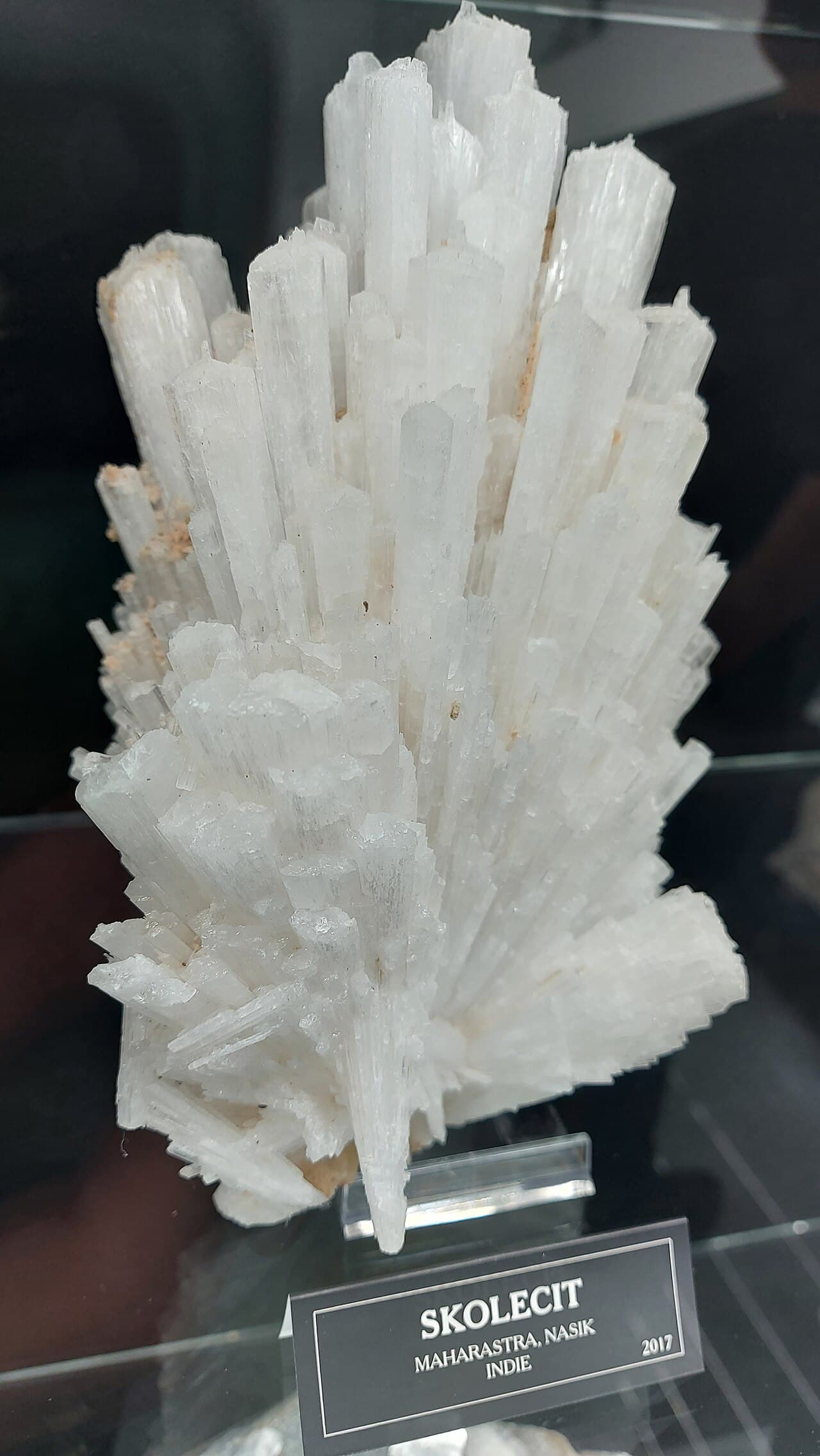
Scolecite is a hydrated calcium aluminosilicate belonging to the zeolite group, with the formula CaAl₂Si₃O₁₀·3H₂O. It is a relatively soft mineral at Mohs 5 to 5.5 and crystallizes in the monoclinic system, but its most recognizable form is not a single blocky crystal at all — instead it grows as masses of slender, needle-like crystals that radiate outward into delicate fans, sprays and rounded clusters often described as puffballs. Most scolecite is white to colorless, with a silky to vitreous luster that gives the needle sprays a soft, almost satiny shimmer. The name comes from the Greek word for worm, a nod to the way the thin crystals can curl when heated.
Scolecite is best known from the volcanic basalt cavities of the Deccan Traps in the Pune and Nashik districts of India, where it forms spectacular specimens alongside other zeolites and related minerals. In these pockets it very commonly grows with stilbite and apophyllite, and the combination of scolecite's white needle sprays against blocky apophyllite or peach stilbite makes for some of the most popular display minerals in the hobby. It also occurs in Iceland, Brazil and elsewhere. As a soft, fragile, needle-form mineral, scolecite is collected and admired chiefly as natural specimens rather than worn as jewelry.
Scolecite at a glance
- Classification
- Mineral — silicate (tectosilicate), zeolite group, hydrated calcium aluminosilicate
- Composition
- CaAl₂Si₃O₁₀·3H₂O
- Hardness
- 5–5.5 (Mohs)
- Luster
- Silky to vitreous (often satiny on the needle sprays)
- Streak
- White
- Colors
- White to colorless, occasionally pale pink or pale yellow tints
- Crystal system
- Monoclinic — slender radiating needle-like crystals forming fans, sprays and rounded puffball clusters
- Transparency
- Transparent to translucent
How to identify it
The single most distinctive feature of scolecite is its habit: very slender, needle-like to acicular crystals that radiate from a common point into fans, sprays and rounded puffball clusters. When you see a snowball-like burst of fine white needles, often with a silky sheen and a slightly fibrous look, you are very likely looking at scolecite or one of its near-identical zeolite cousins. The crystals are soft at Mohs 5 to 5.5, so a steel knife will scratch them, and the streak is white. The needles are fragile and break easily, which is itself a clue to a delicate zeolite rather than a tougher mineral.
Setting and association are powerful confirming clues for scolecite. It is a classic occupant of gas cavities in basalt, and it very frequently grows together with stilbite and apophyllite, so a spray of fine white needles sitting on or among blocky apophyllite cubes or peach-colored stilbite bowties is a strong indicator. The hardest part of identification is telling scolecite from natrolite and mesolite, two closely related zeolites with almost the same look; for those, distinguishing features are subtle and a definitive call often requires laboratory testing such as optical or chemical analysis rather than the eye alone.
Colors and varieties
Scolecite is overwhelmingly white to colorless, and that clean, frosty white is part of its appeal, especially when its needle sprays contrast with darker basalt matrix or with colored companion minerals. Some specimens carry a faint pink or pale yellow tint, usually from associated minerals or trace coloring rather than a true varietal color, but these are subtle. There are no widely recognized named gem varieties of scolecite the way there are for many colored stones.
Because scolecite forms part of a closely related family of fibrous zeolites, much of what looks like color or textural variation actually comes from the company it keeps. Sprays of scolecite are often perched on or intergrown with stilbite, apophyllite, heulandite or other zeolites, and these neighbors supply the peach, green and clear accents that make finished specimens so attractive. The takeaway for identification is that scolecite itself is essentially a white, silky, needle-form mineral, and strong color in a specimen usually belongs to something growing alongside it.
Meaning and properties
In crystal traditions scolecite is regarded as a peaceful, high-vibration stone associated with inner calm, restful sleep and deep meditation. Its soft white radiating sprays have made it a favorite for those seeking a tranquil, serene crystal, and practitioners often link it to relaxation, emotional release and a sense of connection during quiet reflection. The gentle, fan-like form reinforces its reputation as a calming rather than energizing stone.
As with all crystal lore, these associations are spiritual and cultural rather than scientifically demonstrated. Scolecite is a beautiful natural specimen to keep for reflection or display, but it has no proven physical or medical effect and should never be used in place of advice or care from a qualified health professional.
Value: what scolecite is worth
Scolecite is valued as a display mineral, and its worth depends heavily on the quality and completeness of the specimen rather than on any per-carat gem pricing. Small or partial sprays are inexpensive and widely available, thanks to the abundant Indian zeolite localities. What lifts value is a clean, undamaged cluster of long, lustrous needles with an intact radiating form, since the fine tips break so easily that complete, sharp sprays are far less common than chipped ones.
Combination specimens are where scolecite reaches its highest prices. A well-balanced piece pairing crisp white scolecite sprays with attractive apophyllite crystals or peach stilbite, on pleasing matrix, is more desirable to collectors than scolecite alone, and aesthetics, size, contrast and condition all matter. Because scolecite is soft and fragile, presentation and preservation drive value: a large, undamaged, well-composed specimen commands a clear premium over a comparable piece with broken needles or repaired sprays.
Real vs. fake scolecite
Scolecite is rarely faked outright; the real identification challenge is that it looks almost identical to its zeolite relatives natrolite and mesolite. All three form slender white radiating needles, and the eye alone usually cannot separate them reliably, so honest dealers may label such material as part of the natrolite group, and a firm species call often needs optical or chemical laboratory testing. This is a case where uncertainty between closely related natural minerals, not fraud, is the main issue.
Where genuine concerns arise, they tend to involve condition rather than authenticity: because the needles are so fragile, sprays are sometimes glued, repaired or reassembled, so it is worth inspecting clusters closely for breaks, adhesive or unnatural alignment. The associations help confirm the material as a real basalt-cavity zeolite, since natural scolecite typically sits with stilbite and apophyllite on volcanic matrix. For an important specimen, a knowledgeable dealer's identification or laboratory confirmation is the way to be sure of both the species and that the piece is undamaged and unrepaired.
Care
Scolecite is delicate and needs gentle handling. At Mohs 5 to 5.5 it is soft enough to be scratched by many everyday objects, and its slender needles are extremely fragile and snap easily, so handle specimens by the matrix rather than the crystals and never let a spray knock against anything hard. As a hydrated zeolite, it also holds water within its structure, which is another reason to treat it gently and avoid harsh conditions.
Avoid water, ultrasonic and steam cleaning; instead dust scolecite very lightly with a soft brush or gentle air. Keep it out of prolonged direct sunlight and away from heat, since strong heat can dehydrate zeolites and damage the crystals, and avoid rapid temperature swings. Store the specimen in a stable, padded, low-traffic spot where the fragile needle sprays will not be brushed, bumped or pressed, ideally in its own protected display so harder minerals cannot scratch or break it.
Scolecite look-alikes
Frequently asked questions
How can I tell scolecite from natrolite?
Honestly, you usually cannot tell them apart by eye. Scolecite and natrolite are closely related zeolites that both form slender white radiating needle sprays and look almost identical. The real difference is chemical — natrolite is sodium-rich and scolecite is calcium-rich — so a confident identification typically requires optical or chemical laboratory testing. Because of this, dealers sometimes label such material as part of the natrolite group.
What is scolecite usually found with?
Scolecite is a classic mineral of gas cavities in basalt, and it very commonly grows together with stilbite and apophyllite, especially in specimens from the Deccan Traps of India. A spray of fine white needles perched on or among blocky apophyllite crystals or peach-colored stilbite is a strong sign you are looking at scolecite, and these combination specimens are among the most popular in the hobby.
Is scolecite fragile?
Yes, very. Scolecite is soft at Mohs 5 to 5.5, and its slender, needle-like crystals snap easily, so the fine sprays are among the more delicate things a collector can own. Handle specimens by the matrix rather than the crystals, keep them away from hard knocks, avoid water and ultrasonic cleaning, and store them in a protected, low-traffic spot. Intact, undamaged sprays are noticeably scarcer and more valuable than broken ones.
Can scolecite be made into jewelry?
It is rarely used in jewelry. Scolecite is soft and its needle crystals are too fragile to stand up to the knocks and wear that rings and bracelets receive, so it is collected and enjoyed almost entirely as natural display specimens rather than as worn gems. If you want to keep scolecite close, a protected specimen on a shelf is far more practical than trying to set its delicate sprays into jewelry.
Is yours scolecite? Find out from a photo
Photograph your crystal in good light and get an identification with an honest confidence level, the look-alikes to rule out and the at-home tests that confirm it.
Identify my crystal freeOn Android? Get the free rock identifier app
Related
More crystals in the field guide
Keep exploring
More on crystals: the full list of crystal types, how to identify a crystal and crystals by color.
Last updated 2026-06-25. Identification guidance is educational — confirm important results with the diagnostic tests described or a qualified expert.