Unakite
Also known as: Unakite jasper, Epidotized granite, Epidote granite
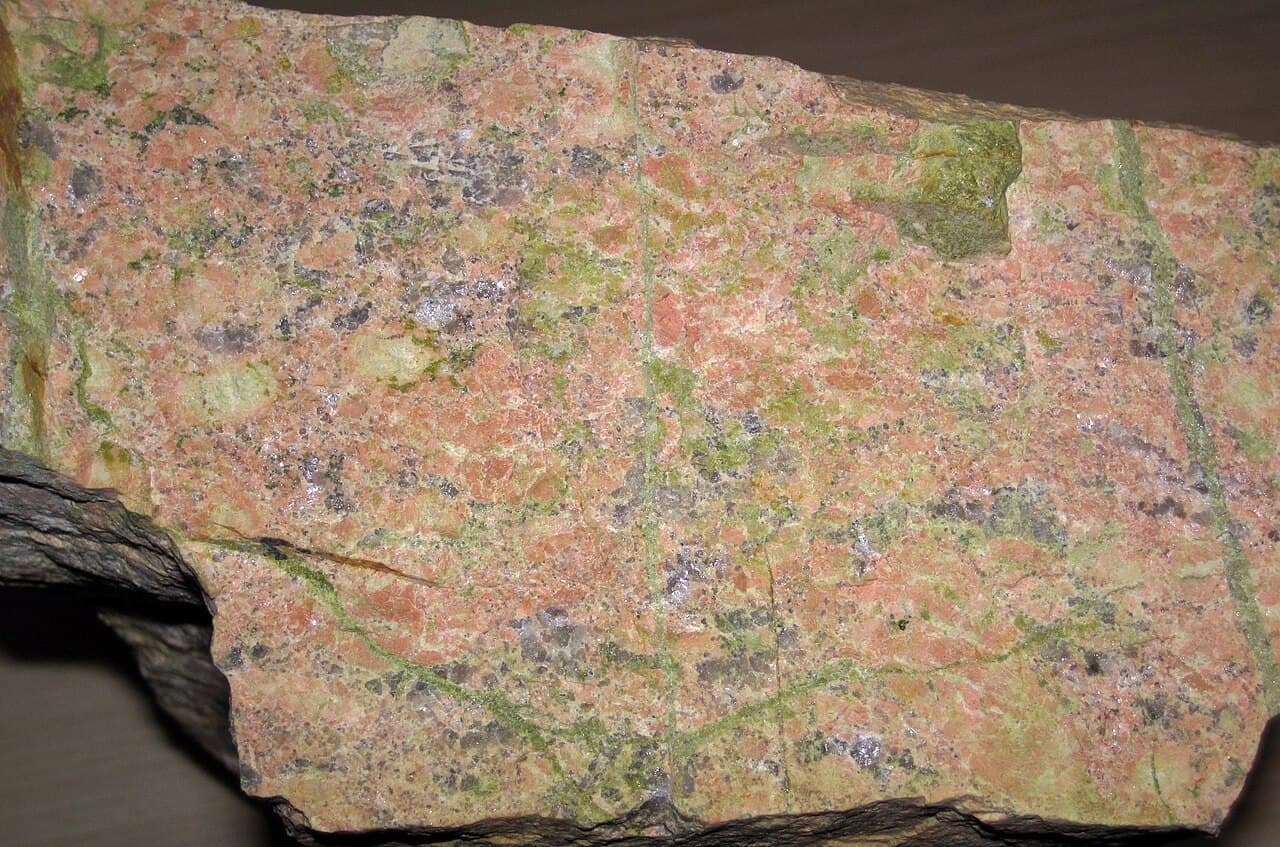
Unakite is not a single mineral but a rock — specifically an altered granite in which the original feldspars have been partly replaced by green epidote, giving the stone its unmistakable mottled mix of pistachio green, salmon to brick pink, and patches of clear or grayish quartz. Geologists call this process epidotization, and the result is sometimes labeled an "epidotized granite" or "epidote granite." The pink comes from potassium feldspar (orthoclase), the green from epidote that grew in as the rock was chemically reworked, and the translucent gray comes from leftover quartz. Because it is a granite, unakite is an interlocking aggregate of these minerals rather than a stone with a single chemistry, and no two pieces share exactly the same pattern.
First described from the Unakas Mountains of the southern Appalachians, from which it takes its name, unakite is hard, tough, and takes an excellent polish, which is why it is one of the most common stones you will find tumbled, beaded, and carved into eggs, spheres, and cabochons. It is sometimes sold under the name "unakite jasper," but that label is misleading: true jasper is a microcrystalline quartz, whereas unakite is a coarse-grained igneous rock. Recognizing unakite is usually easy once you know the look — the green-and-pink speckling is distinctive — but distinguishing it from its lookalikes comes down to spotting the visible feldspar and epidote grains that mark it as an altered granite.
Unakite at a glance
- Classification
- Rock — altered (epidotized) granite
- Rock type
- Igneous (granite altered by hydrothermal metamorphism)
- Hardness
- About 6–7 (varies with the mineral grain tested)
- Luster
- Vitreous to greasy on quartz and feldspar; dull to vitreous on epidote; takes a glassy polish
- Streak
- White (the rock as a whole leaves a pale, mixed streak)
- Colors
- Mottled pistachio to olive green with salmon, pink to brick-red patches, plus clear to gray areas
- Transparency
- Opaque overall, with translucent quartz patches
How to identify it
Unakite is one of the easier ornamental stones to recognize because of its color combination: a granular, opaque stone that mixes patches of olive to pistachio green with salmon, pink, or brick-red areas, often with smaller spots of clear to grayish quartz scattered between them. Unlike a uniformly colored stone, unakite looks distinctly speckled or mottled, and on a polished surface you can usually pick out three separate components — green epidote, pink feldspar, and glassy quartz — each forming its own irregular patches a few millimeters across. The green and pink tend to be the dominant, eye-catching colors, with the quartz reading as colorless or smoky filler.
To confirm it, look at the texture rather than just the color. Because unakite is a granite, it shows an interlocking, coarse-grained fabric of visible mineral grains, not the smooth, featureless body of a true jasper or chalcedony. The stone is hard — around 6 to 7 on the Mohs scale, hard enough to scratch glass — and the green areas, being epidote, have a slightly glassy to greasy luster. If a green-and-pink stone clearly shows separate crystalline grains of feldspar and epidote and reaches that hardness, it is almost certainly unakite. A stone that is the same colors but glassy, conchoidally fractured, and made of one homogeneous material is more likely a dyed or natural jasper imitating the look.
Colors and varieties
The signature palette of unakite is green and pink, but the proportions and shades vary widely from deposit to deposit. The green ranges from a soft pistachio through olive to a deep forest green, depending on how much epidote replaced the original minerals and how iron-rich that epidote is; the pink ranges from pale salmon to a strong brick or rose red, set by the potassium feldspar. Some pieces are mostly green with pink flecks, others mostly pink with green veining, and the best ornamental material has a balanced, high-contrast mix of both colors with clean quartz patches between them. Because it is a rock rather than a mineral, this variation is natural and expected.
There are no formal gem "varieties" of unakite the way there are with quartz, but you will encounter trade names. "Unakite jasper" is the most common, and it is simply unakite — the jasper label is marketing, not mineralogy. Material from different localities (the Appalachians, South Africa, China, and Brazil among them) can look noticeably different, and some sellers distinguish higher-contrast or more vividly colored stock as a premium grade. Occasionally the term is stretched to cover other green-and-pink altered rocks, so the safest definition to hold onto is the mineralogical one: green epidote plus pink orthoclase feldspar plus quartz, in a granitic texture.
Meaning and properties
In modern crystal-working traditions, unakite is often described as a stone of gentle balance and emotional grounding, with its pairing of green and pink read as a union of the heart's energies. People who keep it commonly associate it with patience, slow steady progress, and recovery after difficult times, and it is a popular choice for meditation pieces, worry stones, and jewelry meant to feel calming and supportive. These associations come from spiritual and folk practices rather than from the rock's geology, which is simply that of an altered granite.
It is important to be clear that these meanings are cultural and personal, not medically demonstrated effects. Unakite does not diagnose, treat, cure, or prevent any physical or mental health condition, and it is not a substitute for professional medical or psychological care. Enjoyed as a beautiful, durable stone and as a focus for reflection, it is a lovely thing to own; it should not be relied upon for healing. Because unakite is hard and stable, it is at least safe to handle, but the same caution about health claims applies to it as to every ornamental stone.
Value
Unakite is an abundant and inexpensive stone, valued for its looks and durability rather than its rarity. It is one of the staples of the tumbled-stone and bead market, so most pieces — tumbled stones, bracelets, eggs, spheres, and cabochons — sit at the affordable end of the ornamental range. What drives the modest differences in price within unakite is the quality of the pattern and polish: stones with a strong, balanced green-and-pink contrast, clean coloring, a smooth crack-free surface, and a high glassy polish are more desirable than muddy, pale, or fractured material.
Larger carved items, well-matched bead strands, and pieces from localities prized for vivid color can command somewhat more, but unakite is not a stone bought as an investment. Its appeal is decorative and emotional. For a buyer, the practical guidance is to judge a piece on eye appeal and finish — how lively the colors are, how cleanly they are distributed, and how well it is polished — rather than expecting scarcity-driven value, and to be wary of paying gemstone prices for what is fundamentally a common altered granite.
Real vs. fake
Outright fakes of unakite are uncommon because the stone itself is cheap — there is little incentive to counterfeit it. The more realistic concerns are misnaming and occasional color enhancement. Some dyed green-and-pink jaspers or reconstituted stones are sold to mimic the unakite look, and a stone labeled "unakite jasper" is sometimes genuine unakite and sometimes a different material being marketed under the trendy name. The goal is therefore less about catching a forgery and more about confirming that the stone is the real altered granite.
The surest test is to look at the grains. Genuine unakite shows separate, interlocking crystals of green epidote, pink feldspar, and quartz under a loupe — a true granitic texture — rather than the smooth, uniform body of a microcrystalline jasper or a molded resin piece. The colors of natural unakite are slightly varied and organic across the stone, whereas dyed imitations often show unnaturally even or concentrated color that may collect in cracks; an acetone-dampened swab on a hidden area can lift added dye, which natural epidote and feldspar will not release. A hot-pin test can expose resin or plastic by its acrid smell. If a stone has visible feldspar and epidote grains and reaches a hardness of about 6 to 7, it is real unakite.
Care
Unakite is a hard, durable rock and is one of the lower-maintenance ornamental stones. It can be cleaned with warm water and a little mild soap, scrubbed gently with a soft brush, and dried with a soft cloth; its hardness of around 6 to 7 means it resists everyday scratching reasonably well. Even so, it is wise to keep it away from harsh household chemicals and acids, and to remove unakite jewelry before swimming in chlorinated or salt water or using cleaning products, since prolonged chemical exposure can dull the polish over time.
Because unakite is a multi-mineral rock, it is best to skip ultrasonic and steam cleaners, which can stress the boundaries between its different grains and reach any micro-fractures in the stone. Store it separately from harder gems such as quartz and topaz that could scuff its polished surface, ideally in a soft pouch or a lined compartment, and avoid sharp knocks against hard surfaces that could chip an edge. Prolonged, intense sunlight is generally not a problem for unakite, but as with most colored stones, keeping it out of constant harsh light is a sensible long-term habit.
Unakite look-alikes
Frequently asked questions
Is unakite a rock or a crystal?
Unakite is technically a rock, not a single crystal or mineral. It is an altered granite — an "epidotized granite" — made of three minerals grown together: green epidote, pink orthoclase feldspar, and clear-to-gray quartz. It is sold among crystals and tumbled stones because it polishes beautifully, but mineralogically it is a coarse-grained igneous rock.
Why is unakite green and pink?
The green comes from epidote, a mineral that grew into the rock when the original granite was chemically altered by hot fluids, and the pink comes from potassium feldspar (orthoclase). The clear or grayish patches are leftover quartz. The mottled mix of these three minerals gives unakite its signature pistachio-green-and-salmon-pink appearance.
Is unakite the same as unakite jasper?
They are the same stone, but the name "unakite jasper" is misleading. True jasper is a microcrystalline quartz, while unakite is an altered granite made of epidote, feldspar, and quartz grains. Sellers use the jasper label as marketing; mineralogically, unakite is not a jasper at all.
How can I tell real unakite from a fake?
Look at the grains under a loupe: real unakite shows separate, interlocking crystals of green epidote, pink feldspar, and quartz in a granular texture, and reaches a hardness of about 6 to 7. Dyed jaspers or resin imitations look smooth and uniform, may have color pooling in cracks, and an acetone swab on a hidden spot can lift added dye that natural unakite will not release.
Is yours unakite? Find out from a photo
Photograph your crystal in good light and get an identification with an honest confidence level, the look-alikes to rule out and the at-home tests that confirm it.
Identify my crystal freeOn Android? Get the free rock identifier app
Related
More crystals in the field guide
Keep exploring
More on crystals: the full list of crystal types, how to identify a crystal and crystals by color.
Last updated 2026-06-25. Identification guidance is educational — confirm important results with the diagnostic tests described or a qualified expert.