Obsidian
Also known as: Volcanic glass, Nature's glass
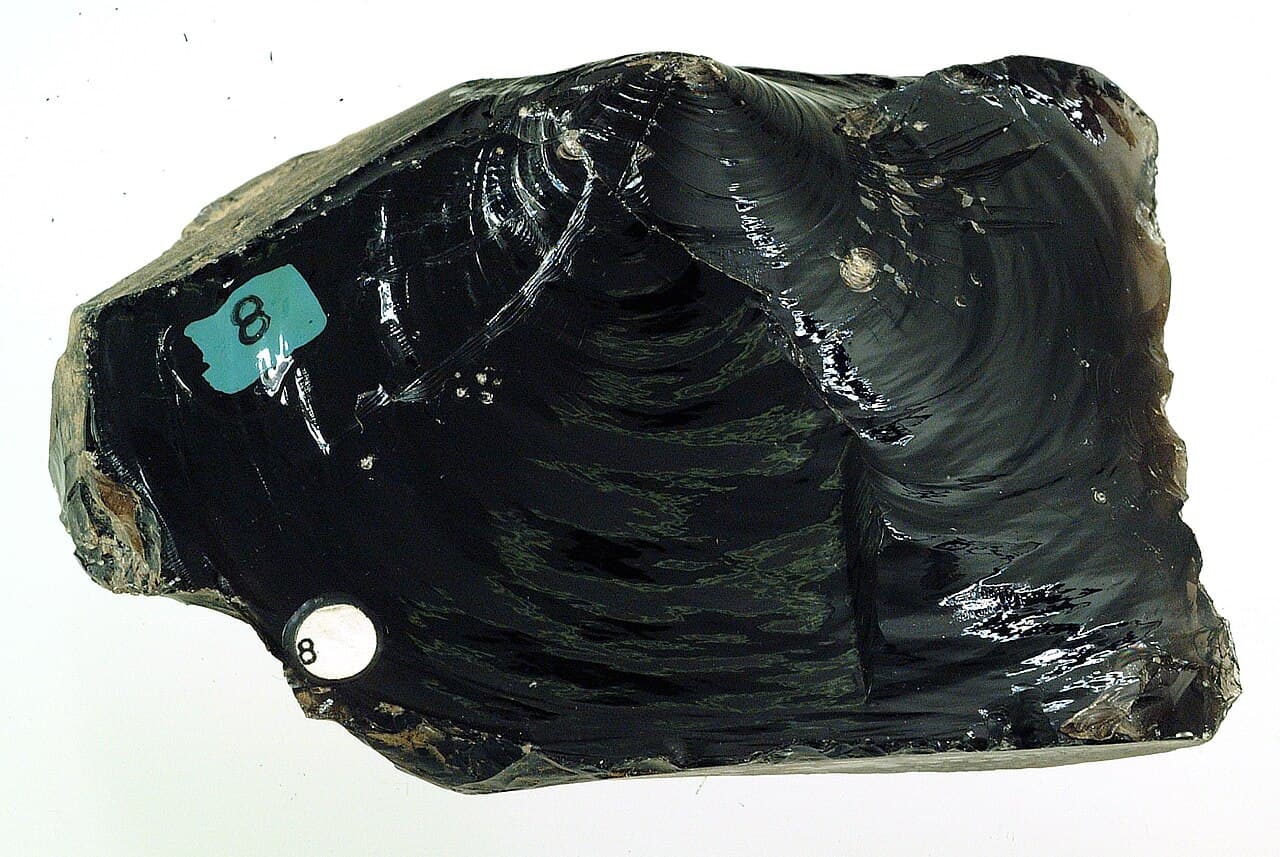
Obsidian is natural volcanic glass — molten felsic (silica-rich) lava that cooled so quickly that its atoms never had time to organize into crystals. Because it lacks an ordered internal structure, obsidian is technically amorphous: it is classed as an extrusive igneous rock and as a glass, but it is not a true mineral, since minerals by definition have a regular crystal lattice. The result is a smooth, glassy material, usually a deep, glossy black, that breaks with the same curved, shell-like surfaces you see in a chipped bottle.
That glassy break is obsidian's most useful and famous trait. When it fractures it produces conchoidal (shell-shaped) surfaces that meet in edges far sharper than steel — sharp enough that ancient peoples worldwide knapped it into blades, arrowheads and scrapers, and that some modern surgical scalpels are still made from it. Moderately hard at about 5 to 5.5 on the Mohs scale, obsidian is hard enough to scratch glass but soft enough to be scratched by a steel knife, and it is brittle, so those keen edges chip easily.
Obsidian at a glance
- Classification
- Volcanic glass (igneous, extrusive)
- Rock type
- Igneous (volcanic glass)
- Composition
- Mostly SiO₂ (silica-rich glass)
- Hardness
- 5–5.5 (Mohs)
- Luster
- Vitreous (glassy)
- Streak
- White
- Colors
- Usually jet black; also brown/mahogany, gray, green, and iridescent gold or rainbow sheen; snowflake (black with white spots)
- Crystal system
- None — amorphous (no crystal structure)
- Transparency
- Translucent on thin edges to opaque
- Texture
- Glassy (no visible crystals)
How to identify obsidian
Start with the surface and the break. A genuine piece of obsidian looks and feels like glass: it has a bright vitreous luster, smooth curved (conchoidal) fracture surfaces, and edges that can be razor-sharp. Held up to a strong light, a thin edge of black obsidian often glows a deep translucent brown rather than staying solid black. It is moderately hard — it will scratch ordinary glass — and gives a white streak on an unglazed tile.
The biggest clues are what obsidian does NOT show. There are no visible crystals, no grains, and no banding of the sort you see in agate or onyx, because it never crystallized. Its weight feels ordinary for a rock (it is relatively low in density, close to common glass) and it is not magnetic. If you see crystal faces, a sugary or grainy texture, sharp color bands, or feel real heft, you are probably looking at something else.
Types and varieties
Most obsidian is jet black, colored by tiny amounts of iron and magnesium dispersed through the glass. But several distinctive varieties exist. Snowflake obsidian is black glass dotted with pale gray-white 'snowflakes' — these are radiating clusters (spherulites) of the silica mineral cristobalite that began to crystallize within the glass. Mahogany obsidian shows swirling reddish-brown and black patterns, the brown coming from iron oxidation. Rainbow, gold-sheen and silver-sheen obsidian display a shimmering iridescence: this is not surface coloring but light scattering off countless microscopic mineral or gas-bubble inclusions aligned in flow layers within the glass.
Other named types include snowflake-free gray and green obsidian, and 'mahogany' grading into nearly solid black. Apache tears are small, rounded nodules of translucent obsidian weathered out of grayish volcanic rock. All of these are the same basic material — volcanic glass — distinguished only by inclusions, oxidation and the way light interacts with them.
How obsidian forms
Obsidian forms when felsic lava — lava rich in silica, the same chemistry that elsewhere makes granite and rhyolite — erupts at the surface and chills almost instantly, for example along the cooled margins of a thick lava flow or where lava meets air or water. Crystals need time and atomic mobility to grow; when cooling is fast enough, the silica-rich melt freezes into a solid before any orderly lattice can develop, locking the atoms into the disordered, glassy state.
Because it is a glass rather than a crystalline solid, obsidian is geologically short-lived. Over thousands to millions of years it slowly devitrifies — the glass gradually crystallizes — and absorbs water, turning cloudy and eventually breaking down. That is why obsidian is found around relatively young volcanic centers and is essentially absent from very old rock formations. The same silica-rich magma that quenches into obsidian will, if it cools slowly underground, instead form coarse crystalline rock; obsidian is simply the fast-cooled, glassy outcome.
Meaning and properties
Obsidian has a long cultural history as a protective stone. In many crystal and folk traditions it is described as grounding and as a 'psychic shield' that absorbs negativity, and black obsidian in particular is associated with protection and with facing difficult truths. Polished obsidian's mirror-like surface gave it a role in scrying and divination across several ancient cultures, and it has been carved into mirrors, masks and amulets for millennia.
It is worth being clear that these metaphysical associations are cultural and spiritual rather than scientifically established. Obsidian has no proven medical or psychological effect, and it should never be used in place of professional medical or mental-health care. Enjoyed for its beauty, its history and its symbolism, it is a striking stone — but its 'healing' properties are a matter of belief, not of demonstrated fact.
Real vs. manufactured glass
The most common thing mistaken for obsidian — sometimes innocently, sometimes deliberately — is ordinary manufactured glass, including black bottle glass and 'slag' glass. Both are glass and both break conchoidally, so fracture alone will not separate them. The tells are in the imperfections. Natural obsidian usually contains subtle, irregular flow lines and tiny stretched or teardrop-shaped bubbles and inclusions, and its color is rarely perfectly even. Manufactured glass tends to look too perfect: uniform, saturated color (often a slightly bottle-green or unnaturally pure black when backlit), and round, evenly distributed air bubbles rather than stretched ones.
Backlighting helps: many natural black obsidians glow warm brown at the edges, while a lot of imitation glass glows green or stays flatly black. Mold seams, a suspiciously regular shape, or a perfectly smooth molded (rather than fractured) surface point to a manufactured piece. None of these tests is foolproof on its own, so weigh several clues together, and treat extremely cheap, flawless 'obsidian' beads with healthy skepticism.
Care and handling
Obsidian is easy to clean — warm water and a soft cloth are all it needs — but it must be handled gently. Although it is hard enough to scratch glass, it is brittle and prone to chipping, and freshly broken edges can be genuinely sharp enough to cut skin, so handle raw flakes with care and keep them away from children. Store obsidian separately from harder stones such as quartz and topaz, which can scratch its glassy surface.
Avoid hard knocks, and avoid sudden temperature changes, which can stress the glass. Because it is a glass that slowly absorbs water and devitrifies over geologic time, no special action is needed on a human timescale, but prolonged harsh chemical exposure is best avoided to keep the polish bright.
Obsidian look-alikes
Frequently asked questions
Is obsidian a rock, a mineral, or a crystal?
Obsidian is a volcanic glass, which makes it an igneous rock but not a true mineral. Minerals have an ordered crystal structure; obsidian is amorphous, with no crystal lattice, so it is also not technically a crystal even though crystal shops sell it as one.
Why is obsidian so sharp?
Because it is a glass, obsidian breaks along smooth, curved (conchoidal) surfaces that meet in extremely fine edges — finer than a steel blade. That is why ancient toolmakers knapped it into blades and arrowheads, and why some surgical scalpels are still made from it.
How can I tell real obsidian from glass?
Look for natural imperfections: irregular flow lines and stretched, teardrop-shaped bubbles, with slightly uneven color. Manufactured glass looks too uniform, often has round evenly spaced bubbles or mold seams, and may glow green when backlit, whereas black obsidian often glows warm brown.
What is snowflake obsidian?
Snowflake obsidian is black obsidian containing pale gray-white spots. Those 'snowflakes' are small radiating clusters of the silica mineral cristobalite that started to crystallize within the glass as it slowly aged.
What does obsidian symbolize?
Obsidian is best known as a stone of protection and grounding — a meaning that fits both its jet-black depth and its practical history, since ancient cultures valued it as the sharpest cutting material available and as a reflective surface for scrying mirrors. Modern crystal practice associates it with clarity, shielding and facing difficult truths. These meanings are cultural and spiritual rather than medical: obsidian is a striking stone to keep, but it treats no condition and is no substitute for professional care.
What are the different types of obsidian?
All obsidian is volcanic glass; the varieties come from what is trapped inside it. Snowflake obsidian carries pale radial clusters of cristobalite; rainbow and sheen obsidian show iridescent bands from microscopic mineral layers catching the light; mahogany obsidian is streaked red-brown by iron oxide; and Apache tears are small, rounded nodules translucent at the edges. Gold or silver sheen obsidian gets its shimmer from aligned gas bubbles.
Is yours obsidian? Find out from a photo
Photograph your rock in good light and get an identification with an honest confidence level, the look-alikes to rule out and the at-home tests that confirm it.
Identify my rock freeOn Android? Get the free rock identifier app
Related
Compare obsidian with look-alikes
More rocks in the field guide
Related reading
Keep exploring
More on rocks: how to identify a rock, what kind of rock is this and the Mohs hardness scale.
Last updated 2026-07-19. Identification guidance is educational — confirm important results with the diagnostic tests described or a qualified expert.