Amethyst
Also known as: Purple quartz
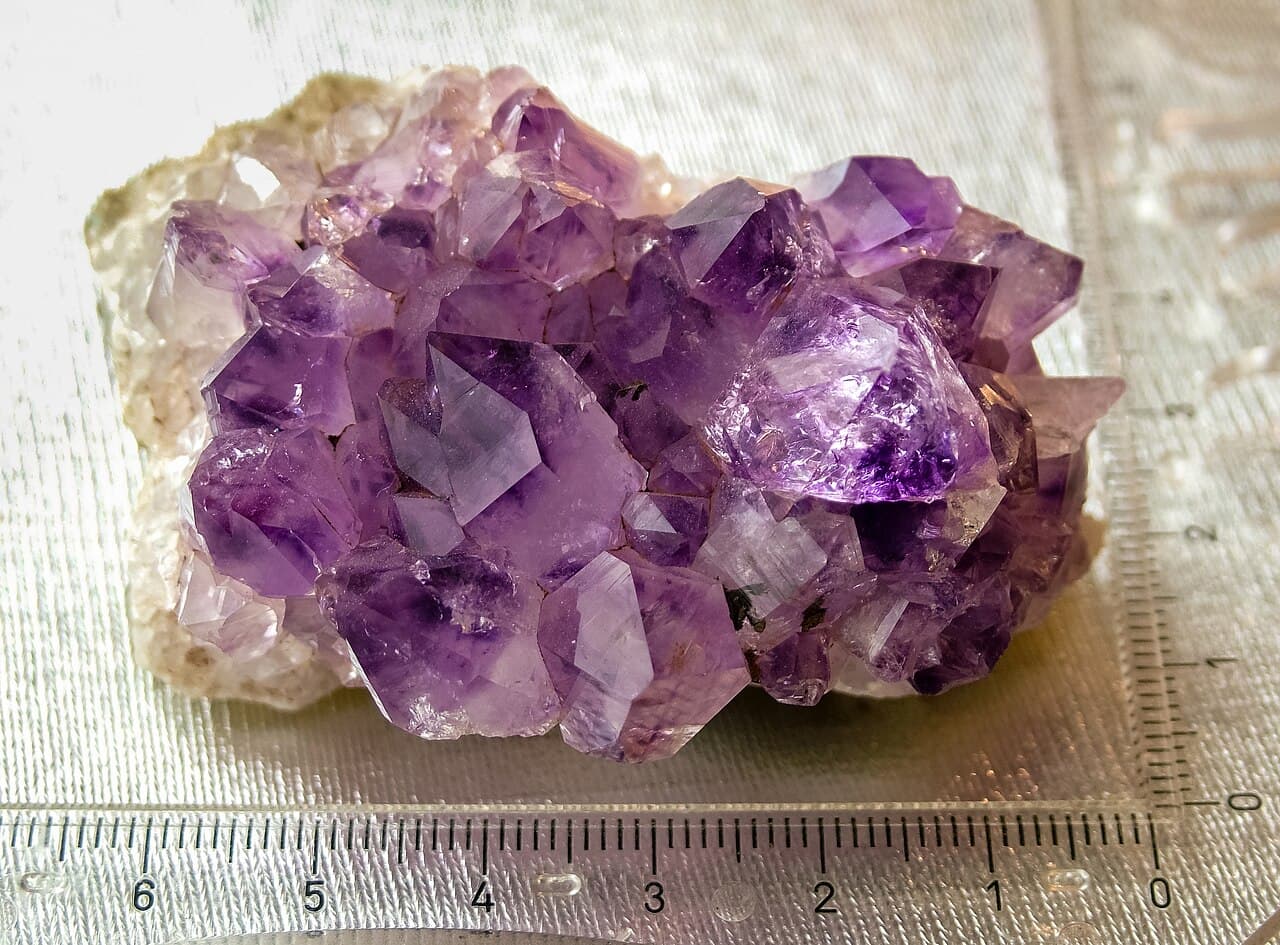
Amethyst is the purple variety of quartz, one of the most popular and recognizable crystals in the world. Chemically it is the same silicon dioxide (SiO₂) as ordinary clear quartz; what sets it apart is its violet-to-deep-purple color, which comes from trace amounts of iron in the crystal combined with natural irradiation deep underground. Like all quartz it is hard, durable and glassy, and it grows the same six-sided crystals — which is why a single amethyst point looks like a clear quartz crystal that someone has dyed purple.
Most people first meet amethyst as a geode or cluster: a rocky shell lined with countless purple crystals ending in sharp, pyramid-shaped points. The color is often unevenly distributed, deepening toward the tips and fading toward the base, a zoning that is a normal and even reassuring sign of natural growth. Because it is abundant, affordable and easy to recognize, amethyst is also one of the crystals people most want to identify and verify, so it is worth knowing both how to confirm it and how it can be imitated.
Amethyst at a glance
- Classification
- Mineral — purple variety of quartz
- Composition
- SiO₂ (silica, colored by trace iron + natural irradiation)
- Hardness
- 7 (Mohs)
- Luster
- Vitreous (glassy)
- Streak
- White
- Colors
- Pale lilac to deep violet-purple; color zoning common
- Crystal system
- Trigonal (hexagonal prisms with pyramidal terminations)
- Transparency
- Transparent to translucent
How to identify amethyst
Start with the obvious clue — a purple color in any shade from pale lilac to rich violet — and then confirm it is quartz. Well-formed amethyst grows as six-sided (hexagonal) prisms capped by a pointed, pyramid-shaped termination, the classic quartz crystal habit; in a geode you will see many of these points crowded together. The color is frequently zoned, stronger near the tips and patchy or banded within the crystal, which is exactly what natural amethyst should look like.
The hardness test is decisive. Quartz sits at 7 on the Mohs scale, so a genuine amethyst will scratch glass and a steel knife will not scratch it — a quick way to rule out softer purple stones and most glass imitations. Amethyst also has no cleavage: instead of splitting along flat planes, it breaks with a curved, shell-like conchoidal fracture, the same as clear quartz. Purple color plus a hexagonal crystal habit plus a hardness of 7 plus conchoidal fracture together confirm amethyst.
Color and varieties
Amethyst spans a wide range of purples, from a faint, almost pinkish lilac to a saturated, inky violet. The deepest, most evenly colored material — sometimes marketed as "Deep Russian" — is the most prized, while paler, washed-out stones are far more common. Color zoning, where bands or patches of stronger purple sit within a paler crystal, is typical of natural growth and is not a flaw.
Two related quartz varieties are worth knowing. Prasiolite, a leek-green stone often sold as "green amethyst," is almost always produced by heat-treating natural amethyst, not by nature; it is real quartz, just artificially colored. Ametrine is a natural blend of amethyst and citrine in the same crystal, showing zones of purple and golden-yellow side by side. Both illustrate how closely amethyst, citrine and clear quartz are related — they are all the same mineral, differing mainly in trace impurities and heat history.
Meaning and properties
Amethyst carries a long cultural history as a stone of sobriety, calm and clear-headedness. The name itself comes from a Greek word meaning "not intoxicated," and the ancient Greeks and Romans associated the stone with protection against drunkenness — a tradition that survives today in amethyst's reputation as a calming, focusing and clarifying crystal. It has also long been linked with the so-called crown chakra and with meditation.
These associations are spiritual and cultural rather than medical. Amethyst is valued in many traditions for promoting a sense of calm and clarity, but it is not a treatment for any condition and should never replace professional medical or mental-health care. Enjoy it for its beauty and its history, and treat "healing" claims as matters of belief and personal meaning, not science.
Value: what amethyst is worth
Amethyst is abundant and, for most pieces, very affordable — tumbled stones, small points and geode slices are inexpensive, which is part of the stone's broad appeal. Because supply is plentiful, value is driven almost entirely by color quality: deep, even, richly saturated purple commands a clear premium, while pale, gray-tinged or unevenly colored material is cheap. Good clarity, a clean crystal shape and an attractive, fully crystallized geode also add to the price.
There are no fixed prices for amethyst — what a piece sells for depends on its color, size, clarity and form. As a rule of thumb, when comparing two pieces, the one with deeper and more uniform purple will be the more valuable, all else being equal. Large cathedral geodes and finely colored faceted gems sit at the top of the range, while everyday cluster and tumbled material remains one of the best values in the crystal world.
Real vs. fake amethyst
Two kinds of imitation come up most often. The first is synthetic amethyst — quartz grown in a laboratory by a hydrothermal process. It is chemically identical to natural amethyst and genuinely is quartz, so simple hardness and fracture tests will not distinguish it; lab-grown material is often unusually clean and evenly colored, and reliably separating it from natural amethyst can require gemological testing. The second is dyed glass sold as amethyst, which is far easier to catch.
Glass gives itself away. Look for tiny round bubbles trapped inside (quartz crystals do not contain spherical bubbles), a too-perfect, uniform color with no natural zoning, and rounded or molded edges rather than true crystal faces. Glass also tends to feel slightly warmer to the touch than quartz, which feels cool, and it is softer, so it can be scratched by a quartz point or a steel file. With dyed quartz, the dye often concentrates in cracks and fractures, showing as thin lines of more intense color — a clear sign the purple was added rather than grown.
Care
Amethyst is hard (7) and physically durable, so it resists scratches and is easy to live with, but it has one real weakness: light. Prolonged, strong sunlight can gradually fade amethyst's purple toward gray or colorless, so it is best kept out of permanently sunny windows and displayed in indirect light. Heat is the other thing to avoid — strong heat will change the color, turning amethyst yellow, orange or brown; in fact much of the "citrine" on the market is heat-treated amethyst.
For everyday cleaning, warm water and a soft cloth or brush with a little mild soap are all that is needed. Avoid harsh chemicals and sudden temperature changes, and do not assume an amethyst is safe in an ultrasonic cleaner. Stored away from direct sun and treated gently, an amethyst will keep its color and polish indefinitely.
Amethyst look-alikes
Frequently asked questions
What is amethyst?
Amethyst is the purple variety of quartz — the same silicon dioxide (SiO₂) as clear quartz, colored violet by trace iron and natural irradiation. It is hard (Mohs 7), glassy and forms six-sided crystals with pyramid-shaped points, often as clusters and geodes.
How can I tell real amethyst from glass or fake?
Real amethyst is quartz, so it scratches glass (hardness 7), breaks with a curved conchoidal fracture, and usually shows some natural color zoning. Glass imitations contain tiny round bubbles, have a too-uniform color, feel slightly warm, and are softer. In dyed quartz, the color tends to pool in cracks. Lab-grown amethyst is genuine quartz and can require gemological testing to identify.
Why does amethyst fade in the sun?
Amethyst's purple comes from a delicate, irradiation-induced color in its iron-bearing quartz. Prolonged strong sunlight can break that color down, gradually fading the stone toward gray or colorless. Keep amethyst out of permanently sunny spots and display it in indirect light to preserve the color.
What is amethyst good for?
Practically, amethyst is a durable, beautiful stone for jewelry, carvings and display pieces. In many traditions it is regarded as a calming, clarifying stone associated with sobriety and focus — associations that are spiritual and cultural, not medical, and not a substitute for professional care.
What does amethyst symbolize?
Amethyst has long symbolized sobriety, calm and clear-headedness — its name comes from a Greek word meaning 'not intoxicated,' and the Greeks and Romans wore it as a guard against drunkenness. Later traditions made it a stone of meditation, intuition and spiritual clarity, and as the February birthstone it stands for peace and protection. These meanings are cultural and spiritual rather than medical: amethyst is meaningful to keep and wear, but it treats no condition and is no substitute for professional care.
What birthstone is amethyst?
Amethyst is the birthstone for February, on every list ancient and modern — one of the few months with a single, undisputed stone. It is also traditionally linked to the zodiac signs Pisces and Aquarius. See our February birthstone guide for the full history, including how amethyst went from a rare 'cardinal gem' to an affordable favorite after huge Brazilian deposits were found.
What is green amethyst?
'Green amethyst' is a trade name for prasiolite — leek-green quartz that is almost always made by heat-treating natural amethyst, not found green in nature. It is real quartz, just artificially colored, so calling it 'amethyst' (which means purple quartz) is really a marketing convenience. An honest seller labels it prasiolite or 'green quartz' and discloses the heat treatment.
Is yours amethyst? Find out from a photo
Photograph your crystal in good light and get an identification with an honest confidence level, the look-alikes to rule out and the at-home tests that confirm it.
Identify my crystal freeOn Android? Get the free rock identifier app
Related
Compare amethyst with look-alikes
More crystals in the field guide
Related reading
- Crystals for Beginners: Where to Start
- How to Cleanse Crystals (Safely)
- How to Identify a Geode: 5 Signs Before You Crack It Open
- How to Tell if a Crystal Is Real vs Fake
- Raw Crystals: What They Are and How to Identify Them
- Rock Tumbling for Beginners: What Actually Works
- Types of Quartz: The Complete Variety Guide
- Where to Find Crystals: A Beginner's Rockhounding Guide
Keep exploring
More on crystals: the full list of crystal types, how to identify a crystal and crystals by color.
Last updated 2026-07-19. Identification guidance is educational — confirm important results with the diagnostic tests described or a qualified expert.