Vesuvianite
Also known as: Idocrase, Californite (massive green variety), Vesuvian
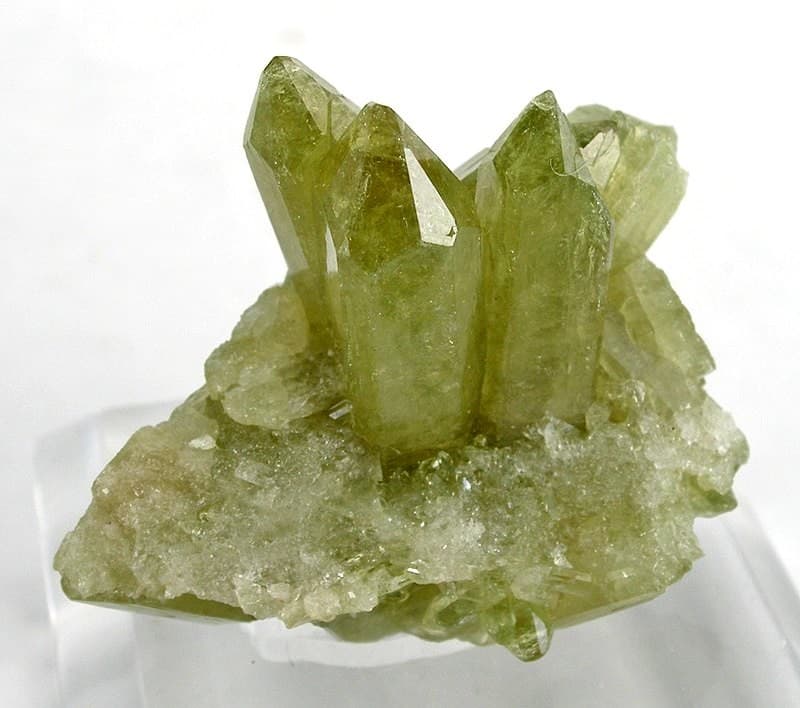
Vesuvianite is a calcium-aluminum silicate that takes its name from Mount Vesuvius in Italy, where it was first described from blocks ejected by the volcano. It is best known by two names: mineralogists and gem dealers often call it idocrase, while the name vesuvianite honors that famous type locality. It typically forms where limestone has been altered by heat and chemically active fluids, the geologic setting called a skarn or contact metamorphic zone, and there it grows alongside minerals like garnet, epidote, and diopside. Most vesuvianite is some shade of green, brown, or yellow, occurring either as stubby four-sided prismatic crystals or as dense massive material.
For identification, vesuvianite sits in a useful middle ground: it is moderately hard at about 6 to 7 on the Mohs scale, so it scratches glass and resists a steel knife, and it has a glassy to slightly resinous luster, a white streak, and crystals that are characteristically short and squarish in cross section. Its greatest source of confusion is its massive green variety, called californite, which looks so much like jade that it has long been sold as a jade substitute. Because vesuvianite shares both its green color and its skarn home with epidote, garnet, and diopside, naming it confidently usually means combining the crystal shape, the hardness, the geologic association, and, for the jade-like material, a careful comparison against true jade.
Vesuvianite at a glance
- Classification
- Sorosilicate mineral (calcium aluminum silicate); a skarn and contact-metamorphic mineral
- Composition
- Ca10(Mg,Fe)2Al4(SiO4)5(Si2O7)2(OH,F)4
- Hardness
- 6 to 7 (Mohs)
- Luster
- Vitreous to resinous
- Streak
- White
- Colors
- Most often green, brown, or yellow; also brownish-green, yellow-green, and rarely blue or purple
- Crystal system
- Tetragonal
- Transparency
- Transparent to translucent (opaque in massive material)
- Magnetic
- Not magnetic
How to identify it
Begin with crystal shape and hardness. When vesuvianite forms good crystals they are typically short and stubby prisms with a square cross section, often stout and brick-like rather than long and slender, sometimes with a pyramid-capped end. It is moderately hard at about Mohs 6 to 7, so it scratches glass and a steel knife will not scratch it, and it shows a glassy to faintly resinous luster with a white streak. Color alone is unreliable because vesuvianite ranges across green, brown, and yellow, but a stubby tetragonal crystal of that hardness with a vitreous luster, especially one sitting in a limestone-derived rock, points strongly toward vesuvianite.
Lean hard on the geologic setting, because vesuvianite is a classic skarn mineral. It forms where limestone has been baked and chemically altered, so it is very commonly found growing with garnet (especially the calcium garnet grossular), epidote, diopside, and wollastonite. Finding a green-to-brown moderately hard silicate in that company is a strong supporting clue. The trickiest case is the massive, fine-grained green variety called californite, which has no obvious crystals and looks remarkably like jade; there, hardness, the company it keeps, and a comparison against jade's distinctive toughness become the deciding tests. No single trait names vesuvianite by itself, but crystal habit, hardness, luster, and skarn association together make a confident identification.
Colors and varieties
Vesuvianite is most familiar in green, brown, and yellow, but it spans a wide range that includes yellow-green, brownish-green, olive, honey-brown, and, in rarer finds, blue and purple tones. The blue, copper-bearing variety is sometimes called cyprine, and there are yellow gem varieties as well. This color variability is exactly why color cannot identify the mineral on its own; a glassy green vesuvianite crystal and a glassy green epidote or grossular garnet can look very similar to the eye, which is why crystal shape, hardness, and association matter so much.
The single most important variety to know is californite, the massive, compact, fine-grained green form named for its California occurrences. Because it is tough, takes a polish, and ranges through the green tones associated with jade, californite has long been carved and sold as a jade imitation, sometimes under misleading names. It is genuine vesuvianite, not a fake mineral, but it is not jade, and treating it as jade is the common pitfall. Beyond californite, gem-quality transparent vesuvianite is faceted for collectors, while the more typical translucent-to-opaque material is used as cabochons, beads, and ornamental carvings, with luster running from glassy in clear crystals to slightly resinous or greasy in massive pieces.
Meaning and properties
In crystal-lore and metaphysical traditions, vesuvianite, often under the name idocrase, is described in those practices as a stone associated with releasing tension, encouraging cooperation, and connecting the heart and mind, with its green tones linked symbolically to the heart energy center. Some people simply value it for its rich color and as a curious, less common alternative to jade. These associations are cultural, spiritual, and personal rather than scientific, and vesuvianite should not be relied upon to diagnose, treat, or cure any condition. It is not a substitute for professional medical care, and anyone with a health concern should consult a qualified professional.
Practically, vesuvianite is a stable silicate that is safe to handle and display, with no special toxicity concerns in ordinary use beyond the common-sense advice not to ingest mineral specimens, to avoid breathing dust when cutting or grinding, and to wash your hands after handling rough or dusty pieces. Keep it away from food, drink, and pets as you would any mineral, and enjoy vesuvianite for its color, its crystal form, and its interesting geologic story rather than for any claimed physical benefit.
Value and what affects price
Vesuvianite's value depends heavily on form and quality. Transparent, well-colored crystals suitable for faceting are uncommon and the most sought-after, prized by gem collectors for clean material in attractive green, yellow-green, or honey tones. Sharp, lustrous crystals on matrix, especially aesthetic specimens associated with garnet, diopside, or epidote from notable skarn localities, are valued by mineral collectors. The dense green californite variety is cut into cabochons and carvings and is generally more modestly priced, valued as an ornamental and jade-alternative material rather than as a top-tier gem.
Color, clarity, size, and craftsmanship drive price within each category, as does locality for collector specimens. For californite and other jade-like material, honest description matters: it should be sold as vesuvianite or idocrase, not represented as jade, and a buyer paying jade prices for californite is overpaying for the wrong stone. As with any mineral, judge a piece on its actual color, transparency, crystal quality, and condition rather than on an appealing name, and be cautious of material marketed in a way that blurs the line with jade. No specific prices are implied here; market values vary widely.
Real vs. fake: avoiding misidentification
With vesuvianite the central issue is not counterfeiting but confusion, in two directions. First, vesuvianite itself, especially as massive green californite, is the imitator: it has long been sold as a stand-in for jade, so the real risk is buying californite while believing it is true jade. To guard against that, remember that californite is genuine vesuvianite but is not jade, and that real jade (jadeite or nephrite) is exceptionally tough and resists chipping in a way that distinguishes it; reputable dealers will name californite honestly rather than calling it jade.
Second, in crystal form, vesuvianite is easily mixed up with the minerals it grows beside. Green epidote co-occurs with it in skarns and shares a similar color, but epidote tends toward slender, deeply striated crystals and a distinctive pistachio-green, while vesuvianite is stubbier and squarer. Grossular garnet, also a skarn mineral, can be a close color match but forms rounded, many-faced crystals rather than stubby square prisms and is harder. To confirm vesuvianite, rely on its short tetragonal crystal habit, its Mohs 6 to 7 hardness, its white streak and glassy-to-resinous luster, and its telltale company of garnet, diopside, and epidote, and treat any green stone marketed simply as "jade" at a bargain with appropriate caution.
Care and cleaning
Vesuvianite is reasonably durable thanks to its Mohs 6 to 7 hardness, so it tolerates everyday handling better than soft minerals, but it still benefits from sensible care. Clean it with warm water, a little mild soap, and a soft brush or cloth, then rinse and dry it; this gentle approach is safe for both crystals and californite cabochons. Avoid harsh chemicals and strong acids, and skip aggressive mechanical or ultrasonic cleaning for pieces with fractures, inclusions, or along crystal cleavage, since vesuvianite can be brittle and a sharp knock or thermal shock may chip or crack a specimen despite its decent hardness.
Store vesuvianite away from harder gemstones such as quartz, topaz, and corundum that could scratch it, and keep faceted stones or fine crystals padded so they are not abraded or bumped against one another. Protect it from sudden temperature changes and from impacts on edges and crystal terminations, which are the most vulnerable points. With mild cleaning, careful storage, and protection from knocks and harsh chemicals, vesuvianite keeps its color, luster, and crisp crystal form well over the long term.
Vesuvianite look-alikes
Frequently asked questions
Is vesuvianite the same as idocrase?
Yes. Vesuvianite and idocrase are two names for the same mineral, a calcium-aluminum silicate. "Vesuvianite" comes from Mount Vesuvius, the locality where it was first described, while "idocrase" is an older name often still used in the gem trade. You may see either name on labels, and they refer to identical material; some dealers favor idocrase for cut gems and vesuvianite for mineral specimens.
Is californite real jade?
No. Californite is the massive, fine-grained green variety of vesuvianite, and although it has long been sold as a jade substitute, it is not jade. It is genuine vesuvianite, not a fake mineral, but true jade is either jadeite or nephrite and is far tougher and more chip-resistant. The honest description is vesuvianite or idocrase; be cautious if californite-like material is marketed simply as "jade," especially at a bargain price.
How do I tell vesuvianite from epidote or garnet?
Use crystal shape and association. Vesuvianite forms stubby, square-section four-sided prisms, while epidote forms slender, deeply striated, elongated crystals with a pistachio-green color, and grossular garnet forms rounded, many-faced crystals. All three can be green and all three form in skarns alongside one another, so when crystals are present the habit is the clearest clue; vesuvianite's brick-like prisms set it apart from epidote's needles and garnet's rounded balls.
What color is vesuvianite, and is green the only one?
Green is the most familiar color, but vesuvianite is not green-only. It commonly occurs in green, brown, and yellow, including yellow-green, olive, and honey-brown shades, and rarer finds can be blue (the copper-bearing variety cyprine) or even purple. This color range is why color alone cannot identify the mineral; crystal shape, the Mohs 6 to 7 hardness, the white streak, and the typical skarn association are needed to confirm it.
Is yours vesuvianite? Find out from a photo
Photograph your mineral in good light and get an identification with an honest confidence level, the look-alikes to rule out and the at-home tests that confirm it.
Identify my mineral freeOn Android? Get the free rock identifier app
Related
More minerals in the field guide
Keep exploring
More on minerals: how to identify a mineral, the streak test and the full list of crystal types.
Last updated 2026-06-25. Identification guidance is educational — confirm important results with the diagnostic tests described or a qualified expert.