Ametrine
Also known as: Bolivianite, Trystine, Amethyst-citrine quartz
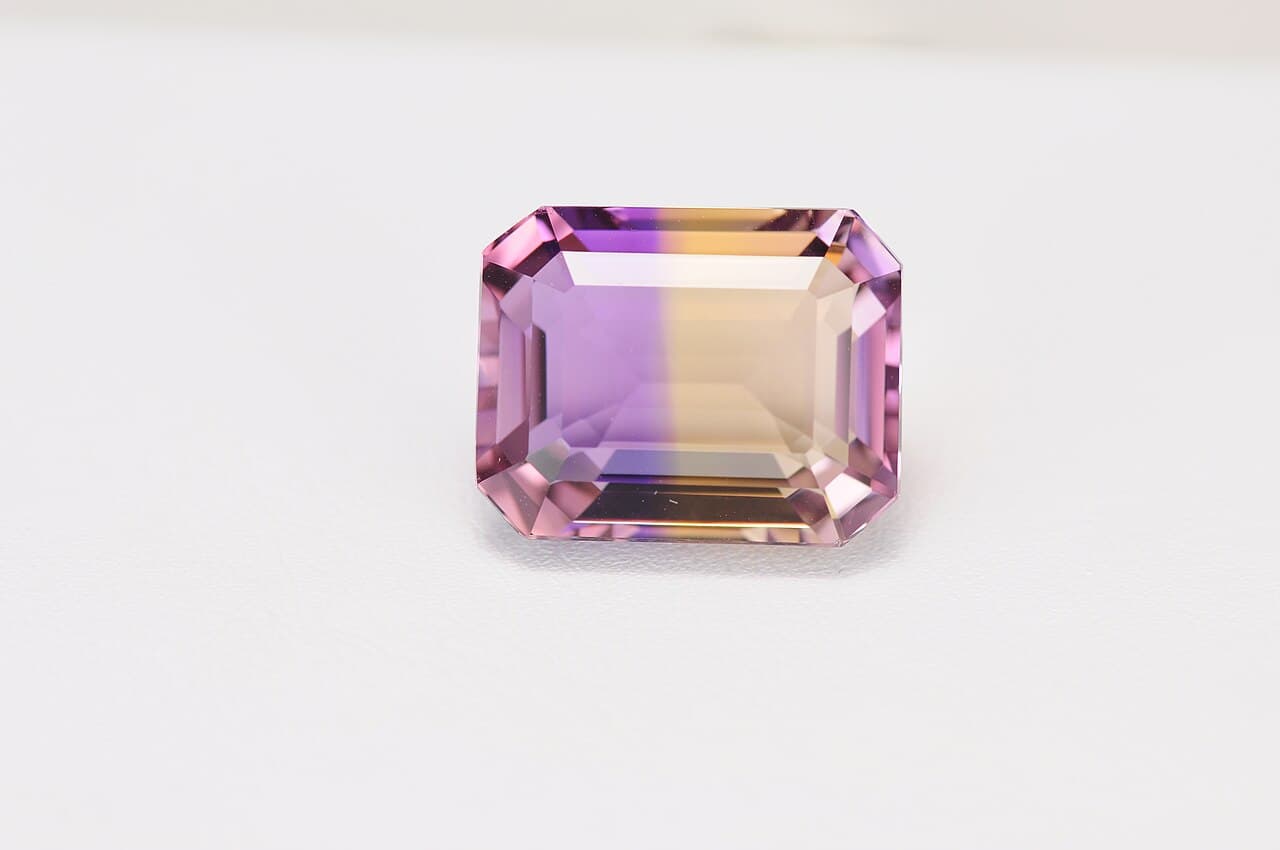
Ametrine is a naturally bicolored variety of quartz (SiO₂) that combines amethyst and citrine in a single crystal — one zone is violet to purple, the other a golden yellow to orange, and the two colors typically meet along a sharp, almost ruler-straight boundary. Because it is simply quartz wearing two colors at once, it shares all of quartz's basic properties: a Mohs hardness of 7, a glassy (vitreous) luster, a white streak, and a trigonal crystal structure. The result is one of the most distinctive gemstones in the quartz family, prized specifically for the contrast between its purple and gold halves.
What makes ametrine remarkable is not just the two colors but where they come from. Both hues are caused by traces of iron within the same silica framework; the difference is the iron's oxidation state, which varied across the crystal as it grew under changing temperature conditions, so part of the stone behaves like amethyst and part like citrine. Almost all natural ametrine in the world comes from a single source, the Anahí mine in eastern Bolivia, which is why the stone is sometimes called bolivianite. That narrow origin, combined with the eye-catching color split, gives ametrine a niche but loyal following among collectors and jewelry designers.
Ametrine at a glance
- Classification
- Mineral — macrocrystalline quartz (bicolor amethyst-citrine variety)
- Composition
- SiO₂ (silica, colored by trace iron in two oxidation states)
- Hardness
- 7 (Mohs)
- Luster
- Vitreous (glassy)
- Streak
- White
- Colors
- Purple/violet and golden-yellow to orange in the same crystal
- Crystal system
- Trigonal
- Transparency
- Transparent to translucent
How to identify ametrine
Ametrine announces itself through its two-tone color: one part of the stone is the violet of amethyst and the other is the golden-yellow of citrine, with the colors usually divided by a crisp, well-defined line rather than blending gradually. Confirm the underlying mineral first — like all quartz, ametrine has a hardness of 7, so it scratches glass and resists a steel knife, shows a glassy luster and a white streak, and breaks with curved, shell-like (conchoidal) surfaces rather than flat cleavage planes. Most ametrine you encounter is faceted, because cutters deliberately orient the stone so both color zones show in the finished gem.
The single most useful identification tip is the boundary between the colors. In genuine ametrine the purple-to-gold transition tends to be sharp and geometric, often running parallel to the crystal's original growth faces, because the two zones formed as distinct bands during growth. Be cautious if the two colors fade softly into one another or look painted on the surface, since that pattern is more typical of dyed or coated imitations than of natural bicolor quartz. Natural ametrine carries its color through the body of the stone, and the split looks like part of the crystal's internal structure rather than a finish applied to the outside.
Colors and varieties
By definition ametrine is two colors at once: a violet-to-purple amethyst zone and a yellow-to-orange citrine zone, both within one quartz crystal. The amethyst portion can range from pale lavender to deep grape, and the citrine portion from light lemon to warm golden orange, so individual stones vary in how strong and how balanced the contrast is. The most prized pieces show a clear, lively division between a rich purple and a bright gold, with both halves well represented rather than one color dominating.
Cutters work hard to make the most of these zones. Standard faceted ametrine is often a step-cut or emerald cut that places the boundary down the middle so the gem reads half-purple and half-gold, but some lapidaries deliberately blend or interleave the colors with fancy or fantasy cuts. Ametrine is closely related to its single-color cousins — amethyst (all purple) and citrine (all golden) — and shares its chemistry and hardness with them; what sets ametrine apart is simply that both colors coexist in the same piece.
Meaning and properties
In crystal traditions ametrine is often described as a stone of balance and harmony, valued because it combines the qualities people associate with amethyst (calm, intuition, clarity) and citrine (warmth, optimism, motivation) in a single stone. This blending of two energies is the heart of its folklore, and it is sometimes kept as a symbol of bringing opposites into equilibrium.
These meanings are cultural and spiritual rather than scientifically demonstrated medical effects. Ametrine is best appreciated for its unusual beauty, its rarity and its symbolism; it is not a treatment for any health condition and is not a substitute for professional medical or psychological care.
Value: what ametrine is worth
Ametrine sits among the more affordable colored gemstones, but its worth rises sharply with the quality of the color split. The most valued stones show a strong, clean contrast between a vivid purple and a bright golden orange, with a sharp dividing line, good transparency, and both zones roughly balanced; weak, muddy, or lopsided color makes a piece far less desirable. Larger gems tend to command more per carat because a bigger stone can display both color zones more dramatically.
Cutting and origin both matter. A well-oriented cut that maximizes the two-tone effect adds real value, and material traceable to the Anahí mine in Bolivia — effectively the world's main natural source — appeals to collectors who want documented natural bicolor quartz. As always, this is a guide to what drives price, not a quote: actual prices vary with the market, the seller, and each individual stone.
Real vs. fake ametrine
There are two things to watch for with ametrine. The first is laboratory-grown (synthetic) quartz: ametrine can be produced hydrothermally in a lab, and synthetic bicolor quartz is real quartz chemically but is not the rarer natural Bolivian material. Synthetic and treated stones often show very even, almost too-perfect color zones, and distinguishing them with certainty can require gemological testing, so for higher-value purchases a report from a reputable lab is the safest route. The second issue is outright imitation — colorless quartz or even glass that has been dyed, heated, or coated to mimic the purple-and-gold split.
You can catch the cruder fakes yourself. Confirm the stone is quartz at all: it should have a hardness of 7 (scratching glass but not scratched by a steel knife), a white streak, and conchoidal fracture rather than flat cleavage faces. Glass imitations are softer, may show tiny round trapped bubbles, and tend to feel warmer to the touch than cool quartz. With dyed or coated pieces the color often pools in surface cracks or sits on the outside rather than running through the stone, and the purple-to-gold boundary looks blurry or painted instead of the sharp, growth-controlled line seen in natural ametrine. None of these home tests separate natural from lab-grown quartz, however — for that distinction, rely on a gemological laboratory.
Care
Ametrine is hard (Mohs 7) and durable enough for everyday jewelry, and the safest way to clean it is with warm water, mild soap, and a soft brush or cloth. Avoid harsh household chemicals and sudden temperature changes, which can stress any quartz, and as a precaution keep it out of ultrasonic and steam cleaners unless you know the stone is untreated.
The most important consideration is light and heat. The amethyst zone can fade with long, intense sun exposure, and strong heat can shift the balance of the two colors — heating amethyst is, after all, how citrine and some ametrine effects are produced — so store ametrine away from prolonged direct sunlight and keep it out of hot environments to preserve its purple-and-gold contrast.
Ametrine look-alikes
Frequently asked questions
What is ametrine?
Ametrine is a naturally bicolored variety of quartz (SiO₂) that is part amethyst (purple) and part citrine (golden), with the two colors meeting in a single crystal — usually along a sharp line. It has a Mohs hardness of 7, a glassy luster and a white streak, and both colors come from trace iron in different oxidation states. Almost all natural ametrine comes from the Anahí mine in Bolivia.
Why is ametrine two different colors?
Both the purple and the golden zones are caused by traces of iron within the same silica structure; the difference is the iron's oxidation state, which varied as the crystal grew under changing temperature conditions. That variation produced an amethyst zone and a citrine zone side by side in one quartz crystal.
Is ametrine real or man-made?
Both exist. Natural ametrine forms in the ground and comes almost entirely from Bolivia's Anahí mine, but ametrine can also be grown synthetically in a lab. Synthetic stones are chemically real quartz but are not the rarer natural material; distinguishing the two reliably usually requires gemological testing rather than a home test.
How can I tell ametrine from a dyed imitation?
Check that it is quartz at all (hardness 7, white streak, curved shell-like fracture, no trapped bubbles), and look closely at the color boundary. Natural ametrine carries its purple and gold through the body of the stone with a sharp, growth-controlled dividing line, while dyed or coated fakes often show color pooling in cracks and a blurry, painted-looking transition.
Is yours ametrine? Find out from a photo
Photograph your crystal in good light and get an identification with an honest confidence level, the look-alikes to rule out and the at-home tests that confirm it.
Identify my crystal freeOn Android? Get the free rock identifier app
Related
More crystals in the field guide
Keep exploring
More on crystals: the full list of crystal types, how to identify a crystal and crystals by color.
Last updated 2026-06-25. Identification guidance is educational — confirm important results with the diagnostic tests described or a qualified expert.