Citrine
Also known as: Yellow quartz, Golden quartz, Heat-treated amethyst (most commercial citrine)
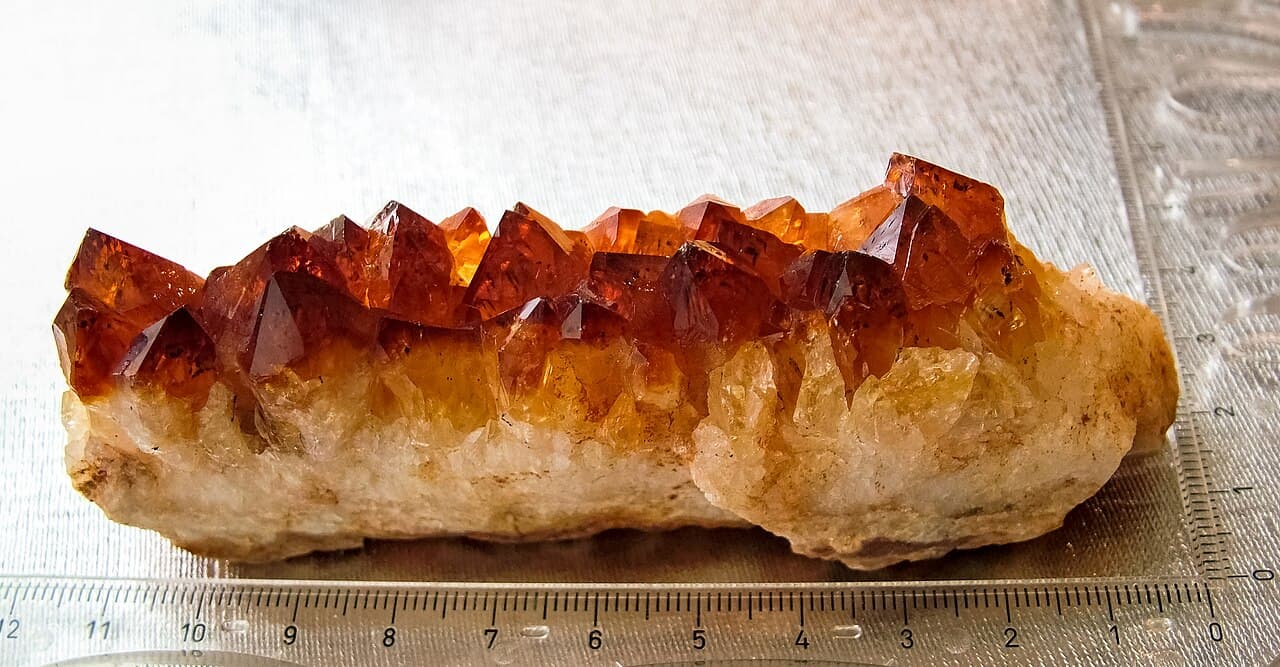
Citrine is the yellow-to-golden-orange variety of quartz (SiO₂), the same mineral family as clear quartz, amethyst and smoky quartz. Like all quartz it has a Mohs hardness of 7, a glassy (vitreous) luster, a white streak and a trigonal crystal structure, and it can grow as well-formed six-sided points or appear as polished tumbled stones and faceted gems. Its warm color comes from traces of iron held within the silica framework, and it ranges from a faint lemon yellow to a deep, almost brandy-like golden orange.
There is one essential truth about citrine that separates an informed buyer from a confused one: genuinely natural citrine is uncommon, and the overwhelming majority of the "citrine" sold today — especially the deep orange-brown points and the dramatic dark-tipped citrine clusters — is actually amethyst (or sometimes smoky quartz) that has been heated until it turns golden. This is a legitimate, centuries-old practice and the resulting stone is still real quartz, but it is not what most people picture when they imagine a rare natural gem. Knowing the difference is the single most valuable skill in identifying citrine.
Citrine at a glance
- Classification
- Mineral — macrocrystalline quartz (yellow-to-orange variety)
- Composition
- SiO₂ (silica, colored by trace iron)
- Hardness
- 7 (Mohs)
- Luster
- Vitreous (glassy)
- Streak
- White
- Colors
- Pale lemon-yellow to golden, amber and orange-brown
- Crystal system
- Trigonal
- Transparency
- Transparent to translucent
How to identify citrine
Start by confirming the stone is quartz at all. Citrine has a hardness of 7, so it will scratch glass and a steel knife will not scratch it; it shows a glassy luster, a white streak, and when it forms crystals they are the classic six-sided quartz prisms capped by a six-sided point. The color should read as a warm yellow, gold, amber or orange — never the violet of amethyst or the gray-brown of unheated smoky quartz. Faceted citrine is transparent and bright, while many natural specimens are slightly hazy or smoky-yellow rather than perfectly clear.
The harder question is whether your citrine is natural or heat-treated, because both are real quartz and both are common. Natural citrine tends toward a soft, fairly even pale yellow, sometimes with a faint smoky cast, and any color it has is usually distributed throughout the crystal. Heat-treated amethyst, by contrast, is typically a more saturated orange-brown with a reddish undertone, and the color often concentrates toward the tips while the base of the crystal stays cloudy whitish or colorless. A cluster of stout points that are bright orange at the tips and milky-white at the base is, in almost every case, heated amethyst rather than natural citrine.
Color and varieties
Citrine's palette runs from a delicate lemon or straw yellow through honey and amber to a rich golden orange. The pale, slightly smoky yellows are most characteristic of natural citrine, while the deep orange-to-brown tones — including the warm shade often marketed as "Madeira" color — are usually the product of heating. A related material, ametrine, is a single quartz crystal that is part purple amethyst and part golden citrine, with the two colors meeting in distinct zones.
Because heat treatment is so widespread, color alone is a poor guide to origin. The most reliable visual tip is the pattern of the color rather than the hue itself: even, throughout-the-stone yellow suggests natural growth, whereas an orange-brown tip over a bleached or whitish base suggests an amethyst that has been baked. Neither is fake — both are quartz — but only the former is properly called natural citrine.
Meaning and properties
Citrine is widely known in crystal traditions as a stone of abundance, optimism and personal energy, and it is sometimes nicknamed the "merchant's stone" for its folkloric association with prosperity and confidence. Its sunny color has long linked it to warmth, positivity and a sense of fresh momentum, and in chakra-based practice it is most often connected with the solar plexus.
These associations are cultural and spiritual rather than scientifically established medical effects. Citrine is best enjoyed for its color, history and symbolism; it is not a substitute for medical or psychological care.
Value: what citrine is worth
Citrine is one of the more affordable warm-colored gems, and most tumbled stones, beads and small faceted pieces are inexpensive. Value rises with size, clarity, and a clean, attractive golden color free of gray or muddy tones, and well-cut transparent gems command more than cloudy rough.
Origin also matters to collectors: because natural, untreated citrine is genuinely scarce, verified natural material can carry a premium over the far more common heat-treated amethyst, even when the two look similar. For everyday jewelry the distinction rarely affects price much, but for collectors and connoisseurs a documented natural stone is the prize.
Real vs. fake citrine
The first thing to understand is that "fake" citrine usually does not mean a non-quartz imitation — it more often means heat-treated amethyst being sold as natural citrine without disclosure. The stone is real quartz, but the natural-versus-treated distinction is what affects value. Watch for the classic tells of heated amethyst: a strong orange-brown to reddish color, bright tips over a cloudy whitish base, and clusters of uniformly colored points, since natural citrine more often shows a gentler, evenly distributed pale yellow.
True non-quartz imitations do exist and are easier to catch. Yellow glass is softer than quartz, often contains tiny round bubbles, and tends to feel warmer to the touch than a cool quartz crystal. Yellow topaz can pass for citrine at a glance but is harder (Mohs 8), noticeably denser in the hand, and has a distinct cleavage that quartz lacks. Yellow beryl (heliodor) is also harder and denser than quartz. Confirming a hardness of 7, a white streak, conchoidal (curved, shell-like) fracture rather than flat cleavage faces, and the absence of bubbles will separate genuine quartz citrine from these look-alikes.
Care
Citrine is hard (Mohs 7) and reasonably tough, so it is safe to clean with warm water and a mild soap, and it stands up well to everyday handling and jewelry wear. Avoid harsh chemicals and sudden temperature shocks, which can stress any quartz.
The most important precaution is light: citrine's color can fade with prolonged exposure to strong sunlight, and intense heat can also alter it. Store citrine away from direct sun for long periods and keep it out of hot environments to preserve its golden tone.
Citrine look-alikes
Frequently asked questions
What is citrine?
Citrine is the yellow-to-golden-orange variety of quartz (SiO₂), with a Mohs hardness of 7, a glassy luster and a white streak. Its warm color comes from traces of iron. Importantly, most commercial citrine is actually amethyst that has been heated to turn it golden, rather than rarer natural citrine.
How can I tell if citrine is natural or heat-treated?
Natural citrine is usually a soft, fairly even pale yellow, sometimes faintly smoky, with color spread through the stone. Heat-treated amethyst tends to be a stronger orange-brown with a reddish tint and bright tips over a cloudy whitish base. A cluster of uniformly orange-tipped points is almost always heated amethyst, not natural citrine.
What is the difference between citrine and yellow topaz?
Hardness and density. Topaz is harder (Mohs 8) and denser, so citrine cannot scratch it and topaz feels heavier for its size. Topaz also has a flat cleavage plane, while citrine, being quartz, breaks with curved, shell-like surfaces and has a hardness of 7.
What is citrine good for?
Practically, it is a durable, attractive stone for jewelry and faceted gems. In crystal traditions it is associated with abundance, optimism and confidence — associations that are spiritual and cultural rather than medically proven, so it is not a substitute for medical care.
What does citrine symbolize?
Citrine is popularly called the 'merchant's stone' or 'success stone,' associated with abundance, optimism and confidence — a sunny meaning that follows naturally from its golden color. Modern crystal practice links it to the solar plexus chakra and to energy and motivation. As with all stone lore, these meanings are cultural and spiritual rather than medical or financial: citrine is a cheerful stone to keep, but it treats no condition and is no substitute for professional advice.
What birthstone is citrine?
Citrine is a birthstone for November, added in the 1952 revision alongside the traditional November stone, topaz. The two are paired because they share a golden color at very different price points — which is also why citrine is so often sold under misleading names like 'gold topaz' or 'Madeira topaz.' See our November birthstone guide for how to tell the two apart.
Is yours citrine? Find out from a photo
Photograph your crystal in good light and get an identification with an honest confidence level, the look-alikes to rule out and the at-home tests that confirm it.
Identify my crystal freeOn Android? Get the free rock identifier app
Related
Compare citrine with look-alikes
More crystals in the field guide
Related reading
Keep exploring
More on crystals: the full list of crystal types, how to identify a crystal and crystals by color.
Last updated 2026-07-19. Identification guidance is educational — confirm important results with the diagnostic tests described or a qualified expert.