Andesite
Also known as: Andesitic lava
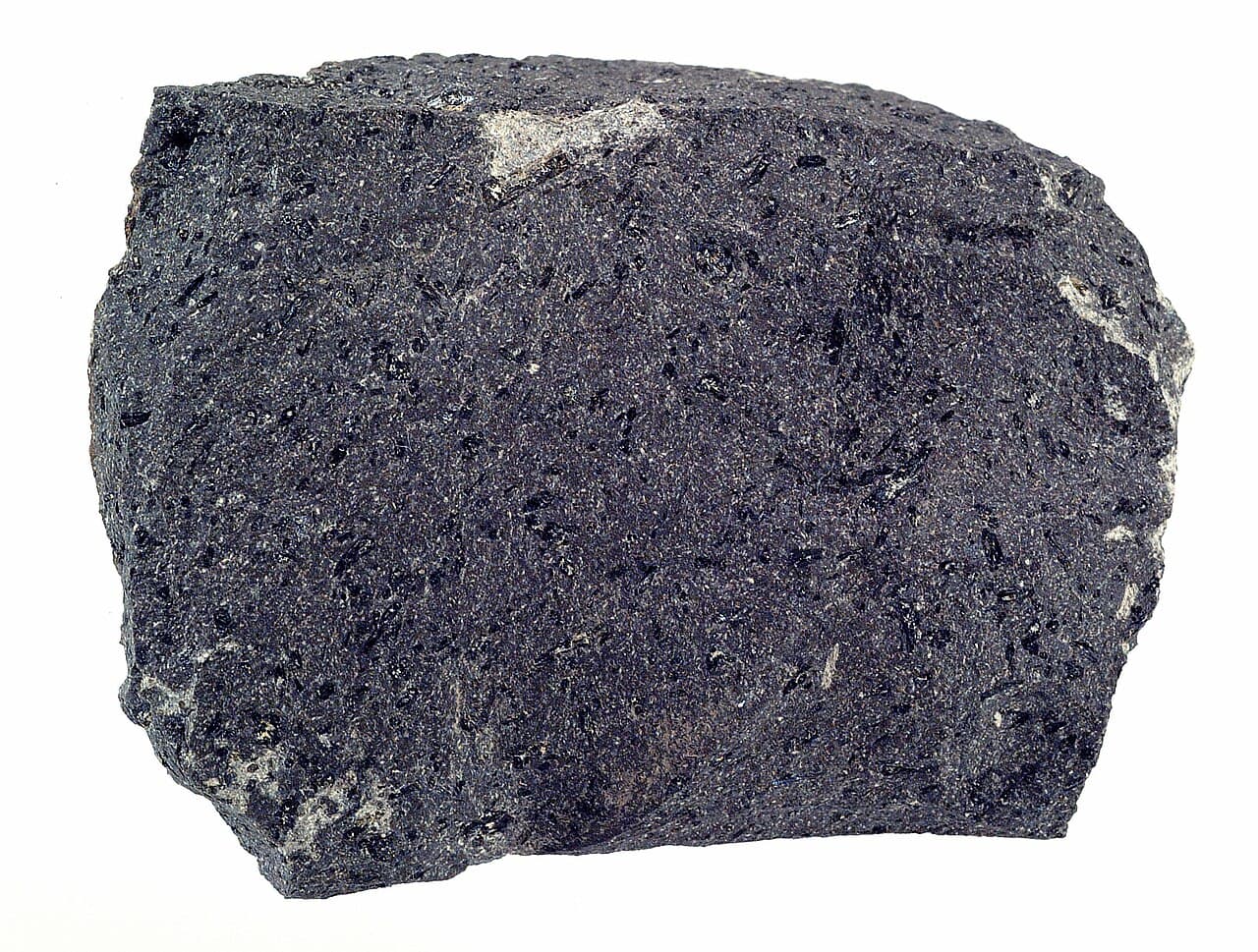
Andesite is a fine-grained volcanic rock that sits squarely in the middle of the igneous family — chemically intermediate between dark, iron-rich basalt and pale, silica-rich rhyolite. To the eye it is usually a medium to dark gray stone, sometimes tinged purple, brown, or greenish, with a dull, even groundmass so fine that you cannot make out individual grains. Its most distinctive feature is that it is frequently porphyritic: scattered through that fine matrix are larger, well-formed crystals — most often chalky white or glassy plagioclase feldspar, and sometimes dark needles or stubby crystals of hornblende or pyroxene — that stand out like raisins in a cake.
The rock takes its name from the Andes, the great chain of subduction-zone volcanoes along South America's western edge, and that geographic origin is a clue to its nature. Andesite is the signature lava of the world's explosive arc volcanoes, the kind that ring the Pacific in the so-called Ring of Fire. Recognizing it is largely a matter of placing it correctly on the basalt-to-rhyolite scale: darker and denser than rhyolite, lighter and more crystal-speckled than basalt, and fine-grained where its deep-cooled twin, diorite, is coarse. Its intrusive equivalent — the same magma frozen slowly underground — is diorite.
Andesite at a glance
- Classification
- Igneous rock — intermediate, extrusive (volcanic)
- Rock type
- Igneous (volcanic/extrusive)
- Composition
- Intermediate silica (~57-63% SiO2); plagioclase feldspar with hornblende and/or pyroxene
- Hardness
- About 6, though grains are usually too fine to test individually
- Luster
- Dull to earthy in the groundmass; phenocrysts may look glassy
- Colors
- Medium to dark gray; also purplish, brownish, or greenish
- Texture
- Fine-grained (aphanitic), very commonly porphyritic with visible phenocrysts
What type of rock is andesite?
Andesite is an igneous rock — it solidified from molten rock — and specifically an extrusive, or volcanic, one, meaning the lava cooled at or near the Earth's surface rather than deep underground. That relatively quick cooling is why it is fine-grained: the bulk of the crystals had little time to grow, so they remain too small to see, and the rock reads as a dense, even-textured gray mass.
Within the igneous family, andesite is defined by its intermediate composition. It carries more silica than basalt but less than rhyolite, which is why it falls between them in both chemistry and color. The single most useful comparison is to diorite: diorite has essentially the same intermediate composition as andesite but cooled slowly at depth, so it is coarse-grained with crystals you can easily see. Andesite is, in effect, the fast-cooled volcanic version of diorite — same recipe, different texture. It is neither sedimentary nor metamorphic; it is not built from cemented sediment grains, and it has not been recrystallized by heat and pressure.
How andesite forms
Andesite forms above subduction zones, where one tectonic plate dives beneath another. As the descending slab sinks and heats, it releases water into the overlying mantle wedge, which lowers the melting point of the rock and generates magma. That magma rises and evolves on its way up — partly by mixing with and melting the crust, and partly by crystallizing and shedding dense early minerals — until it reaches the intermediate, somewhat sticky composition that defines andesite. This is why andesite is so closely tied to the volcanic arcs that rim the Pacific Ocean.
Because andesitic magma is more viscous than runny basaltic lava, it traps gas more readily and tends to erupt explosively, building the steep, layered stratovolcanoes — Fuji, Shasta, and many of the Andes peaks among them — that are classic andesite landforms. The rock's common porphyritic texture records a two-stage cooling history: large feldspar, hornblende, or pyroxene crystals (phenocrysts) began growing slowly in the magma chamber, and then the remaining melt was erupted and chilled quickly into the fine groundmass that now surrounds them. That contrast between big early crystals and a fine later matrix is one of andesite's signatures.
How to identify andesite
Start with color and grain. Andesite is fine-grained — you should not be able to pick out the bulk of the crystals with the naked eye — and medium to dark gray, often with a purplish, brownish, or greenish cast. It is not as black or as heavy as basalt, and not as pale as rhyolite. Placing the rock on that basalt-to-rhyolite color scale is the first and most important step, because andesite occupies the gray middle ground between the two.
Then look for phenocrysts. Most andesite is porphyritic, so scan the dull groundmass for scattered larger crystals: blocky or lath-shaped white-to-glassy plagioclase feldspar is the most common, and you may also see dark, shiny hornblende needles or stubby black pyroxene. The presence of these pale feldspar specks in a gray matrix is a strong hint. To separate andesite from its look-alikes, watch the overall darkness and check for quartz: basalt is darker, denser, and more uniformly black with no quartz; rhyolite is distinctly paler (pink, tan, or light gray) and may show glassy quartz grains; and if the rock is coarse-grained with clearly visible interlocking crystals throughout, it is diorite, the plutonic equivalent, rather than andesite.
What andesite is used for
Andesite is a tough, durable, widely available stone, and most of its practical use is as construction aggregate. Crushed andesite serves as road base, concrete and asphalt aggregate, and railway ballast, where its hardness and angular fracture help it interlock and bear loads. Larger blocks are used as riprap and armor stone to protect embankments and shorelines, and it has long been quarried as a general-purpose building and paving stone.
It also has a notable history as a dimension and carving stone. Many pre-Columbian Andean structures and sculptures were built from andesite, and it continues to be cut for facing stone, flagging, and ornamental masonry where a hard-wearing gray stone is wanted. Its appeal for these uses comes from the same traits that define it: it is hard, dense, resistant to weathering, and abundant in volcanic regions.
Andesite look-alikes
Frequently asked questions
What type of rock is andesite?
Andesite is an igneous rock — specifically an extrusive (volcanic) one that cooled quickly from lava at or near the surface. It is of intermediate composition, sitting between basalt and rhyolite, which is why it is gray rather than black or pale. Its coarse-grained, deep-cooled equivalent is diorite.
How can I identify andesite?
Look for a fine-grained, medium-to-dark gray volcanic rock that is usually porphyritic — scattered larger crystals of white-to-glassy plagioclase feldspar, and sometimes dark hornblende or pyroxene, set in a dull matrix. It is lighter than basalt and darker than rhyolite, and it lacks the free quartz you might see in rhyolite.
What is the difference between andesite and basalt?
Both are fine-grained volcanic rocks, but basalt is mafic — darker, denser, and richer in iron and magnesium — while andesite is intermediate, with more silica, a grayer color, and commonly more pale feldspar phenocrysts. In short, basalt is the black, heavy one; andesite is the gray, speckled one a step up the silica scale.
What is andesite used for?
Andesite is mostly crushed for construction aggregate — road base, concrete and asphalt, and railway ballast — and used as riprap and armor stone. As a hard, durable stone it is also cut for building, paving, and facing, and it was widely used for masonry and sculpture in the pre-Columbian Andes.
Is yours andesite? Find out from a photo
Photograph your rock in good light and get an identification with an honest confidence level, the look-alikes to rule out and the at-home tests that confirm it.
Identify my rock freeOn Android? Get the free rock identifier app
Related
More rocks in the field guide
Keep exploring
More on rocks: how to identify a rock, what kind of rock is this and the Mohs hardness scale.
Last updated 2026-06-25. Identification guidance is educational — confirm important results with the diagnostic tests described or a qualified expert.