Rhyolite
Also known as: Rhyolitic lava
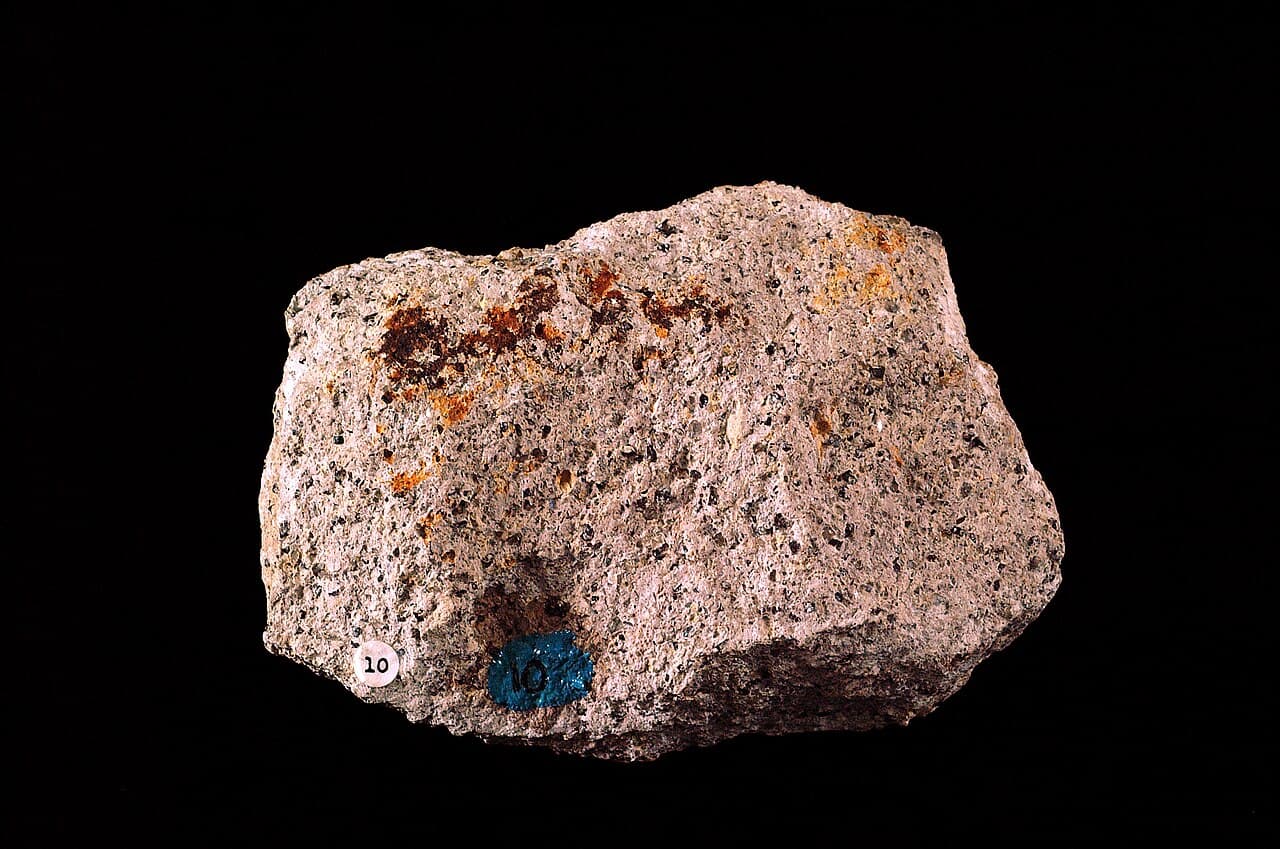
Rhyolite is a fine-grained volcanic rock with a high-silica, or felsic, composition — in plain terms, it is the volcanic equivalent of granite, made from the same kind of magma but cooled quickly at the surface instead of slowly at depth. Because of that chemistry it tends to be pale: pinks, light grays, tans, and creamy buff tones are typical, sometimes with reddish or brownish bands. The groundmass is usually too fine to make out individual crystals, and in some pieces it is partly glassy. A hallmark feature of many rhyolites is flow banding — wavy, parallel streaks and layers frozen into the rock that record the thick, sticky lava slowly oozing as it set.
Rhyolite often contains scattered larger crystals, called phenocrysts, that began growing in the magma before it erupted — usually glassy gray quartz or blocky feldspar — set in the fine, pale matrix. Some varieties are prized by collectors and lapidaries, such as the banded "rainforest rhyolite" (rainforest jasper) with its green and brown patterns, and richly flow-banded ornamental rhyolite. Identifying it is mostly a matter of recognizing a light-colored, fine-grained volcanic rock and then separating it from its relatives: it shares granite's composition but not its coarse grain, it is paler and more silicic than andesite, and it is the crystalline counterpart of fully glassy obsidian.
Rhyolite at a glance
- Classification
- Igneous rock — felsic (high-silica), extrusive (volcanic)
- Rock type
- Igneous (volcanic/extrusive)
- Composition
- High silica (>69% SiO2); quartz, alkali feldspar, and plagioclase
- Hardness
- About 6-7 overall (quartz-bearing); grains often too fine to test individually
- Luster
- Dull to earthy in the groundmass; quartz and feldspar phenocrysts may look glassy
- Colors
- Pale — pink, light gray, tan, cream; sometimes reddish or banded
- Texture
- Fine-grained (aphanitic) to partly glassy; commonly flow-banded, often porphyritic
What type of rock is rhyolite?
Rhyolite is an igneous rock — it solidified from molten rock — and an extrusive, or volcanic, one, meaning the lava cooled at or near the Earth's surface rather than deep underground. That comparatively fast cooling is why the bulk of its crystals are too small to see and the rock takes on a fine, even, often pale appearance, sometimes with a glassy quality where cooling was especially rapid.
What sets rhyolite apart within the igneous family is its felsic, high-silica composition: it is rich in silica and in the light-colored minerals quartz and feldspar, which is exactly why it is so pale. The cleanest way to picture it is as the volcanic twin of granite. Granite and rhyolite form from the same kind of magma and share the same chemistry, but granite cools slowly deep underground and grows large, interlocking, visible crystals, while rhyolite cools quickly at the surface and ends up fine-grained. Rhyolite is the fast-cooled surface version of granite — same recipe, different texture. It is not sedimentary or metamorphic: it is not cemented sediment, and it has not been recrystallized by heat and pressure.
How rhyolite forms
Rhyolite forms when felsic, silica-rich magma reaches the surface and cools quickly. This kind of magma is the most evolved, produced when a melt sheds its dense early-forming minerals and concentrates silica, or when continental crust itself is melted. High silica makes the magma extremely viscous — thick and pasty rather than runny — so it holds onto its dissolved gas. That combination makes rhyolitic eruptions among the most explosive on Earth, capable of producing enormous ash falls and pyroclastic flows; the same magma that erupts gently as rhyolite lava can, under pressure, blast out as pumice and volcanic ash.
When rhyolitic lava does flow rather than explode, it moves slowly and stiffly, and that sluggish movement is recorded as flow banding — the wavy, streaky layers seen in many rhyolites. The rock is also commonly porphyritic: quartz and feldspar crystals that began growing in the magma chamber are carried up and frozen as phenocrysts within the fine groundmass that chilled on eruption. Where cooling is fast enough to prevent crystals from forming at all, the same magma yields the volcanic glass obsidian instead, which is why obsidian and rhyolite are so closely linked.
How to identify rhyolite
Begin with color and grain. Rhyolite is fine-grained — the bulk of its crystals are too small to see with the naked eye — and it is pale: think pink, light gray, tan, or cream, sometimes with reddish or banded tones. That light color is the single best clue, because it reflects the high silica and abundant feldspar that define the rock. A fine-grained volcanic rock that reads as light-colored is a strong candidate for rhyolite.
Then look for the supporting features. Flow banding — wavy, parallel streaks and layers — is common and is a near-giveaway for a silicic volcanic rock. Scan the groundmass for phenocrysts of glassy gray quartz or blocky feldspar standing out from the matrix. To separate rhyolite from its look-alikes, check grain size and luster: if the rock has the same pale, quartz-and-feldspar makeup but is coarse-grained with large interlocking crystals, it is granite, not rhyolite; if it is darker and grayer it is more likely andesite; and if it is glossy, glassy, and breaks with smooth curved (conchoidal) surfaces and sharp edges, it is obsidian, the fully glassy version, rather than a fine-grained crystalline rock.
What rhyolite is used for
As a hard, durable stone, rhyolite is widely used as construction aggregate — crushed for road base, concrete and asphalt, and railway ballast — and as riprap and dimension stone for building and landscaping. Its strength and resistance to weathering make it a serviceable general-purpose stone wherever it is quarried, and its often attractive pink and banded colors make it popular for decorative facing, walls, and paving in landscaping.
Rhyolite also has an ornamental and lapidary side. Banded and colorful varieties — such as flow-banded rhyolite and the green-and-brown "rainforest rhyolite" (rainforest jasper) — are cut and polished into cabochons, beads, tumbled stones, and carvings. Historically, fine-grained and glassy silicic volcanic rock in this family was also flaked into tools and points, taking a sharp edge much as flint and obsidian do.
Rhyolite look-alikes
Frequently asked questions
What type of rock is rhyolite?
Rhyolite is an igneous rock — specifically an extrusive (volcanic) one that cooled quickly from silica-rich lava at or near the surface. It is felsic (high-silica) and is the volcanic equivalent of granite: same composition, but fine-grained instead of coarsely crystalline because it cooled fast rather than slowly underground.
How can I identify rhyolite?
Look for a fine-grained, pale volcanic rock — pink, light gray, tan, or cream — often showing wavy flow banding and sometimes scattered glassy quartz or blocky feldspar phenocrysts. Its light color is the key clue. If the same pale rock is coarse-grained it is granite, and if it is glassy and shiny it is obsidian.
What is the difference between rhyolite and granite?
They have the same felsic, quartz-and-feldspar composition, but granite cooled slowly deep underground and is coarse-grained with large visible crystals, while rhyolite cooled quickly at the surface and is fine-grained. Rhyolite is the volcanic version of granite; granite is the plutonic one.
What is rhyolite used for?
Rhyolite is crushed for construction aggregate such as road base, concrete, asphalt, and railway ballast, and used as riprap, building, and landscaping stone. Colorful banded varieties like rainforest rhyolite (rainforest jasper) are also cut and polished into cabochons, beads, and tumbled stones.
Is yours rhyolite? Find out from a photo
Photograph your rock in good light and get an identification with an honest confidence level, the look-alikes to rule out and the at-home tests that confirm it.
Identify my rock freeOn Android? Get the free rock identifier app
Related
More rocks in the field guide
Keep exploring
More on rocks: how to identify a rock, what kind of rock is this and the Mohs hardness scale.
Last updated 2026-06-25. Identification guidance is educational — confirm important results with the diagnostic tests described or a qualified expert.