Conglomerate
Also known as: Puddingstone, Conglomerate rock
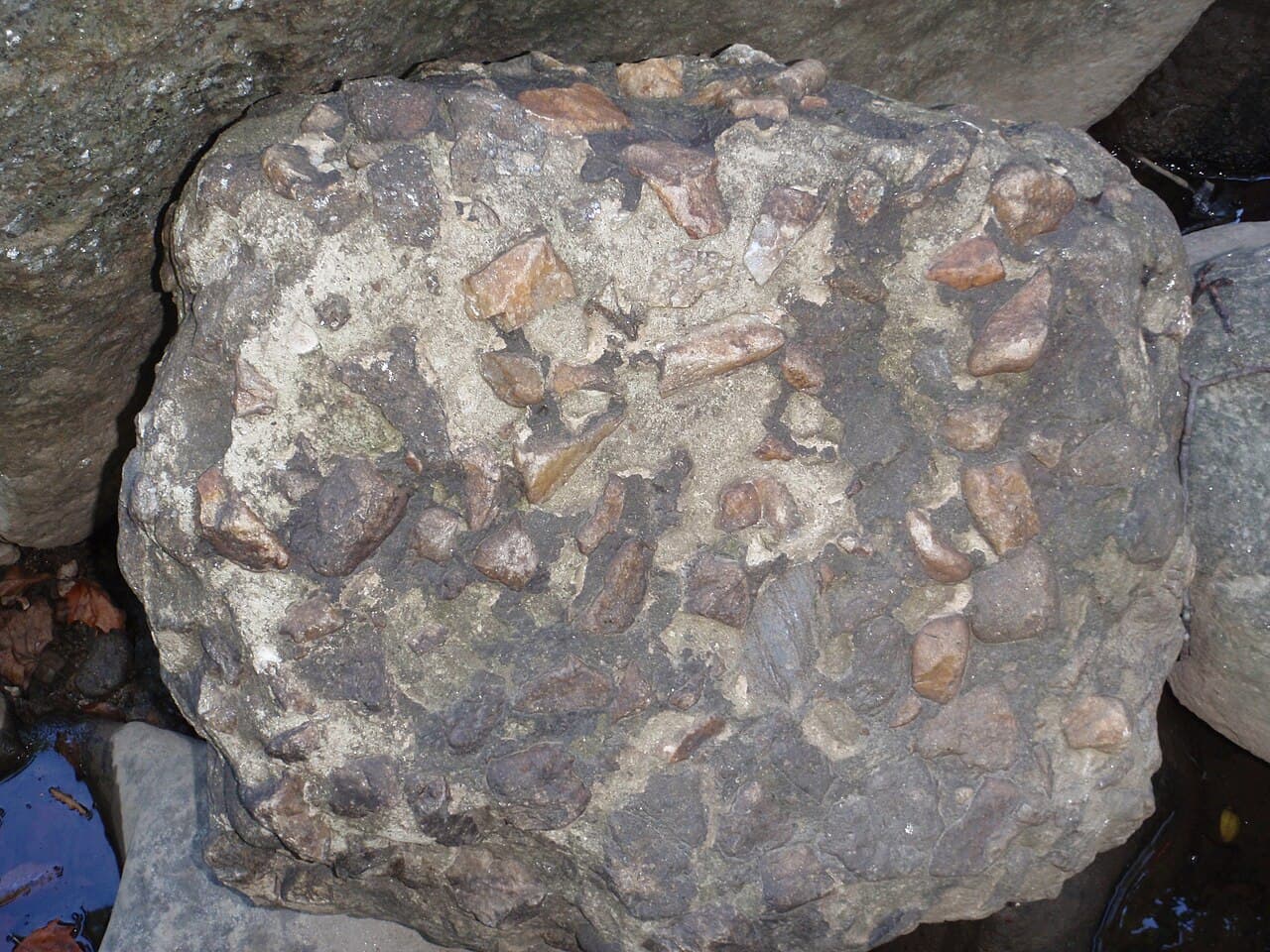
Conglomerate is a coarse-grained clastic sedimentary rock made of rounded, water-worn pebbles and gravel — fragments larger than 2 millimeters across — set in a finer matrix of sand or silt and bound together by natural cement. The feature that defines it, and that you can read at a glance, is the roundness of those pebbles: smooth, well-worn stones with no sharp corners, exactly like the gravel you would scoop from a riverbed or a beach. That rounding is meaningful. Sharp edges wear away only after a fragment has been tumbled and jostled over distance by moving water, so rounded clasts tell you the gravel traveled a real journey before it came to rest, was buried, and turned to stone.
The look is unmistakable: a matrix of fine sediment studded with rounded pebbles of mixed sizes and colors, like fruit in a cake — which is why one classic variety earned the old nickname "puddingstone." The pebbles themselves can be almost any durable rock or mineral, so a single specimen often mixes quartz, chert, and bits of older rock in a range of grays, browns, and reddish tones. Conglomerate is essentially ancient, cemented river or beach gravel, and recognizing it is largely a matter of noticing those smooth, rounded stones held in a finer groundmass.
Conglomerate at a glance
- Classification
- Sedimentary rock — clastic (coarse-grained, rounded)
- Rock type
- Sedimentary (clastic)
- Composition
- No single formula — an aggregate of rounded rock and mineral clasts (>2 mm), commonly quartz and chert, in a sand/silt matrix bound by silica, calcite, or iron-oxide cement
- Hardness
- Variable, roughly 3–7 overall, depending on the pebbles and the cement binding them
- Luster
- Dull to earthy overall, though individual polished-looking pebbles can appear glossier
- Colors
- Mixed and variable — gray, brown, tan, red, and multicolored, since the pebbles come from many different source rocks
- Texture
- Clastic and coarse; rounded, water-worn pebbles and gravel set in a finer sand or silt matrix; often poorly sorted
What type of rock is conglomerate?
Conglomerate is a sedimentary rock, and specifically a clastic (or detrital) sedimentary rock — one made from the broken fragments of older rocks rather than from cooled magma or from minerals recrystallized under heat and pressure. Clastic rocks are classified by grain size, and conglomerate belongs at the coarse end, made of gravel-sized particles larger than 2 millimeters, the same size class as breccia. The two are close cousins, separated by a single feature: conglomerate's clasts are rounded and water-worn, while breccia's are angular and sharp-edged. Remembering that contrast is the key to telling them apart and is the most important fact about the rock.
It is neither igneous nor metamorphic. Igneous rocks such as granite or basalt crystallize from molten material into interlocking crystals, and metamorphic rocks form when existing rock is recrystallized by heat and pressure — neither of which describes a bed of cemented gravel. That said, if conglomerate is subjected to intense heat and pressure deep in the crust, it can be metamorphosed into metaconglomerate, in which the pebbles are stretched and the whole rock recrystallizes. Ordinary conglomerate is the unaltered, sedimentary starting point: rounded gravel deposited by water and glued into stone.
How conglomerate forms
Conglomerate forms where moving water both rounds and deposits gravel. The story begins with weathering and erosion breaking older rock into fragments, which rivers, waves, and currents then pick up and carry. During transport the fragments knock against one another and against the streambed, and their sharp corners are steadily worn away until they become smooth, rounded pebbles — the longer and farther they travel, generally the rounder they get. The gravel is finally dropped where the current loses energy and can no longer move such coarse material: in riverbeds and on bars, at the mouths of rivers, on beaches where waves rework shingle, and in alluvial fans where streams spill out of highlands. These high-energy environments are the natural home of conglomerate.
Once the rounded gravel settles, it must be lithified into solid rock. Finer sediment — sand and silt — fills the spaces between the pebbles to form a matrix, and then groundwater carrying dissolved minerals percolates through the remaining pore space and precipitates a natural cement, most commonly silica, calcite, or iron oxide, that binds the pebbles and matrix together. The finished rock preserves a snapshot of the ancient current that made it: the size of the pebbles records how strong the flow was, and their rounding records how far the gravel traveled. Where transport was short, fragments stay angular and the rock becomes breccia instead; conglomerate is specifically the well-traveled, well-rounded version of coarse clastic sediment.
How to identify conglomerate
The decisive test is to examine the pebbles and judge their shape. In conglomerate the clasts are rounded — smooth, well-worn, with no sharp corners, just like river or beach gravel. If instead the fragments are angular and sharp-edged, the rock is breccia, not conglomerate. This rounded-versus-angular distinction is the whole basis for separating the two coarse clastic rocks, so look at it first and use a hand lens to confirm on smaller specimens. The pebbles should clearly be gravel-sized — larger than 2 millimeters — and embedded in a noticeably finer matrix of sand or silt that surrounds and supports them.
Then read the rock as a whole. Conglomerate is usually poorly sorted, mixing pebbles of different sizes, and it is typically a jumble of colors because the clasts came from many different source rocks — a medley of grays, browns, tans, and reds in one hand specimen is a strong indicator, and a quartz-pebble conglomerate may be studded with pale, glassy, rounded quartz clasts. Test the matrix and cement: try to dislodge a pebble or scratch the groundmass, and a drop of dilute acid will fizz if the cement is calcite. Overall hardness depends on what the rock is built from, so it is a weaker clue than texture. The combination of rounded gravel-sized clasts in a finer matrix — the "puddingstone" look — points clearly to conglomerate.
What conglomerate is used for
Conglomerate's most common practical role is as a bulk construction material. It is quarried and crushed for aggregate, road base, and fill, and used as rough building stone where local deposits are durable and convenient — a serviceable, widely available stone rather than a premium one. Because the strength of a conglomerate depends heavily on how well its pebbles are cemented, well-cemented varieties make sturdier stone while weakly cemented ones crumble more easily, so its construction value varies from deposit to deposit.
Some attractive, well-cemented conglomerates — especially colorful "puddingstone" types with bright rounded pebbles — are cut and polished for decorative and ornamental use as tiles, facing, and curiosities, and tumbled pieces appear in lapidary and collecting hobbies. Conglomerate's greatest value, though, is informational: because it forms only in high-energy water, geologists read it as direct evidence of ancient rivers, beaches, and alluvial fans, using pebble size and rounding to reconstruct past currents and landscapes. Conglomerate beds are also significant in resource exploration, since some of the world's important gold and uranium deposits occur within ancient conglomerates that concentrated heavy minerals among their gravels.
Conglomerate look-alikes
Frequently asked questions
What type of rock is conglomerate?
Conglomerate is a clastic sedimentary rock made of rounded, water-worn pebbles and gravel (over 2 mm) cemented together in a finer sand or silt matrix. It belongs to the coarse end of the clastic rocks, alongside breccia, and is distinguished from breccia by its rounded — rather than angular — clasts. The rounding shows the gravel was transported a distance by water.
What is the difference between conglomerate and breccia?
The difference is the shape of the clasts. Both are coarse clastic sedimentary rocks made of gravel-sized fragments in a finer matrix, but conglomerate's pebbles are rounded and smooth while breccia's fragments are angular and sharp-edged. Rounded means conglomerate; angular means breccia. Rounded clasts indicate the gravel traveled far enough in water to wear down its corners.
Why is conglomerate sometimes called puddingstone?
"Puddingstone" is an old nickname for conglomerate because its rounded pebbles, set in a contrasting finer matrix, look like the fruit and nuts suspended in a traditional pudding or cake. The term is used especially for colorful varieties with bright, well-rounded pebbles, and it captures the rock's distinctive studded appearance.
What is conglomerate used for?
Conglomerate is mainly used as a construction material — crushed for aggregate, road base, and fill, and used as rough building stone. Attractive well-cemented "puddingstone" varieties are polished for decorative tiles and curiosities. Geologists also read conglomerate as evidence of ancient rivers and beaches, and some important gold and uranium deposits occur within ancient conglomerate beds.
Is yours conglomerate? Find out from a photo
Photograph your rock in good light and get an identification with an honest confidence level, the look-alikes to rule out and the at-home tests that confirm it.
Identify my rock freeOn Android? Get the free rock identifier app
Related
More rocks in the field guide
Keep exploring
More on rocks: how to identify a rock, what kind of rock is this and the Mohs hardness scale.
Last updated 2026-06-25. Identification guidance is educational — confirm important results with the diagnostic tests described or a qualified expert.