Breccia
Also known as: Sedimentary breccia, Rubble rock
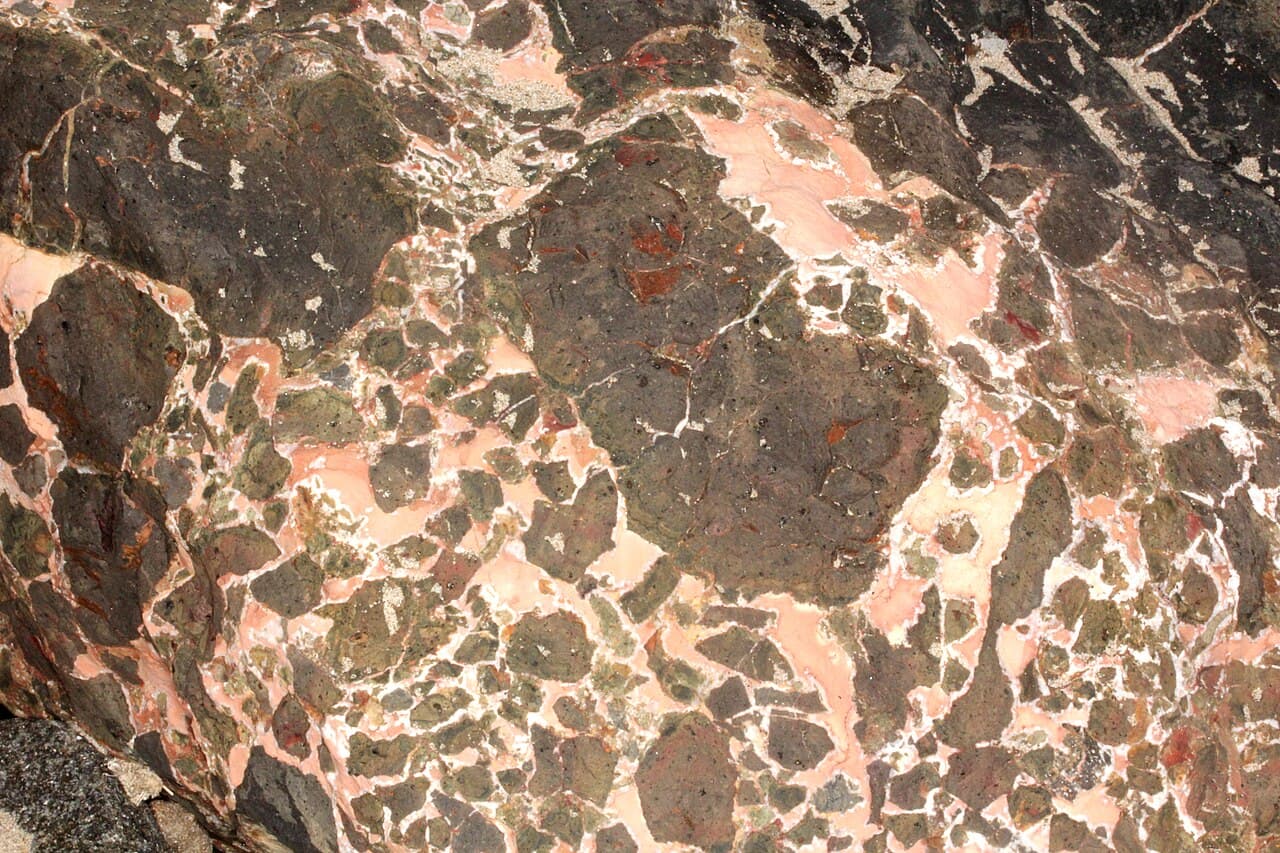
Breccia is a coarse-grained clastic sedimentary rock built from large, angular fragments of older rock — gravel-sized pieces more than 2 millimeters across, and often far bigger — locked together by a finer-grained matrix and natural cement. The defining feature, the one that lets you name it on sight, is the sharpness of those fragments: they have jagged, broken edges and unworn corners, as if a rock had been shattered and the shards glued back together. That angularity is not cosmetic; it is the rock's origin story written into its texture. Because tumbling in water rounds sharp edges quickly, fragments this jagged could not have traveled far before they were buried and cemented.
The name comes from the Italian word for "broken" or "rubble," and that is exactly what breccia looks like — a consolidated pile of rubble. The fragments (called clasts) can be almost any rock type, so a single specimen may mix several colors and textures within the matrix between them, giving breccia a chaotic, mosaic appearance that is one of the most distinctive looks in the whole rock world. While the classic form is a sedimentary rock made from broken gravel, geologists also use "breccia" for angular-fragment rocks made by faulting and by volcanic explosions, and those varieties are worth recognizing too.
Breccia at a glance
- Classification
- Sedimentary rock — clastic (coarse-grained, angular)
- Rock type
- Sedimentary (clastic)
- Composition
- No single formula — an aggregate of angular rock and mineral clasts (>2 mm) bound by a finer matrix and cement (commonly silica, calcite, or iron oxide)
- Hardness
- Variable, roughly 3–7 overall, depending on the clasts and the cement holding them together
- Luster
- Dull to earthy, though individual clasts may be brighter
- Colors
- Highly variable — gray, brown, red, tan, and mixed, often multicolored because the fragments come from different source rocks
- Texture
- Clastic and coarse; large angular fragments with sharp, broken edges set in a finer-grained matrix; typically poorly sorted
What type of rock is breccia?
Breccia is a sedimentary rock, and more specifically a clastic (or detrital) sedimentary rock — one assembled from the broken-down fragments of pre-existing rocks rather than crystallized from magma or recrystallized by heat and pressure. Within the clastic family, rocks are sorted by grain size, and breccia sits at the coarse end alongside conglomerate, both made of gravel-sized particles larger than 2 millimeters. What separates breccia from conglomerate is purely the shape of those particles: breccia's clasts are angular and sharp-edged, while conglomerate's are rounded and water-worn. That single distinction is the most important thing to remember about the rock.
It is not igneous and not metamorphic in the classic sedimentary sense, though the word "breccia" travels into those worlds too. Geologists recognize fault breccia, formed where rock is crushed and broken along a fault zone, and volcanic breccia (sometimes called pyroclastic breccia), formed when an eruption shatters rock and welds the angular fragments together with ash and lava. These share breccia's angular-fragment texture but form by very different processes. When someone simply says "breccia" in the context of identifying a found rock, they usually mean the sedimentary kind — angular gravel cemented into stone — which is the focus of this guide.
How breccia forms
Sedimentary breccia forms where rock is broken into angular fragments and then buried and cemented before the fragments can be rounded by transport. This happens in high-energy settings close to a sediment source. Classic environments include the bases of steep cliffs and mountain slopes, where frost-shattering and rockfall pile up sharp-edged scree (talus); the mouths of canyons, where flash floods dump coarse debris onto alluvial fans; and the floors of caves and sinkholes, where the collapse of a roof or wall heaps angular blocks below. In each case the key is that the fragments do not travel far — a short tumble down a slope or a single violent flood — so their sharp corners survive intact.
Once the angular rubble accumulates, it has to be turned into solid rock through lithification. Finer sediment — sand, silt, or mud — washes into the gaps between the large clasts to form a matrix, and then mineral-rich groundwater percolates through the remaining pore space and precipitates a natural cement, most often silica (quartz), calcite, or iron oxide, that binds everything together. The result is a hard rock in which big, jagged fragments float in a finer groundmass. The other major routes to a breccia texture bypass ordinary sediment transport entirely: fault breccia is produced by the mechanical grinding and fracturing of rock as crustal blocks slide past each other, and volcanic breccia is produced when an explosive eruption blasts rock apart and the angular pieces settle and fuse in ash and lava. All three converge on the same hallmark — angular fragments in a finer binder.
How to identify breccia
The single most reliable test is to look closely at the large fragments and judge their shape. In breccia the clasts are angular — sharp-cornered, with straight broken edges and flat faces, like shards of a smashed tile. If instead the pebbles are smooth and rounded like river stones, you are holding conglomerate, not breccia. This angular-versus-rounded distinction is the entire game when telling the two coarse clastic rocks apart, so train your eye on it first and confirm with a hand lens if the pieces are small. The fragments should clearly be gravel-sized — over 2 millimeters — and set in a noticeably finer matrix that fills the spaces around them.
After shape, take in the overall character. Breccia is typically poorly sorted, mixing large and small fragments together, and it is frequently multicolored because the clasts come from different parent rocks — a jumble of grays, browns, reds, and tans in a single hand specimen is a strong clue. Test the cement by trying to scratch or break the matrix and by checking whether fragments can be pried loose; a few drops of dilute acid will fizz if the cement is calcite. Overall hardness varies with what the rock is made of, so it is a weaker diagnostic than texture. Keep in mind that the look-alike angular textures of fault and volcanic breccia exist, but for a typical found-on-the-ground rock, sharp gravel-sized fragments cemented in a finer matrix point squarely to breccia.
What breccia is used for
Breccia's most prominent use is decorative. Because it is full of contrasting angular fragments, many breccias take a high polish that reveals a striking mosaic of colors, and these varieties have been prized as ornamental and dimension stone since antiquity. Polished breccia shows up as countertops, tabletops, floor and wall tiles, facing slabs, columns, and carved decorative objects; certain colorful breccias were quarried and treasured by the Romans, and ornamental breccias remain popular today wherever a bold, busy pattern is wanted in architecture and interior design.
Beyond ornament, breccia serves as a general construction material — quarried and crushed for aggregate, road base, and fill, and used as rough building stone where local supplies are handy and durable. It also carries scientific and practical value: a breccia is essentially a record of broken rock, so geologists read it to reconstruct ancient cliffs, faults, cave collapses, and eruptions, and fault breccias in particular help map fault zones. The fragment-bearing texture is even used as a descriptive term for some prized lapidary materials — "brecciated" jasper, for example, is jasper that has been fractured and re-cemented, giving it a network of angular pieces that gem cutters value.
Breccia look-alikes
Frequently asked questions
What type of rock is breccia?
Breccia is a clastic sedimentary rock made of large, angular rock fragments (over 2 mm) cemented together in a finer matrix. The fragments' sharp, broken edges are its defining feature. The term is also used for fault breccia and volcanic breccia, which share the angular-fragment texture but form by faulting and eruptions rather than sediment deposition.
What is the difference between breccia and conglomerate?
It comes down to the shape of the clasts. Both are coarse clastic sedimentary rocks made of gravel-sized fragments in a finer matrix, but breccia's fragments are angular and sharp-edged while conglomerate's are rounded and smooth. Angular means breccia; rounded means conglomerate. The angularity tells you the fragments were not transported far before being cemented.
How can I identify breccia?
Look at the large fragments: if they are angular with sharp, broken corners and flat faces, and they are gravel-sized (over 2 mm) set in a finer matrix, the rock is breccia. It is usually poorly sorted and often multicolored because the fragments come from different source rocks. Confirm by checking that the pieces are sharp rather than rounded, which would make it conglomerate instead.
What is breccia used for?
Colorful breccia takes a high polish and is widely used as ornamental and dimension stone for countertops, tiles, facing, and decorative objects — it was prized by the Romans and remains popular in design. It is also crushed for construction aggregate and road base, used as rough building stone, and studied by geologists to reconstruct ancient cliffs, faults, and eruptions.
Is yours breccia? Find out from a photo
Photograph your rock in good light and get an identification with an honest confidence level, the look-alikes to rule out and the at-home tests that confirm it.
Identify my rock freeOn Android? Get the free rock identifier app
Related
More rocks in the field guide
Keep exploring
More on rocks: how to identify a rock, what kind of rock is this and the Mohs hardness scale.
Last updated 2026-06-25. Identification guidance is educational — confirm important results with the diagnostic tests described or a qualified expert.