Dacite
Also known as: Dacitic lava, Quartz andesite (loosely)
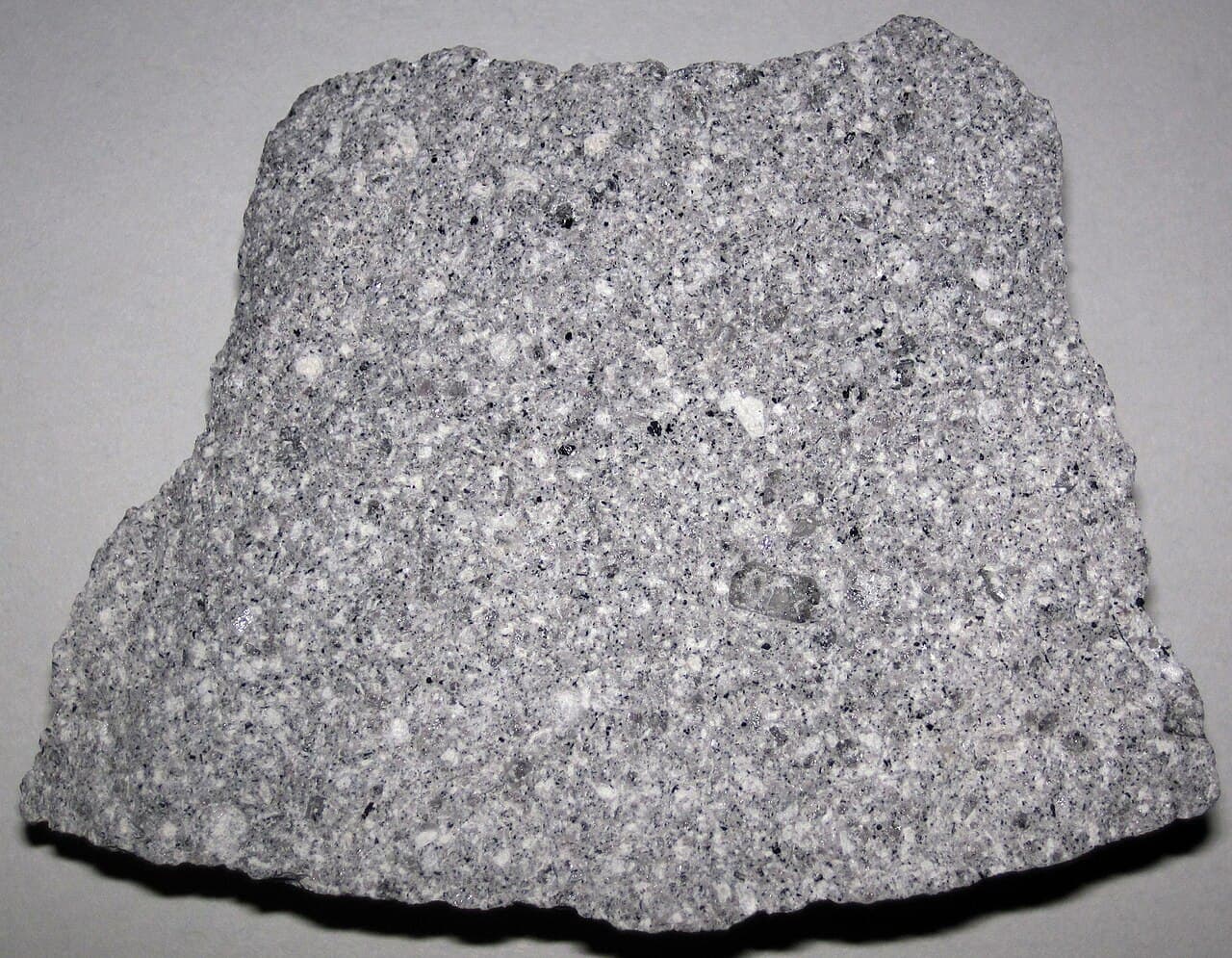
Dacite is a fine-grained extrusive igneous rock — a volcanic rock that erupts and cools at or near the Earth's surface. In silica content it sits squarely between andesite and rhyolite, making it an intermediate-to-felsic rock: more silica-rich than dark andesite, but not quite as silica-rich as pale rhyolite. The result is a light-to-medium gray stone with a dense, often very fine groundmass in which larger crystals are commonly scattered. Those scattered crystals — typically glassy quartz, blocky white-to-gray plagioclase feldspar, and dark needles or flakes of hornblende or biotite — give many dacites a speckled, porphyritic look against an otherwise uniform background.
Dacite matters because of how it erupts. Its silica-rich composition makes its magma thick and sticky, which traps gas and tends to produce violent, explosive eruptions rather than gentle lava flows. It is the rock of many of the world's dangerous stratovolcanoes: Mount St. Helens in Washington and Mont Pelée in the Caribbean both erupted dacitic and related magmas. So while dacite can look like an unremarkable gray volcanic rock in the hand, it carries the geological signature of some of the most powerful eruptions on Earth.
Dacite at a glance
- Classification
- Igneous rock — intermediate to felsic, extrusive (volcanic)
- Rock type
- Igneous (volcanic/extrusive)
- Composition
- Silica-rich; plagioclase + quartz with hornblende and/or biotite (± minor alkali feldspar) in a fine groundmass
- Hardness
- About 6–7 overall, governed by its quartz and feldspar
- Luster
- Dull to slightly glassy depending on the amount of volcanic glass
- Colors
- Light to medium gray; sometimes pale pinkish, tan, or buff
- Texture
- Fine-grained (aphanitic) groundmass, very commonly porphyritic with visible phenocrysts of plagioclase and quartz
What type of rock is dacite?
Dacite is an igneous rock — it solidified from molten rock — and more specifically it is an extrusive or volcanic igneous rock, meaning the magma erupted and cooled quickly at or near the surface. That rapid cooling is why dacite is fine-grained: the crystals in its groundmass had little time to grow and are usually too small to identify with the naked eye. It is not sedimentary (it is not made of cemented grains) and not metamorphic (it has not been recrystallized by heat and pressure).
Compositionally, dacite is defined by where it falls on the volcanic spectrum. Volcanic rocks grade from basalt (low silica, dark) through andesite (intermediate) to rhyolite (high silica, pale), and dacite occupies the slot between andesite and rhyolite — intermediate-to-felsic, rich enough in silica to contain free quartz. Each of these volcanic rocks has a coarse-grained intrusive twin that shares its chemistry but cooled slowly underground; dacite's plutonic equivalent is granodiorite, just as andesite's is diorite and rhyolite's is granite. The chemistry is the same within each pair — only the grain size, set by how fast the magma cooled, differs.
How dacite forms
Dacite forms from silica-rich magma that reaches the surface, most often at subduction-zone volcanoes where one tectonic plate dives beneath another. As the descending plate releases water and partially melts the rock above it, and as that magma rises and interacts with the crust, it becomes enriched in silica — producing the intermediate-to-felsic melt that erupts as dacite. Because this magma is high in silica, it is thick and viscous, so it resists flowing freely and instead traps the gases trying to escape from it.
That trapped gas is what makes dacitic eruptions explosive. Pressure builds inside the volcano until it is released suddenly, blasting out ash, pumice, and rock and often building steep-sided stratovolcanoes and thick, slow lava domes. Many dacites are porphyritic precisely because of this two-stage history: larger crystals of plagioclase, quartz, and hornblende or biotite grow slowly in the magma chamber while it sits underground, and then the remaining melt freezes almost instantly into a fine groundmass when the magma erupts — locking those earlier-formed crystals (phenocrysts) into a fine-grained matrix. Classic dacitic systems include Mount St. Helens and Mont Pelée.
How to identify dacite
Begin with grain size and color. Dacite is fine-grained, so the bulk of the rock is a dense, smooth-looking groundmass in which you cannot resolve individual crystals — this immediately separates it from coarse-grained, fully crystalline rocks like granite and granodiorite. Its overall color is a light-to-medium gray, paler than dark basalt and most andesite but generally a touch grayer and less pale than a typical white or pinkish rhyolite.
The best positive clue is the porphyritic texture. Look closely at the gray groundmass for scattered, larger crystals: blocky white-to-gray plagioclase, small glassy grains of quartz, and dark prisms or flakes of hornblende and biotite. The presence of visible quartz alongside abundant plagioclase in a gray, fine-grained volcanic rock points strongly to dacite — andesite typically lacks obvious free quartz, while rhyolite is paler and tends to be more quartz- and alkali-feldspar-rich. The rock is hard (its quartz scratches glass) and may look slightly glassy where volcanic glass is present. Because andesite, dacite, and rhyolite grade into one another, precise identification ultimately depends on chemistry, but the combination of a gray fine-grained groundmass, visible quartz and plagioclase, and dark hornblende or biotite is the field signature of dacite.
What dacite is used for
Dacite's practical uses come from its hardness and durability rather than from any rarity. Crushed dacite is used as construction aggregate — the angular stone that goes into concrete, road base, and railway ballast — and as riprap and fill where a tough, weather-resistant rock is needed. Where it occurs as sound, massive rock it can also be quarried and cut for use as building and landscaping stone.
Beyond construction, dacite is most valuable to science. Because it is the product of explosive, silica-rich volcanism, dacite and its eruptive deposits are intensively studied to understand volcanic hazards and eruption behavior, and the crystals and glass it contains can be dated and analyzed to reconstruct a volcano's history. Some dacitic and related volcanic systems are also associated with mineral deposits, so the rock can be of interest in mineral exploration. It carries no special value as a gemstone or decorative material.
Dacite look-alikes
Frequently asked questions
What type of rock is dacite?
Dacite is an igneous rock — specifically an extrusive (volcanic) one that erupted and cooled quickly at the surface, giving it a fine-grained texture. In composition it is intermediate-to-felsic, sitting between andesite and rhyolite on the silica scale. Its coarse-grained intrusive equivalent is granodiorite.
How can I identify dacite?
Look for a hard, light-to-medium gray, fine-grained volcanic rock that is commonly porphyritic — with visible blocky plagioclase, small glassy quartz grains, and dark hornblende or biotite crystals set in a dense groundmass. Visible quartz plus abundant plagioclase in a gray volcanic rock is the strongest clue that it is dacite rather than andesite or rhyolite.
What is the difference between dacite and andesite?
Both are gray volcanic rocks, but andesite has less silica and is usually darker with little or no visible free quartz, while dacite has more silica, tends to be a bit paler, and characteristically shows small glassy quartz grains among its plagioclase. The two grade into each other, so chemistry gives the definitive answer.
What is dacite used for?
Dacite is crushed for construction aggregate, road base, railway ballast, riprap, and fill, and sound rock can be cut as building or landscaping stone. Its greatest value is scientific: because it forms in explosive volcanoes, it is studied to understand volcanic hazards and eruption history, and it can be of interest in mineral exploration.
Is yours dacite? Find out from a photo
Photograph your rock in good light and get an identification with an honest confidence level, the look-alikes to rule out and the at-home tests that confirm it.
Identify my rock freeOn Android? Get the free rock identifier app
Related
More rocks in the field guide
Keep exploring
More on rocks: how to identify a rock, what kind of rock is this and the Mohs hardness scale.
Last updated 2026-06-25. Identification guidance is educational — confirm important results with the diagnostic tests described or a qualified expert.