Diorite
Also known as: Salt-and-pepper rock
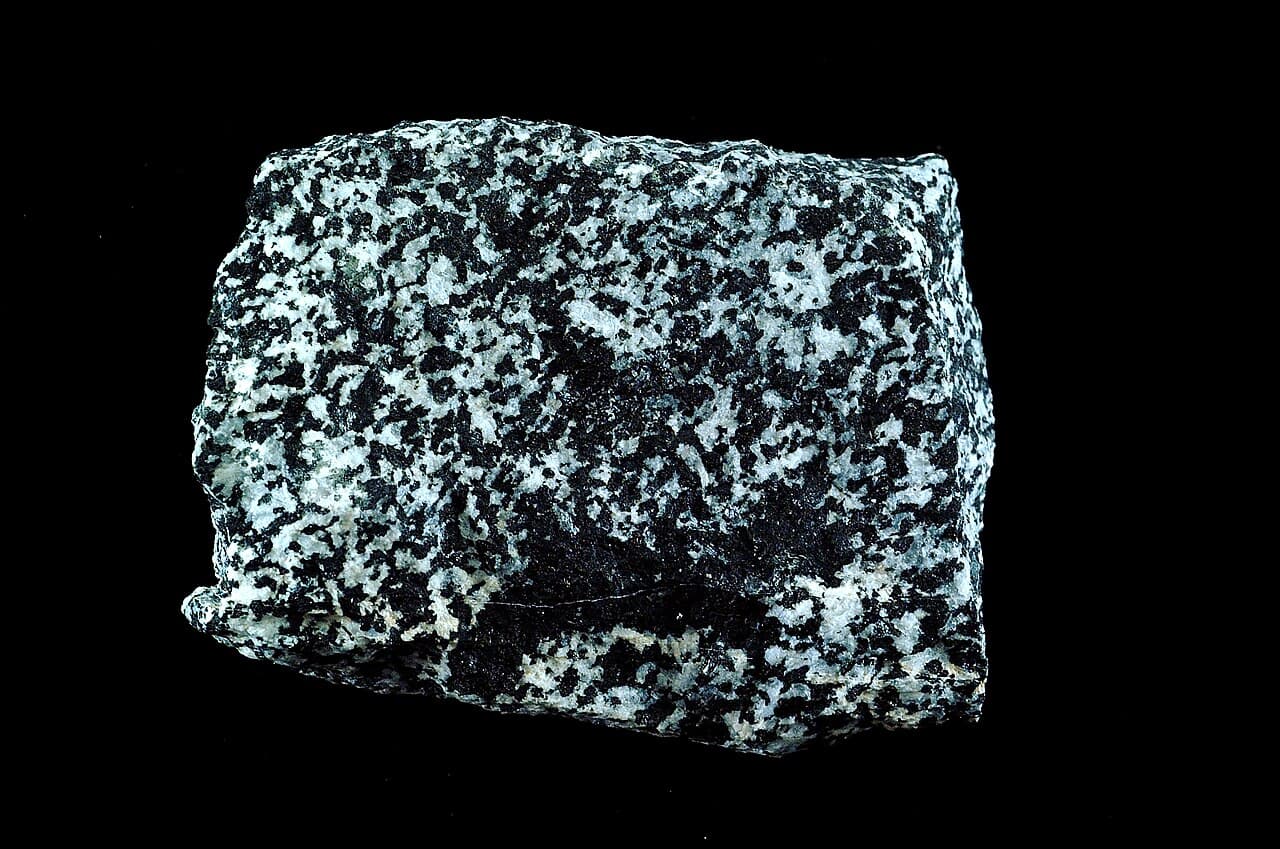
Diorite is a coarse-grained igneous rock with an intermediate chemical makeup, best known for its striking "salt-and-pepper" appearance: a mottle of white-to-gray grains peppered with black specks. The pale grains are plagioclase feldspar and the dark ones are mostly hornblende and biotite mica. Crucially, diorite contains little or no quartz, which sets it apart from the lighter, quartz-rich granites it is often confused with. Look closely and you can see a tight mosaic of interlocking crystals large enough to pick out by eye, with no layering, banding or empty pore space.
Geologists place diorite between the light, silica-rich granites and the dark, iron-and-magnesium-rich gabbros, making it the textbook example of an "intermediate" igneous rock. It is the slowly-cooled, deep-Earth equivalent of the volcanic rock andesite: the two share almost the same minerals and chemistry, but andesite cooled quickly at the surface and is fine-grained, while diorite cooled slowly underground and grew visible crystals. That coarse, crystalline, balanced light-and-dark texture is the single most reliable clue that a rock is diorite.
Diorite at a glance
- Classification
- Igneous rock — intermediate, intrusive (plutonic)
- Rock type
- Igneous (intrusive/plutonic)
- Composition
- Plagioclase feldspar + hornblende and/or biotite (little to no quartz)
- Hardness
- About 6–7, set by its feldspar and amphibole
- Colors
- White-to-gray speckled with black — classic salt-and-pepper
- Texture
- Coarse-grained (phaneritic) — interlocking crystals visible to the naked eye
What type of rock is diorite?
Diorite is an igneous rock — it crystallized from cooling magma. More precisely it is an intrusive, or plutonic, igneous rock, meaning the magma cooled slowly while still trapped deep within the Earth's crust rather than erupting at the surface. That slow cooling let individual minerals grow into crystals large enough to see, which is why diorite has its characteristic coarse, grainy texture rather than a smooth or glassy one.
By composition diorite is classed as intermediate, sitting between felsic rocks like granite and mafic rocks like gabbro. It is dominated by sodium-rich plagioclase feldspar and dark minerals such as hornblende and biotite, with quartz either absent or present only in trace amounts. This intermediate makeup is exactly the same as that of the volcanic rock andesite; the only real difference is cooling history and therefore grain size. Where andesite cooled fast and stayed fine-grained, diorite cooled slowly and grew coarse crystals.
How diorite forms
Diorite forms when a body of magma of intermediate composition becomes trapped within the crust and cools over thousands to millions of years. Because the surrounding rock acts as insulation, the melt loses heat very slowly, giving plagioclase feldspar and the dark minerals time to grow into the interlocking crystals that give diorite its coarse texture. As the magma crystallizes, minerals lock tightly together, leaving virtually no empty space, which is why the finished rock is dense, hard and durable.
Such magma typically develops above subduction zones, where one tectonic plate dives beneath another and the descending slab drives partial melting in the overlying mantle and crust. The intermediate melt that results may erupt to form andesite volcanoes, or it may stall underground and solidify into bodies of diorite. The diorite we see at the surface today was emplaced kilometers deep and becomes exposed only after the overlying rock is gradually stripped away by uplift and erosion.
How to identify diorite
Start with grain size and overall look. Diorite is coarse-grained, so you should be able to pick out individual mineral crystals by eye, and its hallmark is a balanced salt-and-pepper pattern: roughly equal proportions of white-to-gray plagioclase feldspar and black hornblende and biotite, with no single color dominating. There is no layering, banding or alignment of the crystals — they are arranged randomly — and the rock has no visible pore space.
The decisive test is to hunt for quartz. Granite, the most common look-alike, contains obvious glassy, gray, slightly translucent quartz grains and usually a lighter, often pinkish overall tone; diorite has little or no quartz and reads as a cleaner black-and-white speckle. If the rock is coarse-grained but overwhelmingly dark, with almost no pale feldspar, suspect gabbro instead. Diorite is also hard — its feldspar and amphibole will resist a knife blade and scratch glass — and that hardness plus the random, unbanded crystal fabric rules out softer, layered sedimentary and metamorphic rocks.
What diorite is used for
Diorite's hardness, density and resistance to weathering make it a valuable construction material. Crushed diorite is widely used as aggregate in concrete, road base and railway ballast, where its strength and angularity help it lock together and bear heavy loads. Because it is tough and takes a durable surface, it is also quarried as dimension stone for building facing, paving, curbing and steps.
The same durability has long made diorite a favored material for monuments and carving, despite its hardness making it difficult to work. It is often sold commercially under the broad and geologically loose label of "granite," since the stone trade applies that name to almost any hard, grainy, speckled igneous rock used for countertops and cladding. For everyday use the label rarely matters, but for true identification the key is that diorite lacks the abundant quartz of real granite.
Diorite look-alikes
Frequently asked questions
What type of rock is diorite?
Diorite is an igneous rock — specifically an intrusive (plutonic) one that crystallized slowly from intermediate magma deep underground. It is not sedimentary or metamorphic. The slow cooling produced its coarse, visibly crystalline salt-and-pepper texture.
What is the difference between diorite and granite?
Both are coarse-grained intrusive igneous rocks, but granite is felsic and contains abundant glassy quartz and often pink feldspar, giving it a lighter look. Diorite is intermediate, has little or no quartz, and shows a cleaner black-and-white salt-and-pepper speckle.
How can I identify diorite?
Look for a hard, coarse-grained rock with a balanced salt-and-pepper pattern of white-to-gray feldspar and black hornblende and biotite, with no layering and little to no quartz. It scratches glass and resists a knife blade, and its crystals are randomly arranged rather than banded.
What is diorite used for?
Diorite is used as crushed aggregate in concrete, road base and railway ballast, and as dimension stone for building facing, paving, curbing and monuments because it is hard and durable. It is often sold commercially under the loose label of "granite."
Is yours diorite? Find out from a photo
Photograph your rock in good light and get an identification with an honest confidence level, the look-alikes to rule out and the at-home tests that confirm it.
Identify my rock freeOn Android? Get the free rock identifier app
Related
More rocks in the field guide
Keep exploring
More on rocks: how to identify a rock, what kind of rock is this and the Mohs hardness scale.
Last updated 2026-06-25. Identification guidance is educational — confirm important results with the diagnostic tests described or a qualified expert.