Chert
Also known as: Flint (dark variety), Hornstone, Silica rock
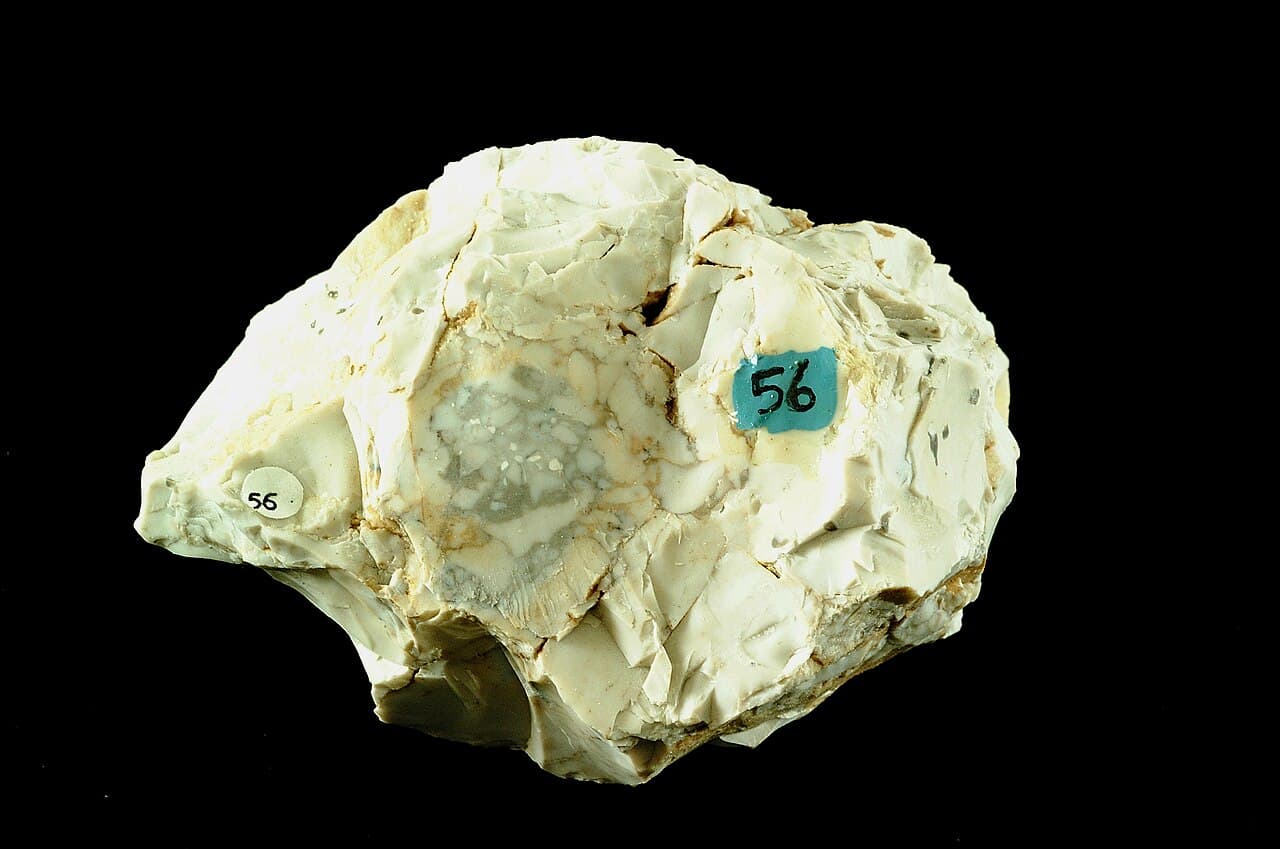
Chert is a hard, dense sedimentary rock made almost entirely of microscopic quartz — silica (SiO₂) — packed so finely that the individual crystals are far too small to see, even under an ordinary hand lens. This very fine, cryptocrystalline structure gives chert its distinctive look and feel: a smooth, almost waxy or glassy surface, a tendency to break with curved, shell-like (conchoidal) fractures, and edges sharp enough to cut. It comes in a wide range of colors — gray, white, brown, black, green, even banded — but whatever the color, it is consistently tough, fine-grained and rings hard against steel.
Because it is essentially solid quartz, chert is genuinely hard: it sits at about 7 on the Mohs scale, the same as crystalline quartz, so it readily scratches glass and a steel knife blade and resists scratching by almost anything in a field kit. Several familiar materials are simply varieties of chert. Flint is the dark gray-to-black kind that ancient peoples knapped into blades and used to strike fire; jasper is opaque red, yellow or brown chert colored by iron; and agate is its banded, translucent relative. Recognizing chert comes down to spotting that combination of high hardness, a smooth conchoidal break and sharp edges in a fine-grained, non-grainy stone.
Chert at a glance
- Classification
- Sedimentary rock — chemical/biochemical, siliceous (silica-rich)
- Rock type
- Sedimentary
- Composition
- Almost entirely quartz / silica (SiO₂), microcrystalline
- Hardness
- About 7 on the Mohs scale — scratches glass and steel
- Luster
- Dull to waxy or slightly glassy on a fresh break
- Colors
- Gray, white, black (flint), brown, red and yellow (jasper), green; sometimes banded
- Texture
- Cryptocrystalline to microcrystalline (grains invisible to the eye); smooth, dense, breaks conchoidally
What type of rock is chert?
Chert is a sedimentary rock. Of the three rock families — igneous (cooled from melt), sedimentary (formed from sediment or by chemical and biological processes at or near the surface) and metamorphic (recrystallized from a parent rock by heat and pressure) — chert belongs to the sedimentary group. It is not cooled from magma and it is not the product of deep metamorphism; it forms from silica that accumulates in marine sediments. So to the common question of whether chert is igneous, sedimentary or metamorphic, the answer is sedimentary.
More specifically, chert is a chemical and biochemical sedimentary rock, because the silica that makes it up was either precipitated directly from silica-rich water or, very often, supplied by the tiny silica skeletons of marine microorganisms. This sets chert apart from a clastic sedimentary rock like sandstone, which is built from loose mineral grains cemented together. It also separates chert from quartzite, which has the same all-quartz chemistry but is a metamorphic rock formed by heating and recrystallizing sandstone. Chert is silica that gathered as sediment; quartzite is sandstone that was later transformed.
How chert forms
Chert forms from the accumulation and hardening of silica in sediments, and it occurs in two main settings. As nodular chert, it grows as lumps, knobs and irregular masses inside other rocks — most famously as the dark flint nodules scattered through chalk and limestone. Here, dissolved silica migrates through the sediment after deposition and precipitates around a nucleus, gradually replacing the surrounding carbonate and building up a hard, fine-grained silica mass within the host rock. As bedded chert, it forms continuous layers, deposited on the deep ocean floor where vast numbers of silica-shelled microorganisms settled and their remains were compacted and recrystallized into solid rock.
Much of the silica ultimately comes from living organisms. Marine plankton such as diatoms and radiolarians, along with some sponges, build their skeletons from silica; when they die, those skeletons rain down and pile up on the seabed. Over long spans of time, burial, compaction and slow chemical change convert this soft silica ooze into the dense, microcrystalline quartz of chert. Whether it forms as nodules in limestone or as thick beds on the ocean floor, the end product is the same: an extremely fine-grained, very hard rock made of interlocking quartz crystals too small for the eye to resolve.
How to identify chert
Begin with hardness, the most reliable test. Because chert is made of quartz, it is very hard — about 7 on the Mohs scale — so it will easily scratch glass and a steel knife blade, and a knife will not scratch it. Next, look at how it breaks: chert fractures with smooth, curved, shell-like (conchoidal) surfaces and produces sharp, sometimes razor-keen edges, exactly the property that made it ideal for stone tools. The surface of a fresh break is dull to waxy or slightly glassy, not grainy, and the rock feels dense and solid in the hand. High hardness plus a smooth conchoidal fracture in a fine-grained stone is the heart of identifying chert.
Then use texture and a couple of confirming checks. Unlike sandstone, chert shows no visible grains and sheds nothing under a fingernail — it is uniform and microcrystalline. Unlike limestone or marble, it does not fizz when dilute acid is applied, because it contains no carbonate. Color helps name the variety rather than the rock: a dark gray-to-black piece is flint, a red, yellow or brown opaque piece is jasper, and a banded translucent one is agate, but all are chert. If a rock is hard enough to scratch steel, breaks with smooth curved fractures and sharp edges, has no visible grains and does not react with acid, it is chert.
What chert is used for
Chert's most important role is historical, and it shaped human technology for hundreds of thousands of years. Because it is hard, fine-grained and breaks with predictable conchoidal fractures into keen edges, it was the premier raw material for knapped stone tools — arrowheads, spear points, knives, scrapers and blades — across cultures worldwide. The dark variety, flint, was also struck against steel or iron pyrite to throw sparks, making it the standard fire-starter and, later, the spark source in flintlock firearms. Colorful jasper and banded agate, both forms of chert, have long been prized as ornamental and carving stones and are still cut and polished for jewelry and decorative objects.
In modern terms, chert is mostly valued as a tough, durable rock material. Crushed chert is used as aggregate in road base, concrete and construction fill, where its hardness is an asset (though in concrete its silica can sometimes react unfavorably with cement, so it is used selectively). It has also served historically as a millstone and grinding material because of its abrasive hardness. Across all of these uses, the same underlying property — a dense, all-quartz rock that is hard, sharp-breaking and chemically stable — is what gives chert its usefulness.
Chert look-alikes
Frequently asked questions
What type of rock is chert?
Chert is a sedimentary rock — specifically a chemical and biochemical one made of microscopic quartz (silica). The silica was either precipitated from silica-rich water or supplied by the skeletons of marine microorganisms, and it formed as nodules in limestone or as deep-sea beds. It is not igneous or metamorphic.
How can I identify chert?
Test hardness and look at the break. Chert is very hard (about 7), so it scratches glass and steel and a knife will not scratch it. It breaks with smooth, curved (conchoidal) surfaces and sharp edges, shows no visible grains, and does not fizz in acid. Hard, sharp-breaking, grainless and acid-inert points to chert.
What is the difference between chert and flint?
Flint is just the dark gray-to-black variety of chert, usually found as nodules in chalk and limestone. They are the same kind of rock — microcrystalline quartz with the same hardness and conchoidal fracture — and the name 'flint' mostly reflects the dark color and its traditional use in tools and fire-starting.
What is chert used for?
Historically chert was the prime material for stone tools — arrowheads, blades and scrapers — and, as flint, for striking fire and sparking flintlock guns; jasper and agate forms are used in jewelry and carving. Today crushed chert is used as a hard aggregate in road base, concrete and construction fill.
Is yours chert? Find out from a photo
Photograph your rock in good light and get an identification with an honest confidence level, the look-alikes to rule out and the at-home tests that confirm it.
Identify my rock freeOn Android? Get the free rock identifier app
Related
More rocks in the field guide
Keep exploring
More on rocks: how to identify a rock, what kind of rock is this and the Mohs hardness scale.
Last updated 2026-06-25. Identification guidance is educational — confirm important results with the diagnostic tests described or a qualified expert.