Dolomite
Also known as: Calcium Magnesium Carbonate, Dolostone (the rock), Dolomite Rock
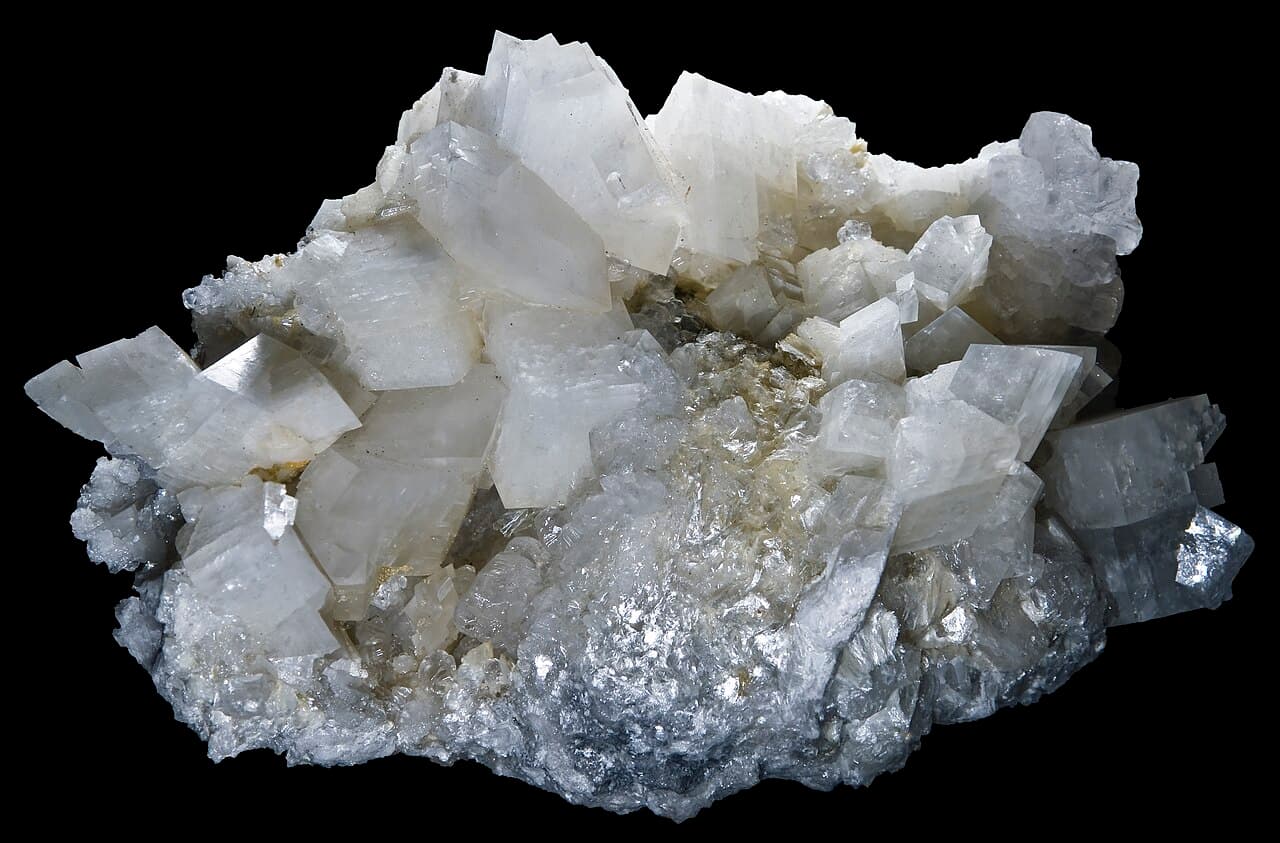
Dolomite is a calcium-magnesium carbonate, CaMg(CO3)2, and it sits right beside calcite as one of the most common carbonate minerals on Earth. As a mineral it grows in clean, glassy rhombohedral crystals that often show a distinctive curved, saddle-shaped warp instead of flat faces. As a rock it forms vast beds of "dolostone" (frequently just called dolomite rock), a close relative of limestone that makes up cliffs, cave systems, and important oil and water reservoirs around the world. Collectors prize the soft pink, gray, and white crystal clusters, while geologists value the rock for the stories it tells about ancient seas.
What makes dolomite worth learning is that it looks so much like calcite that the two are constantly confused, yet a single field test usually tells them apart. Dolomite is modestly soft (Mohs 3.5 to 4), has a white streak, three directions of perfect rhombohedral cleavage, and a vitreous to slightly pearly luster. The decisive clue is its reluctant reaction to acid: where calcite fizzes the instant a drop of dilute acid lands on it, dolomite barely reacts unless the surface is scratched to powder or the acid is warmed. Learn that one difference and a confusing carbonate becomes an easy identification.
Dolomite at a glance
- Classification
- Carbonate mineral (dolomite group)
- Composition
- CaMg(CO3)2
- Hardness
- 3.5 to 4 (Mohs)
- Luster
- Vitreous to pearly
- Streak
- White
- Colors
- White, gray, and a popular soft pink; also colorless, tan, brown, and greenish
- Crystal system
- Trigonal
- Transparency
- Transparent to translucent
How to identify it
The signature test for dolomite is the slow acid reaction, and it is the single most useful thing to remember. Place a drop of dilute hydrochloric acid or white vinegar on a fresh surface: calcite erupts in vigorous bubbles immediately, but dolomite reacts weakly and slowly, often showing little to nothing until you scratch the surface into a fine powder or gently warm the acid. That sluggish, powder-dependent fizz is the classic field separator between dolomite and calcite, and it is reliable enough that experienced collectors lead with it.
Back up the acid test with hardness, cleavage, and crystal habit. Dolomite is slightly harder than calcite at 3.5 to 4 on the Mohs scale, so a steel knife still scratches it but with a little more resistance. It breaks along three directions of perfect cleavage into leaning rhombs, just like calcite, and it carries a white streak and vitreous to pearly luster. The most charming clue is crystal shape: dolomite frequently forms curved, saddle-shaped rhombohedrons whose faces bow outward, a habit calcite almost never shows. When you see softly curved rhombs that only fizz once powdered, you are almost certainly looking at dolomite.
Colors and varieties
Pure dolomite is colorless or white, but trace iron, manganese, and other impurities tint it gray, tan, brown, greenish, and most famously a soft, sugary pink. Pink dolomite, often sold as clusters of glittering small rhombs, is one of the most popular forms among crystal buyers because of its gentle color and frosty sparkle. Iron-rich varieties weather to rusty brown surfaces, and cobalt-bearing dolomite can show a stronger rose to magenta hue. As with all carbonates, color alone never confirms the identification, so always pair the look with the slow acid reaction and the curved-crystal habit.
Dolomite also appears in two very different scales. On the specimen scale it forms the well-known crystal clusters, saddle-shaped rhombs, and cavity linings sought by collectors. On the landscape scale it builds dolostone, a dense, often pale gray sedimentary rock that forms thick cliffs and ridges and is the bedrock of many caves and aquifers. The rock can be massive, granular, or fossil-bearing, and it is sometimes hard to tell from limestone by eye, which is exactly why the weak acid reaction is so valuable for distinguishing dolostone from a calcite-based limestone.
Meaning and properties
In crystal-healing and metaphysical traditions, dolomite, and especially pink dolomite, is often described as a calming, balancing, and grounding stone associated with patience and emotional steadiness. These associations come from spiritual and cultural belief systems rather than scientific evidence, and dolomite should not be used to treat, diagnose, or cure any physical or mental health condition. It is not a substitute for professional medical or mental health care.
If you enjoy the symbolic side of minerals, a soft pink dolomite cluster makes an attractive piece for a display shelf or a meditation space, and you can treat that as a personal or spiritual practice. Just keep practical limits in mind: it is a soft, cleavable mineral, so it is better admired than worn as rugged jewelry. For any genuine health concern, consult a qualified healthcare professional rather than relying on a crystal.
Value and what affects price
Dolomite is an abundant mineral, so plain white or gray pieces and ordinary dolostone are inexpensive and easy to find. Value rises with the quality of the crystals: sharp, lustrous rhombs, well-formed saddle-shaped curves, attractive pink or rose color, and good transparency all push a specimen up in desirability. Clean clusters with undamaged crystals on a pleasing matrix, or dolomite paired with colorful companion minerals, are the pieces collectors actively seek.
Because the mineral itself is common, condition and aesthetics matter far more than rarity for most dolomite. Soft cleavage edges chip easily, so well-preserved crystals with crisp, unbroken faces are worth noticeably more than handled or weathered material. As always, judge a piece on its color, crystal quality, luster, and condition rather than on marketing names, and remember that dolomite's gentle pink does not command the prices of harder, rarer pink stones.
Real vs. fake: avoiding misidentification
Outright fakes of dolomite are uncommon because the mineral is cheap, so the real risk is misidentification, usually mistaking it for calcite or limestone. The acid test settles it: dolomite reacts only weakly and slowly, typically needing a powdered or scratched surface to fizz at all, whereas calcite and limestone effervesce briskly the moment dilute acid or vinegar touches them. The curved, saddle-shaped crystal habit is a second strong clue, since calcite almost never bows its faces that way.
Some inexpensive pink dolomite on the market is dyed to deepen or even out the color, so be cautious with unnaturally vivid, perfectly uniform pinks on cheap tumbled pieces; a hidden or freshly broken surface may reveal paler natural material underneath. Magnesite and rhodochrosite can also be confused with dolomite: magnesite usually lacks dolomite's clear rhombic crystals and reacts only in warm acid, while pink rhodochrosite is distinctly harder and often shows bold banding. Combining the slow acid reaction, a hardness of about 3.5 to 4, rhombohedral cleavage, and the curved-crystal habit makes confident dolomite identification straightforward.
Care and cleaning
Dolomite needs the same gentle handling as other carbonates because it is both fairly soft and chemically reactive. At Mohs 3.5 to 4 it scratches easily, so store it apart from harder minerals and avoid stacking specimens against one another. Its perfect cleavage means a sharp knock can pop a clean flake off an edge, so handle crystal clusters carefully and support larger pieces from underneath. Clean dolomite only with a soft, dry or barely damp cloth, or a soft brush to lift dust, rather than prolonged soaking.
The most important rule is to keep dolomite away from acids of any kind, since the same reaction that helps identify it will slowly etch and dull the surface. That means no vinegar, no acidic cleaners, and care around acidic household products. Because carbonates are mildly soluble, limit water exposure and dry the piece promptly, and avoid sudden, strong temperature changes. Treated this way, dolomite keeps its bright luster and its delicate pink or pearly faces intact.
Dolomite look-alikes
Frequently asked questions
What is the difference between dolomite and calcite?
The fastest test is acid. Put a drop of vinegar or dilute acid on the specimen: calcite fizzes vigorously right away, but dolomite reacts only weakly and slowly, often showing nothing until you scratch the surface into powder or warm the acid. Dolomite is also slightly harder (Mohs 3.5 to 4 versus 3) and frequently forms curved, saddle-shaped crystals that calcite does not.
Why doesn't dolomite fizz in acid like calcite?
Both are carbonates, but dolomite's calcium-magnesium structure dissolves much more reluctantly in cold dilute acid than calcite's simpler calcium carbonate. The reaction speeds up when you increase the surface area by scratching the mineral to a fine powder, or when you warm the acid. That slow, powder-dependent fizz is exactly what distinguishes dolomite from the briskly bubbling calcite.
Is dolomite a rock or a mineral?
It is both, which is a common source of confusion. Dolomite the mineral is the calcium-magnesium carbonate that forms glassy, often curved rhombic crystals. When that mineral builds up into thick sedimentary beds, the rock is called dolostone, though many people simply call it dolomite rock. Cliffs, caves, and aquifers are often made of this dolomite rock.
What color is dolomite?
Pure dolomite is colorless or white, but it commonly appears gray, tan, brown, and greenish, and one of its most popular forms is a soft, sugary pink. The pink comes from trace elements rather than from the dolomite itself, so color alone is not enough to identify it. Always confirm with the slow acid reaction and the curved-crystal habit.
Is yours dolomite? Find out from a photo
Photograph your mineral in good light and get an identification with an honest confidence level, the look-alikes to rule out and the at-home tests that confirm it.
Identify my mineral freeOn Android? Get the free rock identifier app
Related
More minerals in the field guide
Keep exploring
More on minerals: how to identify a mineral, the streak test and the full list of crystal types.
Last updated 2026-06-25. Identification guidance is educational — confirm important results with the diagnostic tests described or a qualified expert.