Dioptase
Also known as: Emerald copper, Copper emerald
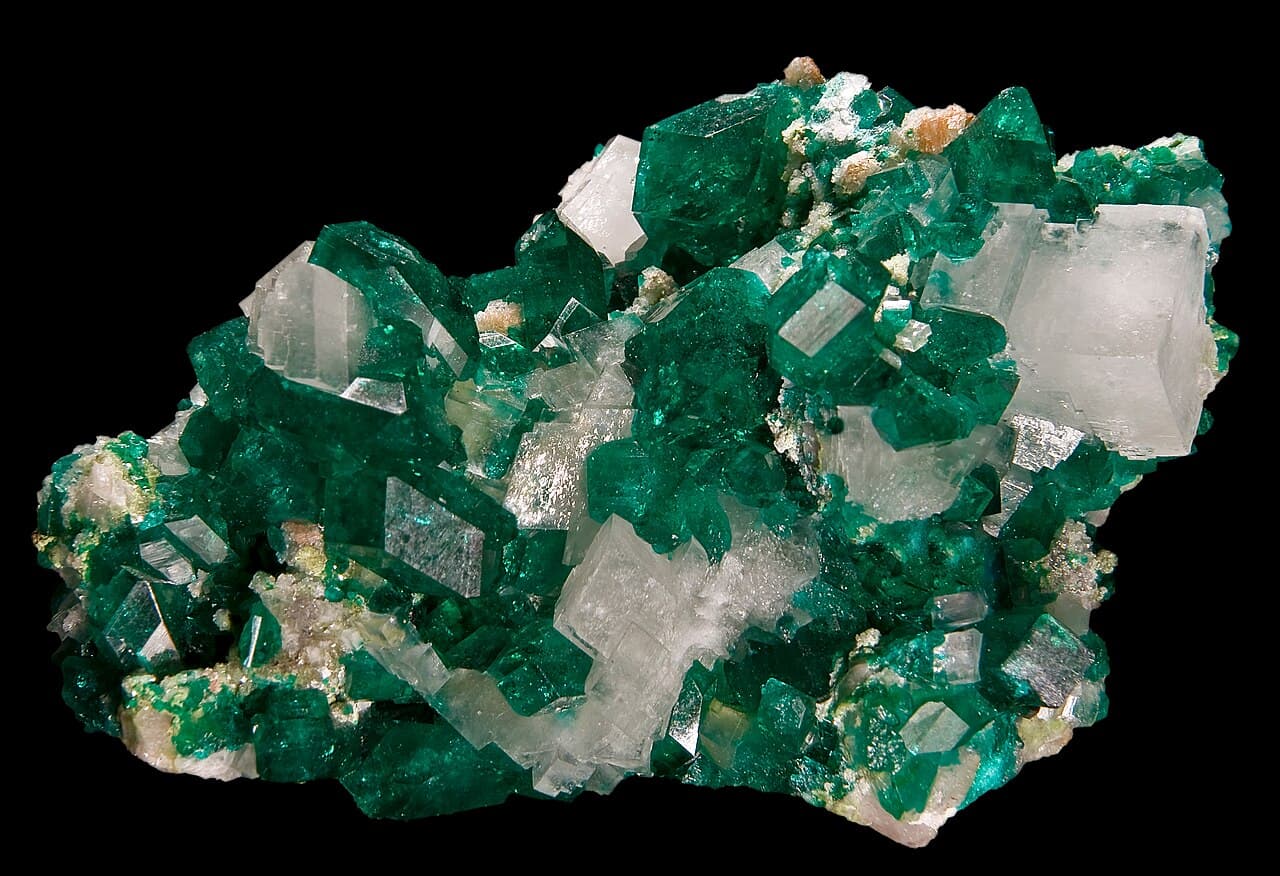
Dioptase is a hydrous copper silicate famous for one thing above all: an intense, glowing emerald-to-deep-green color that rivals the finest emerald. It forms in the weathered, oxidized zones of copper deposits, typically as small, stubby prismatic crystals lining cavities in the host rock, and its vivid green comes directly from the copper built into its structure. Because fine crystals are small and relatively scarce, dioptase is first and foremost a collector's and specimen mineral rather than a mainstream jewelry stone. Mineral enthusiasts prize sharp, lustrous green crystals perched on contrasting matrix, and classic localities such as Tsumeb in Namibia and deposits in Kazakhstan, the Democratic Republic of the Congo, and the American Southwest have produced specimens that are showpieces of any collection.
Beyond its color, dioptase is interesting because it sits in that satisfying middle ground of mineral identification, soft enough to be distinctive yet hard enough to take a glassy polish on a crystal face. It is markedly softer than emerald, which is the single most important fact for telling the two apart, and it has a vitreous, almost gemmy luster on fresh crystals. While transparent to translucent crystals can occasionally be faceted for collectors, they are too soft and brittle for everyday wear, so the species lives mostly in display cases and reference suites rather than on fingers. For anyone learning minerals, dioptase is a rewarding example of how an element, in this case copper, controls a mineral's most memorable trait.
Dioptase at a glance
- Classification
- Silicate mineral (hydrous copper cyclosilicate)
- Composition
- CuSiO3·H2O
- Hardness
- 5 (Mohs)
- Luster
- Vitreous
- Streak
- Green to bluish green
- Colors
- Vivid emerald green to deep blue-green
- Crystal system
- Trigonal
- Transparency
- Transparent to translucent
How to identify it
Start with that unmistakable color and the crystal habit. Dioptase shows a saturated emerald to blue-green that few other minerals match, and it typically appears as small, short, stubby prismatic crystals with well-formed faces, often clustered in cavities or scattered across a contrasting matrix. The crystals carry a bright vitreous luster, looking almost gemmy and glassy on fresh faces, and they leave a green to bluish-green streak when rubbed on unglazed tile. Its association is a strong clue too: dioptase forms in the oxidized zones of copper deposits, so it commonly turns up alongside other copper minerals on the same specimen.
Hardness is the decisive test that prevents the most common mistake. Dioptase is only about 5 on the Mohs scale, so a steel knife or a hard nail will scratch it; this immediately separates it from emerald, which is far harder at around 7.5 to 8 and cannot be scratched by a knife. Note also that dioptase, unlike many green copper minerals, is a silicate rather than a carbonate, so it does not fizz in dilute acid the way malachite does. Put it together, electric green color, small glassy prismatic crystals, a green streak, a soft Mohs-5 hardness, no acid reaction, and an origin in copper ore, and dioptase is straightforward to confirm.
Colors and varieties
Color is dioptase's whole reputation, and it ranges from a brilliant grass or emerald green to a richer, deeper blue-green, all of it driven by copper. The most prized crystals are intensely saturated, transparent to translucent, and brightly lustrous, the kind that seem to glow from within when light passes through them. Specimens vary mainly in the depth of that green, the clarity of individual crystals, and how the crystals are arranged, whether as isolated sharp prisms, sparkling druzy crusts of many tiny crystals, or striking clusters set against a pale matrix that makes the green pop.
There are no major named gem varieties of dioptase in the way there are for quartz, since it is collected as the species itself rather than split into trade names. What collectors distinguish instead is locality and quality: certain classic sources are renowned for particularly large, clear, or deeply colored crystals, and matrix specimens that combine vivid dioptase with attractive associated minerals are especially valued. Occasionally dioptase grows together with other copper-bearing minerals, producing mixed specimens, but the dioptase itself remains recognizable by its glassy emerald-green prisms.
Meaning and properties
Dioptase is primarily a collector and specimen mineral, valued for its beauty and crystallography rather than for any practical or folkloric use, so its lore is comparatively limited. Where it does appear in crystal-healing traditions, it is sometimes described as a stone associated with the heart and with emotional renewal, largely because of its vivid green color. Any such associations are matters of spiritual and personal belief, not scientific fact, and dioptase should never be used to diagnose, treat, or cure any condition or relied upon in place of professional medical care.
A practical safety note is more useful than any metaphysical claim: dioptase is a copper-bearing mineral, so its dust should not be inhaled or ingested, and it should not be made into elixirs or placed in drinking water. Wash your hands after handling freshly broken or powdery pieces. For collectors, the real reward of dioptase is simply having a flawless, glowing green crystal to study and display, and any genuine health concern should be taken to a qualified healthcare professional rather than to a mineral.
Value and what affects price
Dioptase value is driven by color saturation, crystal size and clarity, luster, and the quality of the overall specimen. The most sought-after pieces have deeply saturated emerald to blue-green crystals that are transparent and brightly glassy, with sharp, undamaged faces. Larger well-formed crystals are far scarcer than tiny ones, so size combined with quality raises desirability quickly, and a brilliant gemmy crystal outranks a dull or clouded one of the same color. Because the species is uncommon in fine form, top specimens are genuinely rare.
For a specimen mineral like dioptase, presentation matters enormously. Crystals well displayed on an attractive contrasting matrix are valued above loose or detached crystals, and damage, chips, cleavage breaks, or dullness lowers worth significantly. Locality also influences collector interest, since certain classic sources are associated with the finest material. Faceted dioptase exists but is a niche collector curiosity rather than a mainstream gem, because the mineral is too soft and brittle for everyday jewelry. As always, judge a piece on its actual color, crystal quality, luster, and condition rather than on a name or a claimed source.
Real vs. fake: avoiding misidentification
Outright fake dioptase is uncommon, because the mineral is not a mass-market jewelry stone; the realistic risks are honest misidentification and occasional mislabeling of other green minerals as dioptase, or of dioptase being passed off as emerald. The single best safeguard is hardness. Genuine dioptase is soft at about Mohs 5 and is scratched by a steel knife, whereas emerald is hard at 7.5 to 8 and is not; if a green crystal sold as emerald is easily scratched, it may be dioptase, and a soft green crystal sold as dioptase that the knife will not touch is something else entirely.
Use the rest of the property set to confirm. Real dioptase has a green to bluish-green streak, a vitreous luster, small stubby prismatic crystals, and an origin in copper ore, and as a silicate it does not fizz in acid the way the carbonate malachite does. Be cautious with dyed or coated stones and with glass imitations, which are typically harder, lack the green streak, and do not show genuine crystal faces. Confronted with a vivid green crystal, combining the scratch test, the streak, the crystal habit, and the lack of an acid reaction reliably separates true dioptase from emerald and from other green copper minerals.
Care and cleaning
Dioptase calls for careful handling because it is only moderately hard and is brittle with good cleavage, meaning crystals can chip or split from knocks. Store specimens where they cannot rub against harder minerals, ideally cushioned and individually placed, and handle clusters by the matrix rather than gripping fragile crystal tips. Keep it away from impact and pressure, since the same cleavage that produces clean faces also makes crystals vulnerable to breaking along those planes.
Clean dioptase gently with a soft, dry or barely damp brush, and avoid harsh methods. Do not use ultrasonic cleaners, which can shatter brittle crystals, and never use acids or acidic cleaners. Because it is a copper mineral, wash your hands after handling powdery pieces and keep dust away from food and pets. Prolonged direct sunlight is best avoided for any collection mineral to preserve color over the long term. With gentle, dry care and protection from impact, a fine dioptase specimen keeps its glassy emerald-green brilliance and sharp crystal faces indefinitely.
Dioptase look-alikes
Frequently asked questions
How is dioptase different from emerald?
They look alike in color, but they are very different minerals. Emerald is a beryl and is hard, about Mohs 7.5 to 8, so a knife will not scratch it, while dioptase is a copper silicate and soft at Mohs 5, so a steel knife scratches it easily. Dioptase also has a green to bluish-green streak and forms small stubby crystals in weathered copper ore, whereas emerald has a white streak. The scratch test is the quickest way to tell them apart.
Why is dioptase so green?
Its intense emerald-to-blue-green color comes from copper, which is a fundamental part of the mineral's chemical structure as a hydrous copper silicate. Copper is responsible for the vivid greens and blue-greens seen in many minerals, and in dioptase it produces one of the most saturated greens in the mineral world, which is exactly why it is sometimes nicknamed emerald copper.
Can dioptase be used in jewelry?
Only rarely and with care. Dioptase is too soft (Mohs 5) and too brittle to stand up to everyday wear, so it would scratch and chip in rings or bracelets. Transparent crystals are occasionally faceted as collector curiosities, but the species is valued mainly as a display and specimen mineral. If set at all, it belongs in protected pieces like pendants or earrings that avoid impact, and it is best kept as a collection stone.
Is dioptase safe to handle?
Handling solid crystals is fine, but treat it as a copper-bearing mineral. Do not inhale its dust, taste it, or make elixirs from it, and wash your hands after handling freshly broken or powdery pieces. Avoid ultrasonic cleaning, which can crack the brittle crystals, and never use acids. With sensible dry handling and protection from impact, dioptase is safe to collect and display.
Is yours dioptase? Find out from a photo
Photograph your mineral in good light and get an identification with an honest confidence level, the look-alikes to rule out and the at-home tests that confirm it.
Identify my mineral freeOn Android? Get the free rock identifier app
Related
More minerals in the field guide
Keep exploring
More on minerals: how to identify a mineral, the streak test and the full list of crystal types.
Last updated 2026-06-25. Identification guidance is educational — confirm important results with the diagnostic tests described or a qualified expert.