Smoky Quartz
Also known as: Smokey quartz, Cairngorm (historical), Morion (very dark variety)
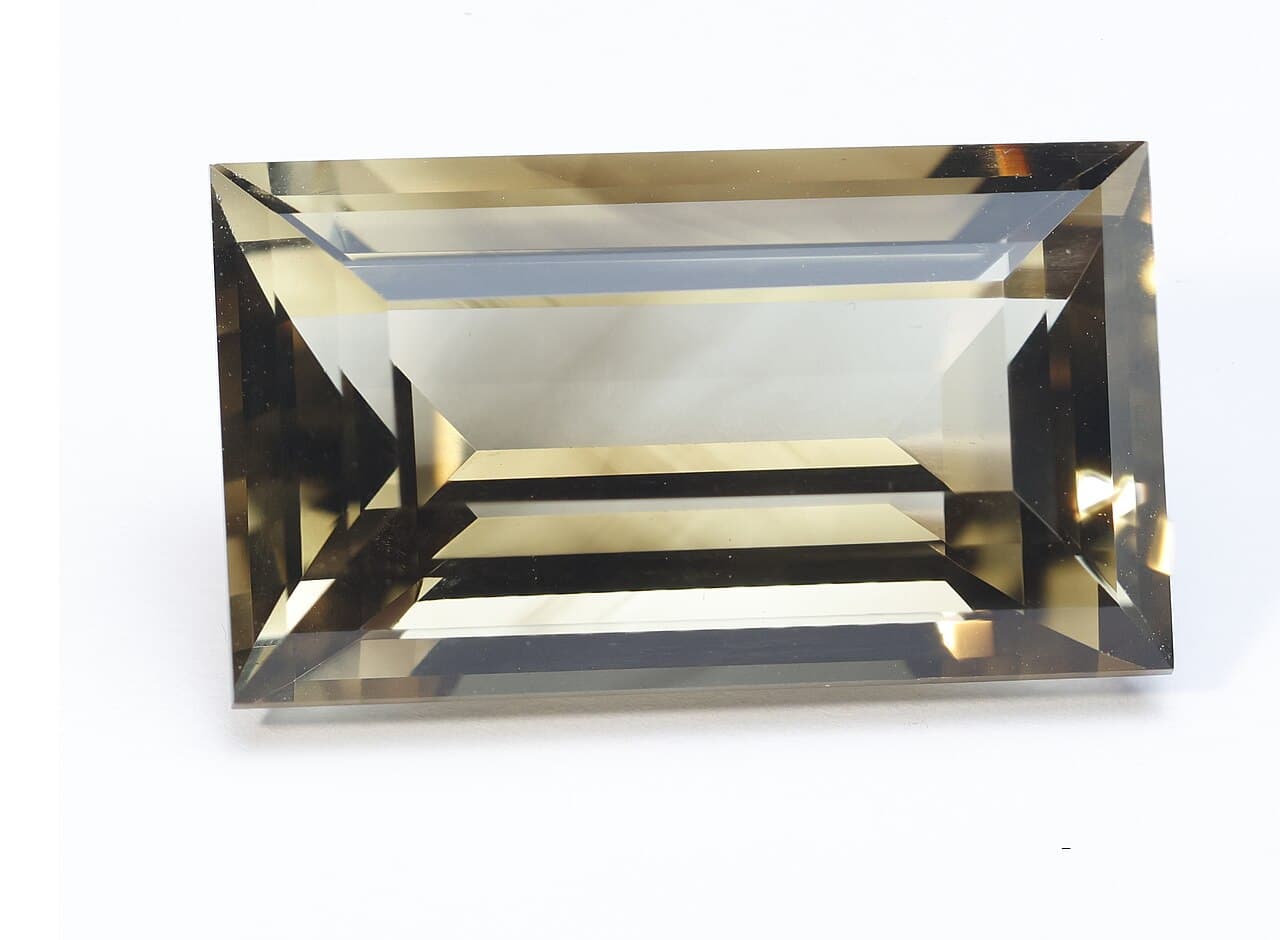
Smoky quartz is the brown-to-gray, smoke-tinted variety of quartz — the same silicon dioxide (SiO₂) as ordinary clear quartz, simply colored. Its tones run from a faint warm gray through tea-brown to near-black, and the deepest, almost opaque material has its own name: morion. The color is not from added minerals but from a natural quirk of physics: tiny amounts of aluminum sit within the quartz, and natural gamma radiation from surrounding rock acts on them over long periods of time to produce the smoky color. The same effect can be reproduced artificially, since clear quartz can be irradiated in a lab to turn it smoky.
Because it is quartz, smoky quartz is hard, durable and glassy, and it grows the classic six-sided (hexagonal) prisms ending in pyramid-shaped points. A well-formed smoky quartz crystal looks just like a clear quartz crystal that has been tinted brown or gray, and it shares quartz's other identifying traits — a white streak, no cleavage, and a curved conchoidal fracture. That family resemblance to clear quartz, amethyst and citrine is the key to recognizing it: it is the same mineral, distinguished mainly by its smoky color and how that color was produced.
Smoky Quartz at a glance
- Classification
- Mineral — brown-to-gray variety of quartz
- Composition
- SiO₂ (silica; smoky color from natural irradiation of trace aluminum)
- Hardness
- 7 (Mohs)
- Luster
- Vitreous (glassy)
- Streak
- White
- Colors
- Light gray-brown to deep brown and near-black (morion)
- Crystal system
- Trigonal (hexagonal prisms with pyramidal terminations)
- Transparency
- Transparent to translucent
How to identify smoky quartz
Start with the color and the crystal shape. Smoky quartz is brown to gray with a translucent, smoke-like quality — hold a piece to the light and you should see through it, the tone deepening in thicker parts. Well-formed crystals grow as six-sided prisms capped by a pointed, pyramid-shaped termination, the unmistakable quartz habit; in clusters you will see many of these points together. Natural smoky color is often slightly uneven, sometimes stronger toward the tips or zoned through the crystal, which is a reassuring sign of natural growth.
The physical tests confirm it is quartz. Smoky quartz sits at 7 on the Mohs scale, so it scratches glass and a steel knife will not scratch it — ruling out softer brown stones and most glass imitations. It has no cleavage and breaks with a curved, shell-like conchoidal fracture rather than splitting along flat planes, and it leaves a white streak. Brown-to-gray translucent color plus a hexagonal crystal habit plus a hardness of 7 plus conchoidal fracture together confirm smoky quartz.
Color and varieties
Smoky quartz spans a range of smoky tones, from the palest warm gray and light tea-brown to a rich chocolate brown. The very dark, nearly opaque black material is called morion, and the historic Scottish smoky quartz from the Cairngorm mountains is sometimes still referred to as cairngorm. The color is caused by natural gamma irradiation acting on trace aluminum in the quartz over geological time, and it is frequently zoned or unevenly distributed within a natural crystal.
Smoky quartz also belongs to the closely related family of colored quartzes. It shares its hexagonal habit and hardness with clear quartz, the purple of amethyst and the golden-yellow of citrine — all the same mineral, differing in trace impurities and in how heat or irradiation has acted on them. Because the smoky color can be produced artificially, some material on the market is clear quartz that has been deliberately irradiated to a brown or near-black tone, which is worth keeping in mind when judging an unusually deep, perfectly even stone.
Meaning and properties
Smoky quartz is traditionally regarded as a grounding and protective stone. Its dark, earthy color has long led crystal traditions to associate it with stability, with feeling rooted and calm, and with a sense of letting go of stress or negativity — it is often described as a stone for steadying and "anchoring" the wearer. It is commonly linked with the root chakra and with the idea of clearing or absorbing unwanted energy.
These associations are spiritual and cultural rather than medical. Smoky quartz is valued in many traditions as a calming, grounding crystal, but it is not a treatment for any physical or psychological condition and is not a substitute for professional medical or mental-health care. Enjoy it for its beauty and history, and treat any "healing" claims as matters of personal belief and meaning rather than established science.
Value: what smoky quartz is worth
Smoky quartz is abundant and, for most pieces, very affordable — tumbled stones, small points and cut gems are inexpensive, which is part of its broad appeal. Value is driven mostly by color quality and clarity: an attractive, even smoky-brown tone with good transparency and a clean, well-formed crystal is worth more than a pale, murky or cracked piece. Large, sharply terminated natural crystals and fine clusters command a premium over everyday tumbled material.
There are no fixed prices for smoky quartz — what a piece sells for depends on its color, size, clarity and form, and on whether the color is natural. Because clear quartz can be irradiated to imitate a deep smoky tone, naturally colored material with honest disclosure is generally preferred by collectors. As a rule of thumb, when comparing two similar pieces, the one with a more attractive, even natural color and better clarity will be the more valuable.
Real vs. fake smoky quartz
Two issues come up most often. The first is glass sold as smoky quartz, which is the easiest to catch: glass tends to look warm brown rather than truly smoky, frequently contains tiny round bubbles (quartz crystals do not), shows a too-even color with no zoning, and has rounded or molded edges instead of true crystal faces. Glass is also softer than quartz and feels slightly warmer to the touch, where quartz feels cool — so a hardness check (real smoky quartz scratches glass and is not scratched by steel) quickly separates them.
The second issue is treatment rather than outright fakery. Clear quartz can be irradiated in a lab to turn it smoky, producing genuine quartz with an artificial color; this passes hardness and fracture tests because it really is quartz. Warning signs of treated material are color that is too uniform and unusually dark, often a flat near-black with little of the gentle zoning seen in natural stones. Distinguishing natural from irradiated smoky quartz can require gemological assessment, so for valuable pieces rely on a reputable source and honest disclosure rather than price alone.
Care
Smoky quartz is hard (7) and physically tough, so it resists scratches and is easy to live with, but it shares amethyst's sensitivity to light: prolonged, strong sunlight can fade some smoky quartz, lightening the smoky color over time. For that reason it is best displayed in indirect light rather than a permanently sunny window. Strong heat should also be avoided, as it can alter the color, and sudden temperature changes can stress the stone.
For everyday cleaning, warm water and a soft cloth or brush with a little mild soap are all that is needed. Avoid harsh chemicals and do not assume a piece is safe in an ultrasonic cleaner. Kept out of direct sun and handled gently, smoky quartz will hold its color and polish for the long term.
Smoky Quartz look-alikes
Frequently asked questions
What is smoky quartz?
Smoky quartz is the brown-to-gray variety of quartz — the same silicon dioxide (SiO₂) as clear quartz, colored smoky by natural gamma irradiation acting on trace aluminum in the crystal. It is hard (Mohs 7), glassy and forms six-sided crystals with pyramid-shaped points. The very dark, nearly black version is called morion.
How can I tell real smoky quartz from glass?
Real smoky quartz is quartz, so it scratches glass (hardness 7), breaks with a curved conchoidal fracture, leaves a white streak, and usually shows some uneven or zoned natural color. Glass imitations contain tiny round bubbles, have a too-uniform color, feel slightly warm, show molded rather than crystal edges, and are softer.
Is smoky quartz natural or irradiated?
Both exist. Natural smoky quartz gets its color from gamma radiation in the surrounding rock acting on aluminum over geological time. The same color can be produced in a lab by irradiating clear quartz, which yields genuine quartz with an artificial color — often a flat, very uniform dark tone. Separating natural from treated material reliably can require gemological testing.
Does smoky quartz fade in sunlight?
It can. Like amethyst, some smoky quartz loses color under prolonged strong sunlight, with the smoky tone lightening over time. Display it in indirect light rather than a permanently sunny window, and avoid strong heat, to preserve the color.
Is yours smoky quartz? Find out from a photo
Photograph your crystal in good light and get an identification with an honest confidence level, the look-alikes to rule out and the at-home tests that confirm it.
Identify my crystal freeOn Android? Get the free rock identifier app
Related
More crystals in the field guide
Related reading
Keep exploring
More on crystals: the full list of crystal types, how to identify a crystal and crystals by color.
Last updated 2026-06-24. Identification guidance is educational — confirm important results with the diagnostic tests described or a qualified expert.