Howlite
Also known as: Silicoborocalcite, White buffalo turquoise (when dyed and mislabeled), Howlite turquoise (a misnomer for dyed howlite)
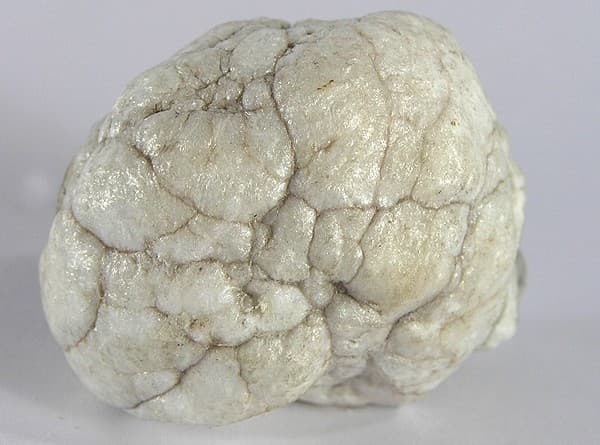
Howlite is a white calcium borosilicate mineral, instantly recognizable by its chalky-white body laced with fine gray-to-black veins that branch across the surface like a spiderweb or like cracked porcelain. It usually forms as nodules — rounded, cauliflower-like masses — and the material that reaches the market is almost always this opaque, porous, white-with-dark-veining stone, cut into beads, cabochons, tumbled pieces and small carvings. The veining pattern is its signature, and it is the first thing to look for when identifying it. Howlite is soft, only about 3.5 on the Mohs scale, so it is easily scratched and easily worked.
The single most important fact about howlite is its relationship to dye. Because it is white and porous, howlite soaks up coloring agents readily, and this has made it the workhorse imitation stone of the crystal trade. Dyed blue, it mimics turquoise so convincingly that it is sold — honestly or otherwise — as howlite turquoise, white turquoise or even passed off as the real thing; dyed red, it stands in for coral; and it is tinted in nearly every color imaginable for inexpensive jewelry. So howlite plays a double role in identification: you need to recognize natural howlite, and you need to recognize when howlite is masquerading as a more valuable stone. Both come down to the same handful of simple tests.
Howlite at a glance
- Classification
- Mineral — borate (calcium borosilicate)
- Composition
- Ca₂B₅SiO₉(OH)₅
- Hardness
- About 3.5 (Mohs)
- Luster
- Subvitreous to dull, often chalky
- Streak
- White
- Colors
- White to gray with gray-to-black spiderweb veining (commonly dyed any color)
- Crystal system
- Monoclinic
- Transparency
- Opaque (rarely translucent)
How to identify it
Natural howlite is one of the easier stones to recognize: look for a chalky, opaque white body crossed by fine gray-to-black veins that web across the surface in an irregular, branching pattern. The veins are the giveaway — they look like cracks in old porcelain or the lines on a road map and stand in sharp contrast to the white background. The material is usually slightly porous and matte rather than glassy, and it often comes as smooth tumbled pieces, round beads or cabochons cut from nodules. If you are holding a white-with-black-veining stone that feels light and a little chalky, howlite is the obvious first guess.
Hardness confirms it. Howlite is soft, only about 3.5 on the Mohs scale, so a steel knife or even a copper coin will scratch it, and it leaves a white streak. It does not have the heft of denser stones, and because it is a borate it is not magnetic and shows no acid reaction worth relying on for identification. The most useful confirming check, though, is the dye test described below: because so much howlite is colored, a quick rub with a cotton swab dipped in acetone (nail-polish remover) on an inconspicuous spot will often pull off surface dye and reveal the natural white underneath, settling both the identity and the question of whether it has been treated.
Colors and varieties
In its natural state howlite is essentially monochrome: white to pale gray, marbled with the darker gray-to-black veining that defines it. Occasional material is a more uniform creamy white with sparse veins, while other pieces are densely netted with dark lines. That neutral white canvas is exactly why the mineral is so heavily dyed — it takes color evenly and the veining shows through, mimicking the matrix patterns of pricier stones.
The familiar varieties are therefore almost all dyed. Blue-dyed howlite is by far the most common, sold as howlite turquoise or white turquoise to imitate turquoise, with the natural veins standing in for turquoise's matrix. Red- or pink-dyed howlite imitates coral; green-dyed material stands in for stones like variscite or chrysocolla; and howlite is also tinted purple, yellow, black and almost any other hue for cheap fashion jewelry. The key point for identification is that these are colored howlite, not separate stones — underneath the dye the same soft, white, spiderwebbed mineral is doing the work.
Meaning and properties
In modern crystal-working traditions howlite is associated with calm, patience and a quiet mind. Its cool white color naturally links it to ideas of stillness in these practices, and people describe it as a soothing stone used for relaxation, easing an overactive mind and supporting restful sleep — some keep a piece by the bedside for that reason. It is also a popular base for dyeing precisely because it is inexpensive and widely available, so a great deal of decorative jewelry sold for these calming associations is howlite.
These meanings are cultural and spiritual rather than scientifically established medical effects. Howlite is a pleasant, affordable stone to collect, wear and keep around, but it is not a treatment for anxiety, insomnia or any other physical or emotional health condition and should never replace advice or care from a qualified medical or mental-health professional. Enjoy it for its calm looks and its versatility rather than as medicine.
What it's worth
Howlite is an inexpensive, abundant stone, and that is central to its identity — its low cost is exactly why it is used so widely as an imitation for pricier materials. Natural white howlite beads, cabochons and tumbled pieces are budget-friendly, and even attractive carved or well-patterned pieces remain affordable. Value within natural howlite comes from the usual factors — even white color, an appealing veining pattern, good polish and clean, undamaged material — but the overall ceiling is modest.
The practical money question with howlite is usually not what it costs but what it is being sold as. Dyed blue howlite has real value as howlite, but it is worth a tiny fraction of genuine turquoise, so the danger is paying turquoise prices for dyed howlite. Honestly labeled, dyed howlite is a perfectly legitimate, affordable decorative material; the problem arises only when it is passed off as a more valuable stone. As always, value tracks honest identity — know what you are actually buying, and the price should follow.
Real vs. fake
Howlite sits at the center of one of the most common deceptions in the stone trade, and it cuts two ways. First, howlite is the number-one imitation of turquoise: dyed blue and sold as howlite turquoise, white turquoise or simply as turquoise, it fools a great many buyers. The tells are price (real turquoise costs far more), hardness (turquoise is harder, around 5–6, while howlite is a soft 3.5 and scratches easily), and the dye itself — a cotton swab with acetone or even just water rubbed on a hidden spot will often lift blue dye and expose white howlite underneath, and dye tends to pool darker inside the veins and surface pits. So if a blue stone is suspiciously cheap, soft and shows dye that rubs off, it is almost certainly dyed howlite, not turquoise.
Second, even when a stone really is howlite, it may be dyed and sold without disclosure, so identifying genuine natural howlite means confirming the color is its own. Natural howlite is white with gray-to-black veining; any vivid blue, green, red or purple howlite has been colored. To verify, look at the back and inside drill holes (dye often penetrates unevenly and looks blotchy there), do the acetone-swab test, and remember the softness check. Glass and plastic imitations of the whole white-veined look also exist; those lack howlite's slight chalkiness and softness, and glass may show bubbles or molded seams. When in doubt, buy from a seller who clearly labels dyed and imitation material.
Care
Howlite needs gentle care because it is both soft and, very often, dyed. At about 3.5 on the Mohs scale it scratches easily, so store it away from harder stones and metal and treat jewelry as occasional rather than rough everyday wear. Because the stone is porous, it can also absorb oils, perfumes and lotions, which over time may stain it or discolor dyed pieces, so it is best to put howlite jewelry on after applying cosmetics and to wipe it down after wear.
Clean howlite only with a soft, barely damp cloth and dry it promptly; avoid soaking it, since prolonged water exposure can seep into the porous body. With dyed howlite this matters even more — water, heat, solvents and strong sunlight can all cause the color to fade, bleed or rub off, so keep dyed pieces out of prolonged sun and away from chemicals. Skip ultrasonic and steam cleaners entirely, as they can damage the soft stone and drive out dye. Treated kindly, howlite holds up well as an affordable, attractive stone for years.
Howlite look-alikes
Frequently asked questions
Is howlite the same as turquoise?
No. Howlite is a soft white mineral that is very commonly dyed blue to imitate turquoise and then sold as howlite turquoise or white turquoise. Real turquoise is a different, harder, much more valuable stone. You can tell them apart by hardness (turquoise resists a steel knife; howlite scratches easily), by price, and by the acetone-swab test, which lifts blue dye off howlite but not the natural color of real turquoise.
How can I tell if howlite has been dyed?
Natural howlite is white with gray-to-black veining, so any vivid color means it has been dyed. To confirm, rub an inconspicuous spot or the inside of a drill hole with a cotton swab dipped in acetone (nail-polish remover) — dye will often transfer to the swab. Dye also tends to look blotchy or pooled inside veins and bead holes. If the color comes off or looks uneven, the piece is dyed.
Is howlite a real crystal or just fake turquoise?
Howlite is a genuine natural mineral — a calcium borosilicate — in its own right. It is real; it is simply soft, white and porous, which makes it the most popular base stone for dyeing to imitate turquoise, coral and other materials. Honestly labeled white or dyed howlite is a legitimate, affordable stone. The only problem is when dyed howlite is sold dishonestly as something more valuable.
Can howlite get wet?
Brief contact with water is fine, but howlite should not be soaked. It is porous, so prolonged water exposure can seep in, and for dyed howlite water, heat and solvents can make the color fade or bleed. Clean it with a soft, barely damp cloth, dry it promptly, keep it away from chemicals and strong sunlight, and avoid ultrasonic and steam cleaners.
Is yours howlite? Find out from a photo
Photograph your crystal in good light and get an identification with an honest confidence level, the look-alikes to rule out and the at-home tests that confirm it.
Identify my crystal freeOn Android? Get the free rock identifier app
Related
Compare howlite with look-alikes
More crystals in the field guide
Related reading
Keep exploring
More on crystals: the full list of crystal types, how to identify a crystal and crystals by color.
Last updated 2026-06-25. Identification guidance is educational — confirm important results with the diagnostic tests described or a qualified expert.